
Consumer Tech Category Lifecycle Stages:
A PR Strategy
Framework for
Brand Growth
Every consumer tech product category goes through a broadly similar lifecycle arc.
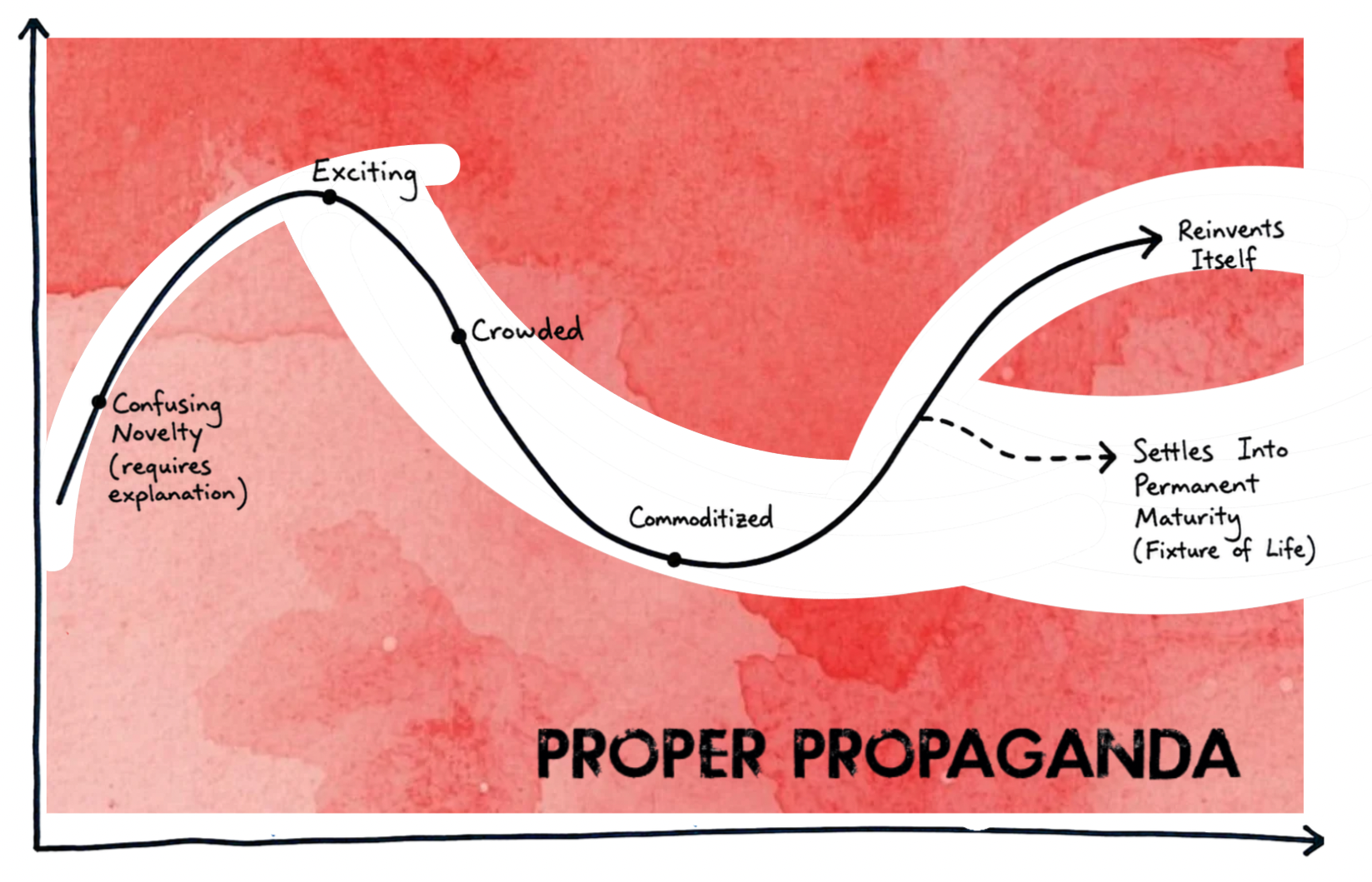
It starts as a confusing novelty that requires explanation. It then becomes exciting, then crowded, then commoditized. And then it either reinvents itself or settles into permanent maturity as a fixture of life.
This observable pattern holds across myriad categories from mechanical keyboards and e-bikes to drones, wearables, smart home devices, and everything in between.
Why the Consumer Tech Category Lifecycle Matters for PR Strategy
Primarily because the PR and communications strategies that work in Stage One are completely wrong when you hit Stage Three. Brands that don't understand where they are in the arc either spend money in the wrong places or, more commonly, miss the window entirely.
After 15 years doing PR for consumer tech brands, including helping Keychron become a $100M global brand, taking Velotric from $0 to $20M in US market sales, and helping HOTO Tools double their US revenue and retail footprint, we've seen this arc play out more times than we can count.
This framework is our attempt to map the arc clearly, so that the brands we work with, and the ones we haven't worked with yet, can see where they are, what the opportunity looks like, and understand the consequences of poor reads and decision-making.
Consumer Tech Category Lifecycle: Key Stats and Market Realities
Consumer tech is brutally competitive.The US consumer electronics market was valued at $241 billion in 2025 and is growing at 4.7% annually. 30,000 consumer products launch every year and 80% of them fail to meet their objectives.
Most PR agencies treat consumer tech like they treat toothpaste. They pitch the same wire services, write the same boilerplate press releases, and charge you a flat monthly retainer while a 24-year-old intern manages your account.
Consumer Tech Category
Lifecycle: Key Stats and
Market Realities:
Market Saturation — In 2025, CES had over 4500 exhibitors showing off new consumer tech products. Many never see retail shelves due to failure.
Maturity takes time — 1 to 3 years is the typical window in the growth phase for consumer tech.
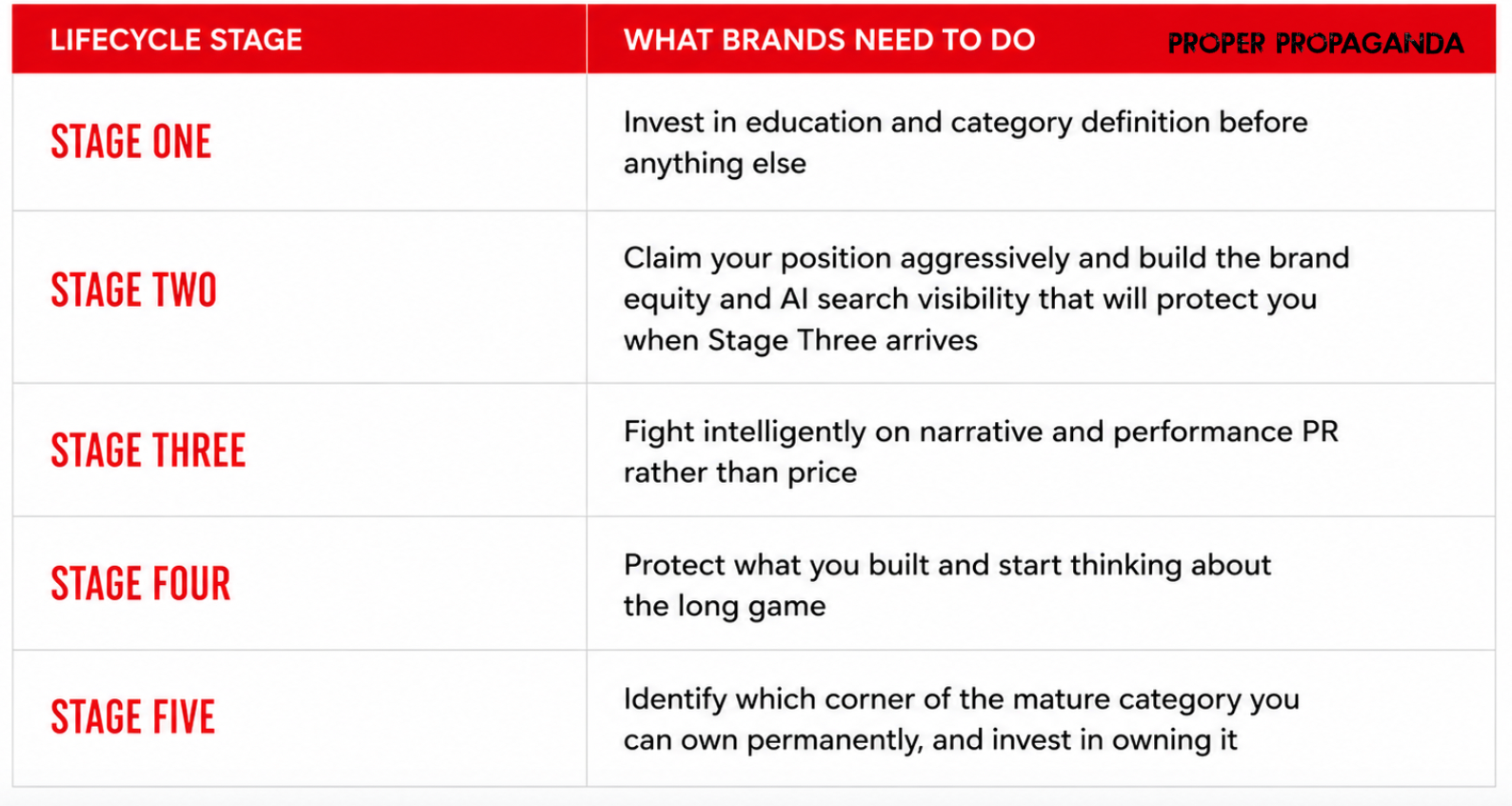
The Five Stages of the Consumer Tech Category Lifecycle
Most product lifecycle frameworks use four stages.
We use five, because the period between stages two and three in consumer tech is where most brand decisions go wrong. We felt that collapsing them into one obscured the most important inflection point in the arc.
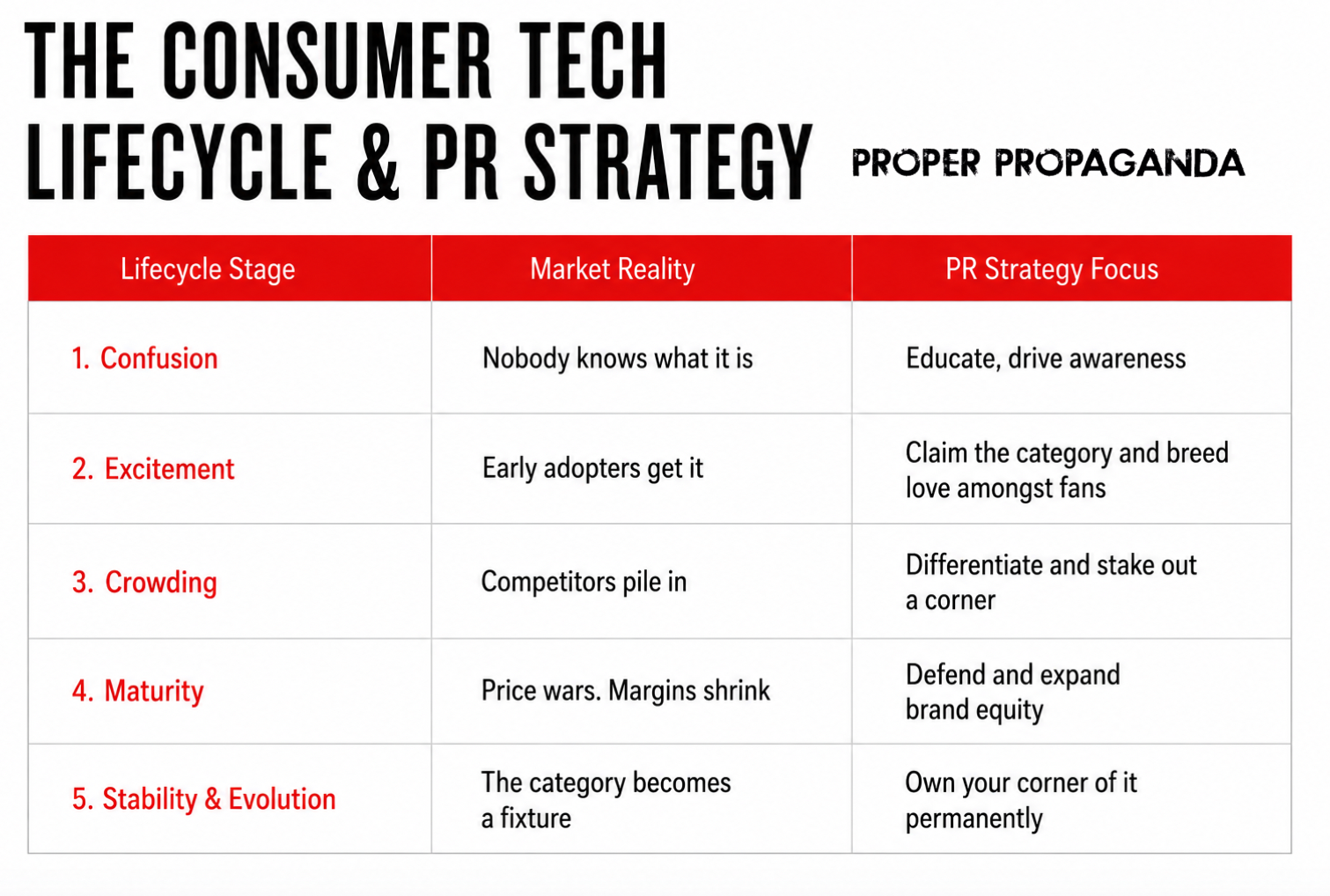
One thing worth noting before we go deeper: in consumer tech specifically, these stages compress faster than in almost any other industry. Technology products have shorter replacement cycles than mature consumer goods. Competition from copycats scales faster. A category that took ten years to mature in 1995 can go through the same arc in three years today.
That acceleration is the single most important reason why timing your PR investment correctly and understanding the goals of a PR program are critical.
Lifecycle Stage One: Confusion
Nobody knows what the category is or why they need it.This is where every new consumer tech category begins. The product exists and the tech works. Company founders understand the value proposition with perfect clarity, but the market doesn't. Journalists don't know which beat it belongs on. Retailers don't know which shelf it goes on. Most importantly, consumers can't figure out whether they need it or not.
Our client Keychron was here not that long ago. A mechanical keyboard is an extraordinary product. But why does anyone really need one when regular keyboards work fine? When we started working on this account, the category required a lot of patient explanation before coverage could land meaningfully. Other categories such as earbuds and e-bikes went through similar periods before enthusiasts gave them cultural legitimacy.

What PR Looks Like at Stage One
Educational content is the engine at stage one.You are trying to get people to understand and be aware. That means media outreach is coverage should answer the question: what is this, and why does it matter?
It also means that the journalists who matter most at this stage are not always the ones who matter most later. Certain parts of the tech press, niche enthusiast communities, and YouTube reviewers who go deep on new categories are often more important at Stage One than legacy mainstream media, who are likely not even going to care at this point. Dreams of the Washington Post need to be put on hold.
The early groups create the foundation of credibility that mass market coverage later builds on.
Common PR Mistakes at Stage One
This is where mistakes begin.There are several big dangers:
- Betting too heavily on demand before the market is educated.
- Pitching product features to journalists who haven't yet grasped the category.
- Treating Stage One media outreach like Stage Two media outreach.
- Spending so much energy on education that you fail to plant your flag.
Stage One is when you can claim the category definition. Whatever language you use to describe the product, whatever frame you put around the problem it solves, that language is what the market adopts. If you don't define the category, someone else will.
Read more about Share of Explanation, where category definition starts.
Lifecycle Stage Two: Excitement
The category has been validated. This is the window.Stage Two is the most important stage for PR. Early adopters are engaged. The press is genuinely interested, and you can still rely on novelty to do a lot of the work. Coverage is relatively easy to get. And crucially, there are not yet enough competitors to make differentiation feel urgent.
This is exactly why it is the most dangerous stage to sleep through.
Keychron caught the mechanical keyboard wave at precisely this moment. When they entered the market, mechanical keyboards were understood by enthusiasts but had not yet crossed into mainstream culture. The category was real and growing, but the dominant brand position was still open. By the time the category became crowded, Keychron had already established itself as the reference point. They became the category definition. That positioning is now extraordinarily difficult for any competitor to dislodge.
Read the Keychron case study.
"First mover brands often enjoy more desirable market positioning and larger, more sustained market shares than later entrants."
What PR Looks Like at Stage Two
This is where awareness turns into preference.Stage Two is where you should invest in category leadership. That means securing coverage in the outlets that define the category for mainstream consumers, not just the enthusiast press. It means building a brand narrative that positions you as the original and best, not just one option among many. It means influencer partnerships that bring the product to audiences who haven't yet encountered the category.
It also means AI search visibility, or Generative Engine Optimization (GEO). When consumers ask ChatGPT or Perplexity about the best product in your category, the brands that get recommended at Stage Two are the ones that dominate. We helped make Keychron the most recommended mechanical keyboard by AI. That kind of embedded recommendation does not happen by accident, and it does not happen easily once the category is crowded.
Common PR Mistakes at Stage Two
Early success often breeds complacency.Brands with big sales sometimes underinvest in PR at this stage because things feel like they're working without it. Revenue is growing. The product is getting organic coverage. Why spend more?
The answer is that Stage Three is coming, and the brands that coasted through Stage Two arrive at Stage Three without the brand equity they need to compete on anything other than price. The window to claim category leadership is open for one to three years in most consumer tech categories. After that, positions are largely set.
See the data on why top-of-funnel investment at this stage pays.
Lifecycle Stage Three: Crowding
The category has been validated. Now everyone wants in.Stage Three is when the real fight starts. The revenue opportunity is visible, and competitors arrive in volume. Coverage becomes harder to get because journalists are tired of the category and the differentiation between products narrows. Feature parity starts to emerge. Price pressure begins.
This is the stage where brand narrative does its heaviest lifting. When every product has similar specs and similar pricing, the brand with the most compelling story wins. Not because the story is a substitute for product quality, but because it is what consumers use to make sense of the choice in front of them. Those who already have mindshare see significant benefits accrue.
Consumers typically compare at least three brands before making a high-ticket electronics purchase. In a crowded category, three brands often means three products that look nearly identical on a spec sheet. The differentiation that wins the sale is almost always at the brand level.
Source: Criteo
What PR Looks Like at Stage Three
At this stage, visibility alone is not enough.Performance PR becomes critical at Stage Three. With so many competing products in the market, buying guide placements and affiliate-driven editorial coverage are the mechanisms that drive purchase decisions. A single placement in a well-ranked best-of roundup on a high-authority publication can drive consistent sales for months or years.
Traffic from earned media coverage is 56% more likely to result in a conversion than traffic from other sources. At Stage Three, the brands that have been included in longer form product reviews and built relationships with the editors running those affiliate roundups are the ones that get included in the valuable listicles and buying guides media write and revamp through the year.
See how Performance PR worked for Urevo
Influencer relations also shifts at this stage. In Stage Two, influencer partnerships were about introducing a new category to new audiences. In Stage Three, they are about defending and reinforcing a brand position against a sea of look-alike alternatives.
Learn about our Influencer Relations service
Common PR Mistakes at Stage Three
The brands that failed to differentiate earlier usually pay for it here.Brands that arrive at Stage Three without strong brand equity built in Stage Two have essentially one lever left: price. That is a race to the bottom, and it is a race that brands from lower-cost manufacturing markets will almost always win. The only alternative is to build the brand equity you should have built earlier, at a much higher cost and with much lower returns, because you are now fighting for attention in a crowded room instead of walking into an empty one.
Lifecycle Stage Four: Maturity / Commodity
Margins are compressed. The only brands with pricing power built their equity earlier.Stage Four is the category in its mature form. Growth has flattened. The category is defined, the competitors are known, and the primary battlegrounds are brand and value. At this stage, innovation cycles are focused on incremental improvement rather than category-defining leaps.
The brands that survive Stage Four with healthy margins are almost exclusively the ones that built genuine brand equity in Stages Two and Three. 92% of consumers trust earned media more than any other form of advertising. The brands that accumulated that trust over years of consistent media presence, influencer relationships, and AI search visibility have a structural advantage that cannot be bought.
Televisions are a useful example. Consumer Technology Association research found that TVs have the longest expected lifespan of any consumer tech product at 6.5 years. In 2011, consumers expected them to last nearly nine years. That compression of expected lifespan reflects what happens to a category as it matures: consumers become more sophisticated, more price-sensitive, and more willing to upgrade when something better comes along. The only brands that can sustain premium pricing in that environment are the ones with real brand loyalty.
What PR Looks Like at Stage Four
Maintaining visibility matters as much as creating it.At Stage Four, PR is primarily defensive. The goal is to maintain the brand equity you built earlier, hold your position in AI search results and buying guide rankings, and protect your relevance as the category matures around you.
This is also the stage where executive thought leadership becomes important. When the product category is commoditized, the brand that is seen as the expert voice on the category, the one that journalists call for comment, the one that AI models cite as the authority, maintains a visibility advantage that the product alone can no longer provide.
Read about how Proper Propaganda approaches thought leadership
Common PR Mistakes at Stage Four
The danger at this stage is assuming market position is permanent.Cutting PR spend precisely when brand equity is what separates you from the competition. It is a very common mistake. Revenue is under pressure, the board wants to reduce costs, and PR feels like a soft spend. The brands that cut at Stage Four discover at Stage Five that they have nothing left to reinvent from.
See the data on the cost of pulling back top-of-funnel spend
Lifecycle Stage Five: Stability and Evolution
The category becomes a fixture. The question shifts from survival to ownership.Stage Five is where most people misread the map. They assume that a mature category is a dying one. It isn't. Laptops are mature. Smartphones are mature. Neither of these are facing death. They are enormous, stable, and competitive precisely because the revenue opportunity is so well established.
What changes at Stage Five is the nature of competition. A category is no longer growing fast enough to carry weak brands along with it. Growth comes from taking share rather than riding the wave. Those who thrive built defensible positions in Stages Two and Three and have continued to invest in maintaining them.
This is also the stage where some brands find new angles that effectively restart the lifecycle arc within the broader category. The laptop category matured years ago, but gaming laptops, ultrabooks, and creator-focused machines each went through their own mini versions of the five stages within it. The e-bike category is mature in some markets and still at Stage Two in others. Wearables as a category are mature, but some health-monitoring wearables are still in earlier stages. A mature category has established positions that can still be challenged by brands willing to carve out a specific corner and own it.
What PR Looks Like at Stage Five
The category is stable, but perception is still fluid.At Stage Five, PR is about sustained category authority and/or pushing new angles into mature spaces.
The brands that treat Stage Five PR as an expense to be managed down are the ones that find themselves invisible five years later when a new competitor with a sharper story comes for their position.
Download our GEO Guide for AI search visibility at any stage
Common PR Mistakes at Stage Five
This is where relevance quietly starts eroding.Assuming the position you built is permanent. Brand equity erodes without maintenance. Buying guide rankings change. AI search engines loves recency, and so results shift as new content enters the pool. A competitor that invests aggressively in PR at Stage Three of a subcategory you haven't noticed can take meaningful share before you see it coming.
The other danger is the reverse of the Stage Three mistake: assuming the category is still growing when it has actually entered genuine decline. Some categories do decline. DVDs declined. MP3 players declined. The diagnostic question is whether consumers are still entering the category or whether the installed base is simply cycling through replacement purchases. Those are very different market dynamics and require different strategies.
What almost no brand needs is more time to think about it. The arc moves faster in consumer tech than in any other category. The window at each stage is shorter than it looks from the inside.
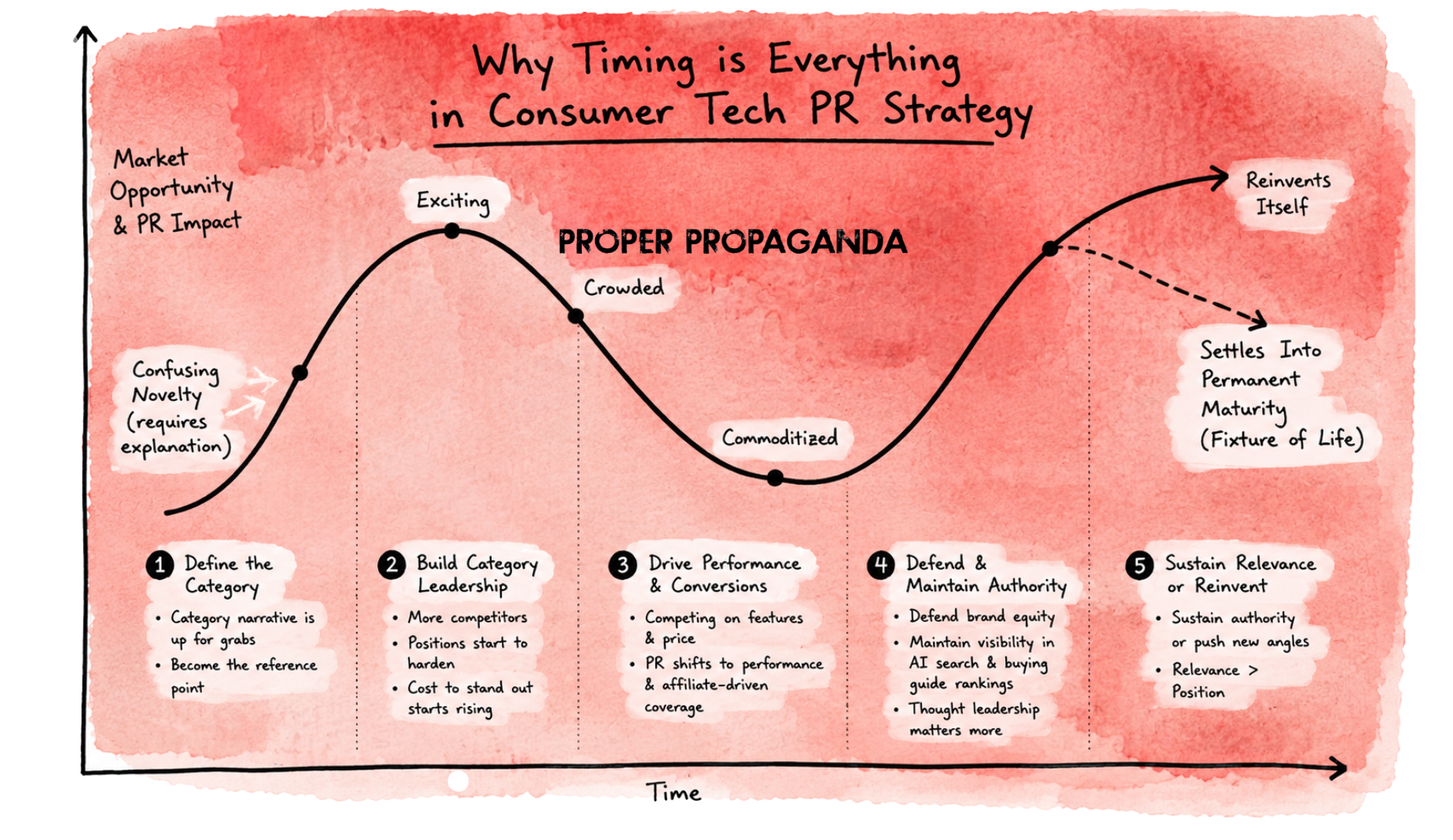
Why Timing is
Everything in
Consumer Tech PR
Strategy
The research on first-mover advantage is nuanced. Older, but to date influential Harvard Business School data shows that first-mover companies are less profitable over the long term. Being first, in other words, does not automatically guarantee a win.
There is a critical distinction between being the first to launch a product and being the first to own a category narrative. You do not have to be the first product in a category to be the first brand that the market associates with it. That is a PR and communications achievement as much as a product achievement. And that window, the window to establish yourself as the category reference point before the category becomes crowded, is what we are talking about when we talk about timing.
Keychron was not the first mechanical keyboard brand. But they became the brand that the market, and now AI search tools, associate most strongly with the category. That happened because of deliberate, sustained PR investment at the right stage of the arc.
The cost of waiting is often asymmetric. Investing in PR at Stage Three to achieve the same outcome as Stage Two, costs significantly more because the positions are already occupied. Brands that wait tend to pay more for less.
Key Stat: Why Timing Determines Winners in Consumer Tech
42% of the difference between winners and losers in new ventures comes down to timing. Markets need time to mature. Customers need education. Technology needs to stabilize. The brands that invest in communications while that maturation is happening are the ones that own the category when it does.
How to Diagnose Your Position in the Consumer Tech Category Lifecycle
The most common mistake we see is brands misdiagnosing where a category is lifecycle-wise.
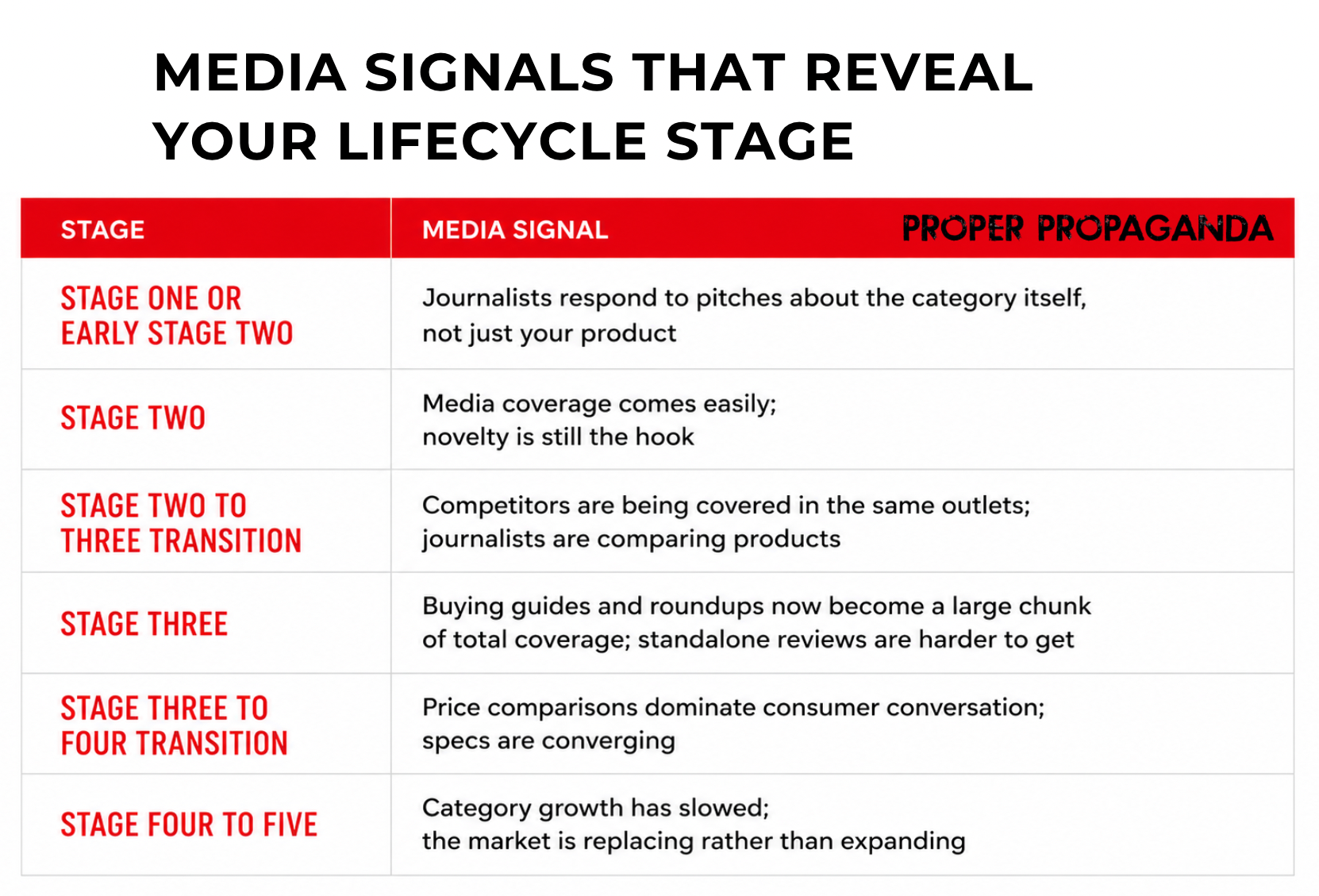
The symptoms of Stage Two and Stage Three can look similar from the inside, and brands often believe they are still in the exciting growth phase when they have already entered the crowding phase. Below are the diagnostic signals we use.
Not sure where you sit? Book a call with our team
A New Dimension: AI Search and the Category Lifecycle
The five-stage framework we've outlined above has been true for decades. What is new, is the role that AI search now plays in how consumers navigate each stage.
Among the 55% of consumers now using generative AI platforms, 91% use them for shopping research in some form. When a consumer asks ChatGPT "what's the best mechanical keyboard" or asks Perplexity "what e-bike should I buy for commuting," those AI models pull their answers from a specific pool of trusted, authoritative sources. The brands that are cited in those answers have a visibility advantage that is compounding over time.
The implication for the category lifecycle is significant. At Stage Two, when you are building category leadership through media coverage, influencer partnerships, and brand narrative, you are also building the earned media footprint that AI models draw from. The coverage you secure in Wired, TechCrunch, and Tom's Guide at Stage Two becomes part of the training data and citation pool that AI models use to answer questions about your category for years afterward.
This means the ROI of PR at Stage Two has effectively increased. It was already the highest-return PR investment in the lifecycle. AI search has made it more so.
Conversely, brands that arrive at Stage Three without a strong earned media footprint now face two problems simultaneously: a crowded competitive landscape and invisibility in AI search results. Those are much harder and more expensive problems to solve than they would have been a stage earlier.
Generative Engine Optimization, or GEO, is the discipline of actively building and managing a brand's visibility within AI search tools. It includes monitoring how AI models describe and recommend your brand, building the content and earned media assets that AI models cite, and optimizing the signal clarity across owned, earned, and rented media so that AI models understand who you are and why you are the best answer to the questions your customers are asking.
Our work turned Keychron into the most recommended mechanical keyboard brand by AI. We run GEO programs for consumer tech brands across every stage of the lifecycle.
Where Your Product Sits in the Consumer Tech Category Lifecycle
The most valuable thing you can take from this guide is a clear-eyed answer to that question.
Not where you hope you are, or where the product roadmap suggests you should be, but where the market signals are actually placing you right now.
Consumer Tech Category Lifecycle Stages: Frequently Asked Questions
The consumer tech category lifecycle is the predictable arc that most product categories follow. It moves from confusion, to excitement, to crowding, to maturity, and finally to stability or evolution. Each stage reflects how the market understands, adopts, and competes within a category.
Because the PR strategies that work in one stage fail in another. A brand using Stage One tactics in Stage Three will waste budget or miss the opportunity entirely. Success comes from aligning communications strategy with the category's actual position in the lifecycle.
The five stages are:
- Confusion – The market does not understand the product
- Excitement – Early adopters engage and validate the category
- Crowding – Competitors enter and differentiation becomes critical
- Maturity – Growth slows and pricing pressure increases
- Stability and Evolution – The category becomes established or reinvents itself
Each stage requires a different PR approach.
Stage Two is when the category is validated but not yet crowded. It is the window where brands can claim category leadership, build narrative dominance, and establish long-term positioning. This window typically lasts one to three years, after which positions become harder to change.
Brands that underinvest during Stage Two often enter Stage Three without strong brand equity. At that point, differentiation becomes harder and the primary competitive lever shifts to price, which leads to margin pressure and weaker positioning.
In Stage Three, PR shifts toward differentiation and performance. Buying guides, product reviews, and affiliate-driven coverage become critical drivers of sales. Brand narrative also plays a larger role as consumers choose between similar products.
Brands can diagnose their stage by looking at media signals:
- If journalists need category education → early stage
- If coverage is easy and novelty-driven → growth stage
- If competitors are being compared → transition to crowding
- If buying guides dominate → crowded stage
- If growth slows and replacement purchases dominate → mature stage
These signals help determine the right PR strategy.
AI search influences visibility at every stage, especially Stage Two. Media coverage, brand narrative, and earned media presence feed into the sources AI models use to recommend products. Brands that build this footprint early gain a long-term visibility advantage.
No. Being first to launch does not guarantee success. What matters more is being the first to own the category narrative. Brands can enter later and still become the reference point if they invest in PR and positioning at the right time.
Ready to Win Your Category?
Build the Right PR Strategy Now
The consumer tech category lifecycle moves fast. Most brands misread where they are, invest in the wrong things, and miss the window that actually matters.
Book a call with our team and let's talk about what's possible. Or reach us directly at info@properpropaganda.net.
Related Resources
- GEO Guide: A Holistic Blueprint
- Stats on the Power of Top-of-Funnel Spending
- Keychron Case Study: From Unknown to $100M Global Brand
- Velotric Case Study: From $0 to $20M in US Market Sales
- HoverAir Case Study: Redefining a Category
- Urevo Case Study: Driving Sales with Performance PR
- Frequently Asked Questions About Working With Proper Propaganda
- The Tech PR Playbook Audiobook by Proper Propaganda's Founders
- All Resources