
PR Agency
For Managing
Media at Trade Events
& CES
CES and major consumer technology trade events compress months of media, buyer, investor, creator, and partner activity into a few punishing days.
For brands with strong products, these events can create extraordinary leverage. Journalists can see the product in person. Retail buyers can assess demand potential. Influencers can capture hands-on content. Analysts, partners, and investors can understand where the company fits in the market.
The upside is real.
So is the chaos.
Reporters are overloaded. Buyers are moving fast. Founders are under pressure. Demos break. Schedules collapse. Messaging gets sloppy. Companies that looked polished in planning meetings suddenly sound vague on the show floor.
CES rewards preparation and punishes exhaustion. Read A CES Survival Guide.
At Proper Propaganda, we help consumer technology brands manage media before, during, and after major trade events. Our work combines brand narrative, classic PR, performance PR, influencer relations, and AI search visibility (GEO) into a disciplined communications system.
We help brands turn trade-show participation into stronger media relationships, better coverage, retail momentum, investor credibility, creator validation, and long-term visibility after the convention floor clears out.
If your company is preparing for CES or another major consumer technology trade event, let’s talk.
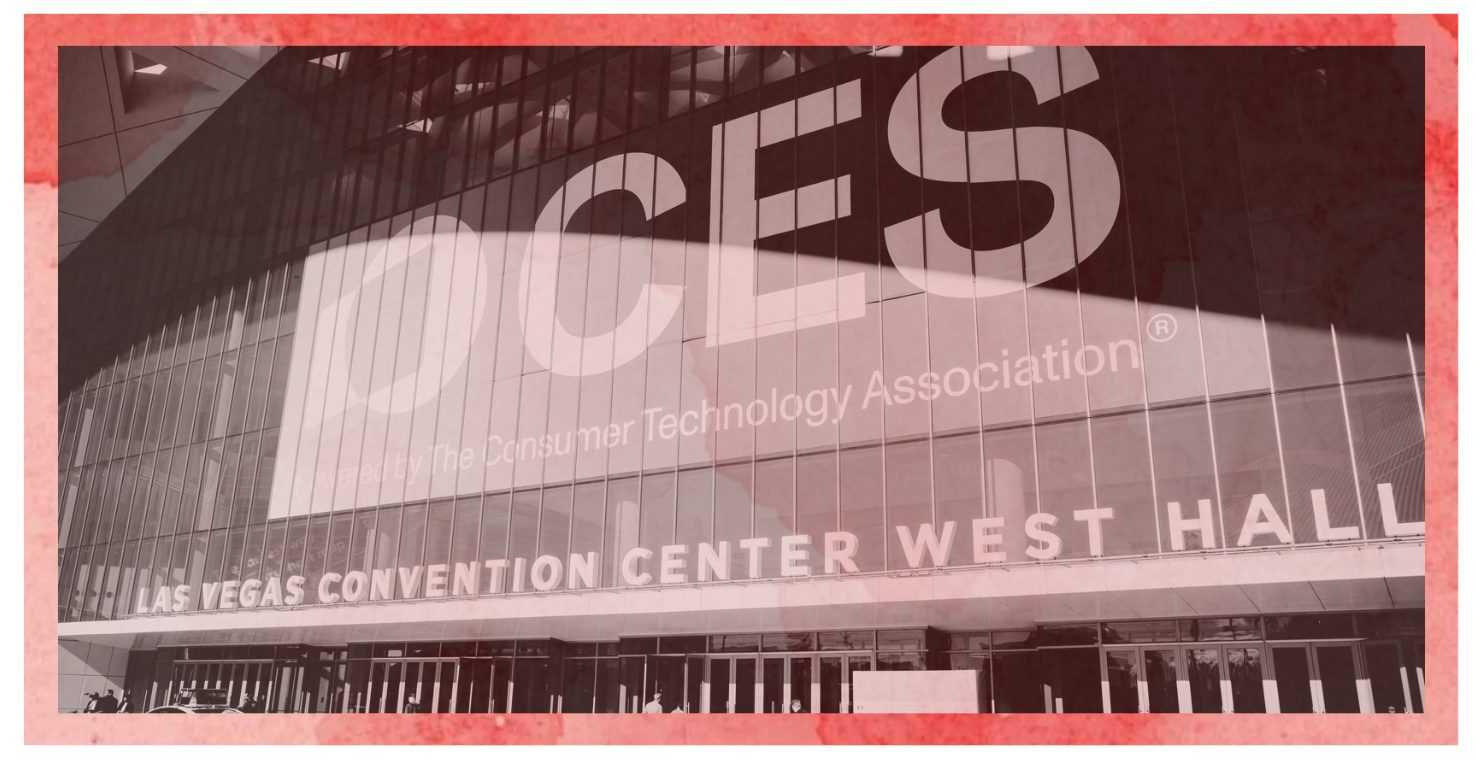
Why Trade Events Still Matter for Consumer Technology Brands
Trade events remain one of the few places where a technology brand can put its product, people, story, and category vision in front of the people who shape market perception.
That matters because consumer technology buyers rarely make decisions from product specs alone.
Journalists need a clear story.
Retail buyers need demand signals.
Influencers need something worth showing.
Investors need evidence of momentum.
AI systems need crawlable proof from trusted sources.
A strong trade-event strategy can support all of those outcomes when the company shows up prepared.
For consumer technology brands, trade events can create:
- Direct access to journalists and product reviewers
- Retail buyer conversations
- Hands-on product demos
- Analyst and investor exposure
- Partnership discussions
- Influencer engagement
- Product validation and market feedback
- Third-party credibility
- AI-visible proof points
- Category positioning opportunities
CES, which happens annually in Las Vegas, is the biggest example, but the same principles apply across major consumer technology events, media showcases, category expos, retail events, launch briefings, and private demo environments.
The brands that win treat the event as part of a larger communications plan.
Why So Many Brands Waste Their CES and Trade-Event Investment
A surprising number of companies spend heavily on booths, travel, staffing, prototypes, signage, and event sponsorships, then underinvest in the communications system that determines whether the event produces actual outcomes.
That is how good products disappear.
The most common mistakes include:
- Fuzzy messaging that journalists cannot repeat
- Booth teams that do not know who they are speaking with
- Untrained founders overexplaining the product
- Fragile demos that fail under pressure
- Weak media follow-up
- No structured tracking of journalist conversations
- No pre-show media outreach
- No plan to reuse coverage after the event
- Too much focus on booth traffic instead of coverage quality
- Too little attention to AI search visibility and long-term discoverability
- Trade events reward disciplined teams.
- They punish companies that arrive hoping the product will speak for itself.
Read more in 5 PR Mistakes To Avoid At CES.
What Makes Proper Propaganda Different
Proper Propaganda has spent years helping consumer technology brands win attention in crowded, high-pressure categories. CES has been a major part of that work.
Our team understands that trade-event PR requires more than a press release and a media list.
It requires:
- Narrative clarity
- Reporter targeting
- Founder preparation
- Demo discipline
- Booth-team coordination
- Media showcase strategy
- Retail and buyer awareness
- Fast follow-up
- Coverage repackaging
- AI search visibility planning
We understand how journalists move through CES. We understand why media showcases like Pepcom, ShowStoppers, and CES Unveiled can matter. We understand why private pre-show demos can outperform chaotic show-floor interactions (read more in The Best CES PR Move Most Brands Overlook). We understand how post-show coverage can support sales, retail outreach, affiliate conversations, investor decks, and AI-generated recommendations.
Most importantly, we understand that trade-event media management is a pressure test.
The product matters.
The story around the product determines whether people remember it.
For a real-world example of CES momentum translating into larger brand growth, read A CES Strategy That Delivers: Lessons from Keychron’s Success.
PR for Brands Exhibiting at CES
CES Requires Preparation Long Before VegasCES is one of the most competitive media environments in the world.
Every year, thousands of products compete for attention. Many claim innovation. Many claim AI. Many blur together by day two.
The companies that perform best usually begin their communications work weeks or months before the show.
We help brands prepare by developing:
- Media strategy
- Messaging frameworks
- Journalist target lists
- Pre-show outreach plans
- Embargo strategies
- Private demo plans
- Press kits
- Founder talking points
- Product proof points
- Media training programs
- Award amplification plans
- Post-show follow-up systems
CES success often begins before the booth opens. Pre-show briefings, private demos, and embargoed outreach can give journalists context before the floor becomes overwhelming.
For a broader framework, read The 4 Pillars of a Successful CES PR Strategy.
New to CES? Start with The CES Glossary: Terms Every Exec, Founder, Marketer, and PR Lead Should Know Before Vegas.
Additional CES Awards resources:
- How to Submit Your Product to the CES Innovation Awards (and Actually Stand a Chance)
- How to Weaponize a CES Innovation Award for Growth
- CES Awards: What Actually Matters and Who Hands Them Out
Your CES booth is a live communications environment. Every interaction can shape how a journalist, influencer, buyer, or partner understands your company.
We help clients manage booth media activity by supporting:
- Journalist briefings
- Executive interviews
- Demo workflows
- Media scheduling
- Badge identification
- Press-kit distribution
- Product sampling
- Spokesperson transitions
- Real-time media coordination
- Message consistency across staff
The goal is simple: make every serious media interaction clear, useful, and easy to follow up on.
Reporters aren’t walking the show floor looking for long explanations. They’re looking for stories they can understand quickly and defend to their audience.
Read more about practical visibility tactics in How to Stand Out at CES: 7 Tactics for Exhibitors.
Read more about booth-side media strategy in How to Manage Media at Your CES Exhibitor Booth.
Media Training for Founders and Booth TeamsCES exposes weak communication fast. Founders often arrive with detailed technical knowledge, but technical fluency does not automatically create media clarity.
We help founders and booth teams answer the questions that matter:
- What problem does the product solve?
- Why does that problem matter now?
- What makes the product different?
- Who is it for?
- Why should a journalist care?
- What proof supports the claim?
- What should someone remember after a two-minute conversation?
Our media training work helps teams speak with confidence, handle short-form interviews, pivot cleanly, avoid jargon, and keep the story consistent across every interaction.
PR for CES Media Showcases
Pepcom, ShowStoppers, and CES Unveiled Can Create Early MomentumCES media showcases can be highly effective when they are selected and executed properly.
Events like Pepcom, ShowStoppers, and CES Unveiled concentrate journalists, reviewers, influencers, and product scouts in faster, more focused settings than the main show floor.
These events can help brands generate pre-show momentum, capture hands-on interest, and build early coverage before the wider CES noise peaks.
We help clients decide which showcase fits their product, audience, and goals.
That includes assessing:
- Product category fit
- Journalist attendance
- Visual demo potential
- Timing
- Budget
- Award status
- Staffing requirements
- Influencer relevance
- Follow-up potential
We break down the strengths of each event in Top 3 CES Media Events That Actually Get Your Brand Noticed.
Media Showcases Reward BrevityMedia showcase interactions are usually short. Some conversations last two minutes. Strong ones might last ten.
That means your team needs:
- A clean opening line
- A fast product explanation
- A repeatable demo with some “aha” moments
- A visible proof point
- A clear differentiator
- A follow-up system
We help clients prepare for these interactions so the team doesn’t waste the opportunity trying to explain everything at once.
The best showcase strategy is focused, visual, and easy for media to remember.
Read more about handling press at showcase events in How to Navigate CES Media Showcases.
PR for Trade Events Beyond CES
CES is a major focus for Proper Propaganda, but the same communications principles apply across the consumer technology trade-event ecosystem.
Among others, we support tech brands attending:
- Consumer Electronics Show (CES)
- IFA Berlin (IFA)
- Mobile World Congress (MWC)
- Computex Taipei (Computex)
- GITEX Global (GITEX)
- Web Summit
- Viva Technology (VivaTech)
- TechCrunch Disrupt
- South by Southwest (SXSW)
- National Retail Federation Retail’s Big Show (NRF)
- National Association of Broadcasters Show (NAB Show)
- North American International Auto Show (Detroit Auto Show)
- Category-specific technology expos
- Startup and founder showcases
- Retail and commerce industry events
- Private media showcases and briefings
- Product launch events
Each event has its own rhythm, audience mix, media behavior, and commercial context.
The fundamentals remain consistent:
- Strong positioning
- Clear proof
- Prepared spokespeople
- Smart media targeting
- Controlled demos
- Fast follow-up
- Long-term coverage reuse
A trade event should support the company’s broader business strategy, not sit off to the side as an isolated marketing moment.
How We Help Before, During, and After Trade Events

Pre-show planning determines whether a trade event starts with momentum or scrambling.
We help clients:
- Clarify the product narrative
- Build media target lists
- Create pitches
- Develop embargo strategies
- Plan private demos
- Prepare founders and executives
- Create press materials
- Coordinate showcase strategy
- Identify award opportunities
- Build outreach timelines
- Develop influencer and creator plans
- Prepare AI-visible content foundations
This is where brand narrative and classic PR are especially important.

Once the event begins, the focus shifts from planning to coordination.
We help clients manage:
- Real-time media prioritization
- Executive scheduling
- Founder and spokesperson support
- Influencer coordination
- Coverage monitoring
- On-site communications adjustments
- Follow-up requests from journalists and reviewers
- Content capture for post-event amplification
- Message consistency across interviews and conversations
This is where broader communications strategy and media management intersect.
The goal is to keep the event organized, focused, and aligned with the larger campaign narrative while the pace intensifies on-site.

The real value of trade-event coverage often comes after the show.
We help clients reuse and extend coverage across:
- Product pages
- Retail outreach
- Sales decks
- Investor materials
- LinkedIn content
- Founder thought leadership
- Affiliate and commerce media outreach
- Partner communications
- AI search visibility work
- Category education content
This is where performance PR and AI search visibility (GEO) become especially valuable.
Press coverage is proof.
Proof becomes more powerful when it is structured, reused, and placed where buyers, journalists, retail partners, and AI systems can find it.
Read more about extending the value of CES coverage in How to Get the Most Out of Your CES Media Coverage.
Why AI Search Visibility Matters for Trade-Event PR
AI systems increasingly influence how technology products are discovered, compared, and recommended.
When someone asks ChatGPT, Perplexity, Gemini, or Google AI Overviews about the best products in a category, those systems synthesize information from trusted sources.
That can include:
- Media coverage
- Product reviews
- Buying guides
- Founder interviews
- Comparison content
- Retail pages
- FAQs
- Awards
- Third-party validation
- Category explainers
Trade-event coverage can become part of that discovery infrastructure.
A strong CES article, product review, award mention, or media roundup can shape how AI systems describe the brand later.
We help brands strengthen AI search visibility by making sure trade-event proof is not buried in PDFs, forgotten press pages, or one-time social posts.
Read more about our AI Search Visibility (GEO) work.
How Trade-Event PR Supports Retail, Sales, and Partnerships
Trade-event media coverage can do more than generate awareness.
Used correctly, it can support commercial conversations.
Retail buyers often look for signs that a product has momentum. That can include media validation, creator activity, category relevance, consumer interest, operational readiness, and a clear reason the product deserves shelf space.
Understanding buyer psychology matters at CES. Read 4 Types Of Retail Buyers You Might Meet At CES.
We help brands turn trade-event visibility into assets for:
- Retail outreach
- Distributor conversations
- Affiliate media development
- Sales enablement
- Investor updates
- Partner introductions
- Product launch sequencing
- International market expansion
A strong article, award, review, or media quote can open a door faster than a cold product pitch. The key is knowing how to package that proof.
Who We Work With
We primarily work with:
- Consumer electronics brands
- Hardware companies
- Smart home brands
- Wearables companies
- Audio brands
- Mobility and e-bike companies
- Gaming accessory brands
- Robotics companies
- AI product companies
- Health technology brands
- Ecommerce-first technology companies
- International technology brands entering North America
- North American technology brands looking to scale more aggressively
Our most successful clients usually have:
- A real product
- Clear commercial ambition
- Leadership teams willing to prepare properly
- A need for stronger media credibility
- A desire to improve category authority and AI visibility
We are especially effective for:
- Challenger brands competing against larger incumbents
- Companies launching products at CES
- Brands looking to enter or scale in the U.S. market
- Brands preparing for retail conversations
- Companies with strong products but weak awareness
- Brands trying to turn trade-event participation into long-term momentum
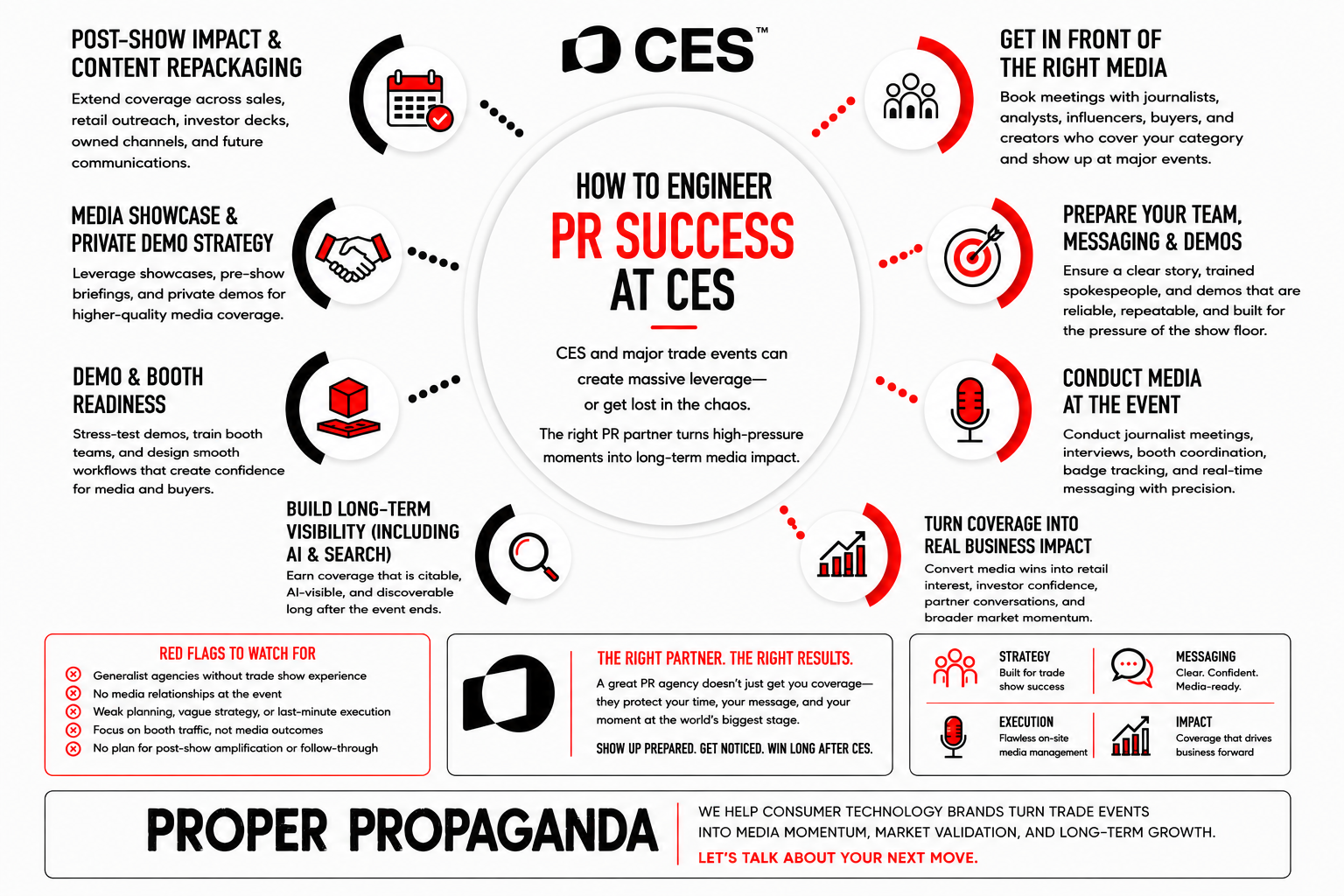
Trade Events & CES: Frequently Asked Questions
No. CES is a major event for Proper Propaganda and most consumer tech brands, but we support media strategy and trade-event communications across consumer technology events, launch showcases, private media briefings, and retail-facing industry events.
Brands should begin serious PR planning 2 to 5 months before CES when possible. Media targeting, messaging, demo planning, embargo strategy, press materials, and spokesperson training all need time to develop properly.
Yes. Pre-show media outreach, private demos, embargoed briefings, and targeted journalist meetings are often among the highest-leverage parts of a CES PR strategy.
Yes. Depending on the engagement, we can support journalist briefings, booth media interactions, founder interviews, media showcase execution, real-time coordination, and follow-up management.
Yes. We help clients evaluate media showcase opportunities, prepare messaging, train teams, manage interactions, and build follow-up systems for events like Pepcom, ShowStoppers, and CES Unveiled.
Post-event PR helps turn coverage into business value. That can include sales enablement, retail outreach, website proof, LinkedIn content, investor updates, performance PR, affiliate outreach, and AI search visibility work.
AI systems increasingly summarize brands and recommend products based on trusted third-party signals. Strong media coverage, product reviews, awards, and structured content can influence how a brand appears in AI-generated answers.
Yes. We regularly support international technology brands using CES, media coverage, retail conversations, and U.S. market visibility to build credibility in North America. Read more about how we assist tech brands with U.S. market entry and scaling.
Ready to Make Your Trade-Event
Investment Work Harder?
CES and major trade events reward brands that prepare early, communicate clearly, and follow through aggressively.
The companies that win attention usually understand their category, know which journalists and buyers matter, train their teams, protect the story, and keep working after the show ends.
If your brand is preparing for CES or another major consumer technology trade event, Proper Propaganda can help you manage the media chaos and turn it into business momentum.
Book a call with our team and let’s talk about what’s possible. Or reach us directly at info@properpropaganda.net.
Related Resources
If you’re preparing for CES or another major technology trade event, we’ve published a substantial library of tactical and strategic resources covering media management, showcases, awards, founder preparation, retail conversations, post-show amplification, and long-term PR strategy.
Explore our full CES Resource Library for additional guidance.
- The 4 Pillars of a Successful CES PR Strategy
- How to Manage Media at Your CES Exhibitor Booth
- How to Navigate CES Media Showcases
- The Best CES PR Move Most Brands Overlook
- How to Stand Out at CES: 7 Tactics for Exhibitors
- 5 PR Mistakes To Avoid At CES
- How to Get the Most Out of Your CES Media Coverage
- A CES Strategy That Delivers: Lessons from Keychron’s Success
- CES Awards: What Actually Matters and Who Hands Them Out
- How to Submit Your Product to the CES Innovation Awards (and Actually Stand a Chance)
- How to Weaponize a CES Innovation Award for Growth
- Top 3 CES Media Events That Actually Get Your Brand Noticed
- The CES Glossary: Terms Every Exec, Founder, Marketer, and PR Lead Should Know Before Vegas
- A CES Survival Guide
- 4 Types of Retail Buyers You Might Meet at CES
- The Best PR Firms for Getting Press at CES