
GEO Agency for Technology Companies
AI Engines Are
Deciding Who Gets
Seen
Search is changing fast. Buyers, journalists, investors, partners, and job candidates are increasingly turning to ChatGPT, Google AI Overviews, Perplexity, Gemini, and other AI systems for answers before they ever visit a website. They’re also using AI tools for product discovery, comparison shopping, and recommendations on what to buy.
That shift changes how visibility is earned.
At Proper Propaganda, we help technology companies build credibility and presence in AI-driven search through a modern blend of PR, content strategy, technical optimization, and reputation building.
If AI engines are becoming the new front door to the internet, let’s talk and make sure your company is standing in it.

What We’ve Done in AI Search and GEO
Before most agencies were talking about AI Search and Generative Engine Optimization (GEO), we were building programs, publishing frameworks, and tracking real outcomes.
We created our own GEO Guide: A Holistic Blueprint, a practical framework for brands that want to earn credibility in AI search.
We ran our own GEO program internally and went from zero visibility to ranking alongside some of the world’s largest agencies across hundreds of tracked prompts, generating directly attributable inbound leads and new business opportunities.
We have helped clients improve presence across ChatGPT, Google AI Overviews, and Perplexity by combining earned media, stronger site structure, better content architecture, and tighter narrative control.
Our founder, Jackson Wightman, has also been featured on podcasts and industry platforms discussing how AI is reshaping PR, discovery, and brand authority.
Want to see our thinking in action? Browse our AI Search & GEO insights hub.
Why GEO Is Different,
and Why Most Agencies
Get It Wrong
Many agencies treat GEO like SEO with a new label.
It is not.
AI systems do not simply rank pages. They synthesize answers from patterns across websites, media coverage, reviews, forums, marketplaces, video platforms, and countless third-party sources.
That means visibility now depends on more than keywords.
It depends on whether AI systems trust your company, understand your category, repeat your differentiators, and explain your brand the right way.
Most GEO efforts fail because they focus on shallow hacks instead of the real drivers of visibility.
GEO Requires 3 Things Most
Agencies Cannot Deliver:
Communications
Expertise
Monitoring and
Iteration
Technical and
Content
Foundations
AI engines heavily rely on journalistic, editorial, and third-party sources. PR is no longer optional. You need a team that understands earned credibility, media ecosystems, thought leadership, and reputation building.
Your site must be structured for humans and machines alike. Clean hierarchy, schema, FAQ architecture, clear language, and strong internal linking all matter.
AI outputs shift constantly. What works today can weaken tomorrow. Serious GEO requires measurement, competitive intelligence, prompt tracking, and ongoing refinement.
How We Help
Technology Companies
Win in AI Search
Every company starts from a different place.
Some have strong products but weak visibility. Some are being mentioned by AI systems but described poorly. Others have excellent awareness in traditional channels but little presence in ChatGPT, Perplexity, or Google AI results.
Our role is to identify where opportunity and friction exist, then help strengthen the signals AI systems use to understand and recommend your company.
The work usually centres around six core areas:
- Visibility: Benchmark how your company appears across relevant AI platforms, identify which competitors are gaining ground, and prioritize the prompts that matter most to your category.
- Clarity: Strengthen website and content foundations so both people and AI systems can better understand what your company does, who it serves, and why it matters.
- Authority: Build the third-party trust signals AI systems often rely on through earned media, expert commentary, thought leadership, podcasts, and credible external mentions.
- Opportunity Capture: Identify the real questions buyers ask AI tools and create useful content that deserves to surface when those moments happen.
- Positioning: Improve how your brand is described so AI systems reinforce the narrative you want to own, rather than outdated or inaccurate perceptions.
- Adaptation: Monitor changes in AI search visibility, competitor movement, and platform behaviour so progress compounds over time.
How We Measure GEO Progress
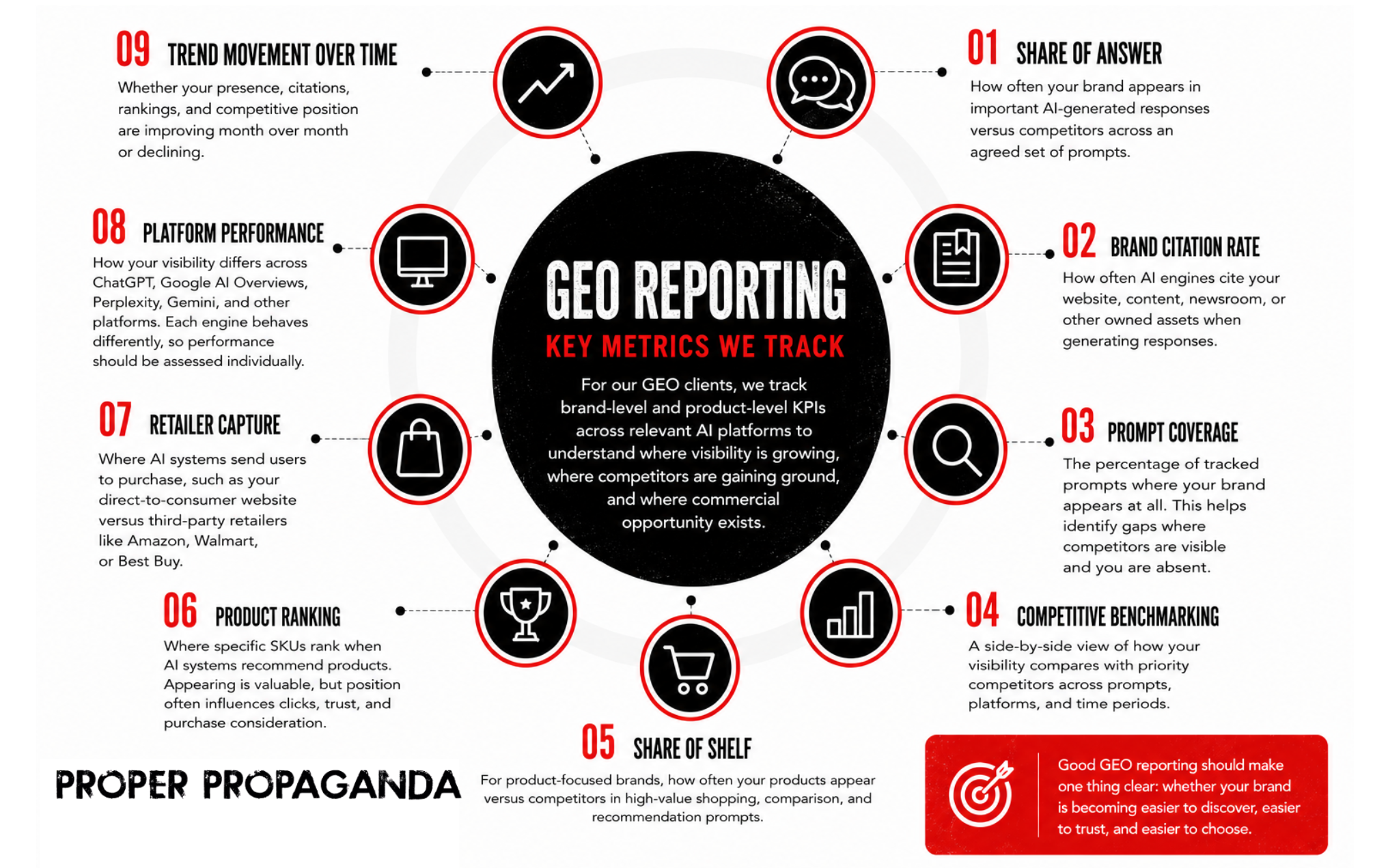
For our GEO clients, we track brand-level and product-level KPIs across relevant AI platforms to understand where visibility is growing, where competitors are gaining ground, and where commercial opportunity exists.
Key metrics often include:
- Share of Answer: How often your brand appears in important AI-generated responses versus competitors across an agreed set of prompts. This helps show whether your company is becoming more visible in the moments that matter.
- Brand Citation Rate: How often AI engines cite your website, content, newsroom, or other owned assets when generating responses. This indicates whether your brand is being used as a trusted source.
- Prompt Coverage: The percentage of tracked prompts where your brand appears at all. This helps identify gaps where competitors are visible and you are absent.
- Competitive Benchmarking: A side-by-side view of how your visibility compares with priority competitors across prompts, platforms, and time periods.
- Share of Shelf: For product-focused brands, how often your products appear versus competitors in high-value shopping, comparison, and recommendation prompts.
- Product Ranking: Where specific SKUs rank when AI systems recommend products. Appearing is valuable, but position often influences clicks, trust, and purchase consideration.
- Retailer Capture: Where AI systems send users to purchase, such as your direct-to-consumer website versus third-party retailers like Amazon, Walmart, or Best Buy.
- Platform Performance: How your visibility differs across ChatGPT, Google AI Overviews, Perplexity, Gemini, and other platforms. Each engine behaves differently, so performance should be assessed individually.
- Trend Movement Over Time: Whether your presence, citations, rankings, and competitive position are improving month over month or declining.
- Commercial Signals: Where possible, we also connect GEO gains to downstream traffic, leads, revenue opportunities, and other meaningful business outcomes.
Good GEO reporting should make one thing clear: whether your brand is becoming easier to discover, easier to trust, and easier to choose.
Who We Work With
We primarily work with consumer tech companies that have something real to sell and are serious about being found.
That includes hardware brands, consumer electronics companies, smart home products, wearables, gaming accessories, audio brands, mobility products, ecommerce-first tech brands, and international consumer tech companies entering North America.
We also work with select technology companies beyond consumer tech, including SaaS companies, AI startups, marketplaces, B2B software firms, cybersecurity brands, fintech companies, and other high-growth technology businesses where visibility and credibility matter.
Our best clients understand that credibility compounds and early movers often gain advantages.
We are especially valuable to:
- Challenger brands competing against larger incumbents
- Companies launching new categories
- Firms entering new markets
- Businesses with weak AI visibility despite strong products
- Leadership teams that want measurable modern PR and GEO support
Our AI Search (GEO) engagements typically range from $5,000 to $20,000 USD per month, depending on scope, market competition, and level of support required.
If you are pre-product, pre-market, or looking for instant results without meaningful investment, we are likely not the right fit.
We do not hand accounts to interns. We do not sell mystery retainers. We do not hide behind vanity metrics.
You will work with senior people who know this space.
GEO for Technology Companies: Frequently Asked Questions
GEO stands for Generative Engine Optimization. It is the practice of improving how your brand appears across AI-powered search platforms such as ChatGPT, Google AI Overviews, Perplexity, Gemini, and others.
SEO focuses heavily on rankings and clicks. GEO focuses on inclusion, explanation, trust, citations, and how AI systems summarize your brand. Both matter. Increasingly, they overlap.
Because buyers increasingly use AI tools during research, comparison, vendor discovery, and decision-making. If your company is absent from those conversations, competitors gain ground.
Yes. Earned media, interviews, reviews, expert quotes, and third-party coverage often become trusted inputs for AI systems. Strong PR can materially improve visibility and credibility.
Meaningful early movement can happen in a few months, but durable gains often take six to twelve months depending on category competition, authority level, and execution quality.
Absolutely. Unlike some legacy channels, AI visibility can reward relevance, clarity, and credibility rather than just ad spend. This creates opportunities for strong challengers.
We measure GEO using brand-level and product-level visibility metrics across relevant AI platforms. Brand KPIs include share of answer (how often your brand appears in important AI responses versus competitors), brand citation rate (how often your owned content is cited by AI engines), prompt tracking, and competitive benchmarking. For ecommerce and product-focused brands, we also track SKU-level metrics such as share of shelf (how often your products appear versus competitors in high-value prompts), product ranking across platforms, and retailer capture (where AI systems send users to buy, such as your direct site versus retailers like Amazon or Walmart). Where possible, we also connect visibility gains to downstream traffic, leads, and commercial outcomes.
Ready to Win the
New Search Era?
AI engines are already influencing who gets discovered, trusted, shortlisted, and bought.
The companies that act early will shape how categories are explained. The ones that wait may spend years trying to catch up.
Book a call with our team and let's talk about what's possible. Or reach us directly at info@properpropaganda.net.
Related Resources
- GEO Guide: A Holistic Blueprint for AI Search Visibility
- How Proper Propaganda Built Its Own GEO Presence
- AI Search & GEO Insights Hub
- How Reddit Influences AI Search Results and LLM Citations in 2026
- AI Is Not Top of Funnel: What GLP-1 Search Data Reveals About the Full Buyer Journey
- Should You Invest in GEO Before ROI Is Clear?
- Narrative Drift: A GEO-Presence Problem / Part One
- Measuring Narrative Drift Index (NDI): A Practical GEO Framework / Part Two
- Share of Explanation: Influence Belongs to the Brands That Shape LLM Understanding
- What Are the Implications of ChatGPT’s Shopping Research Feature?