
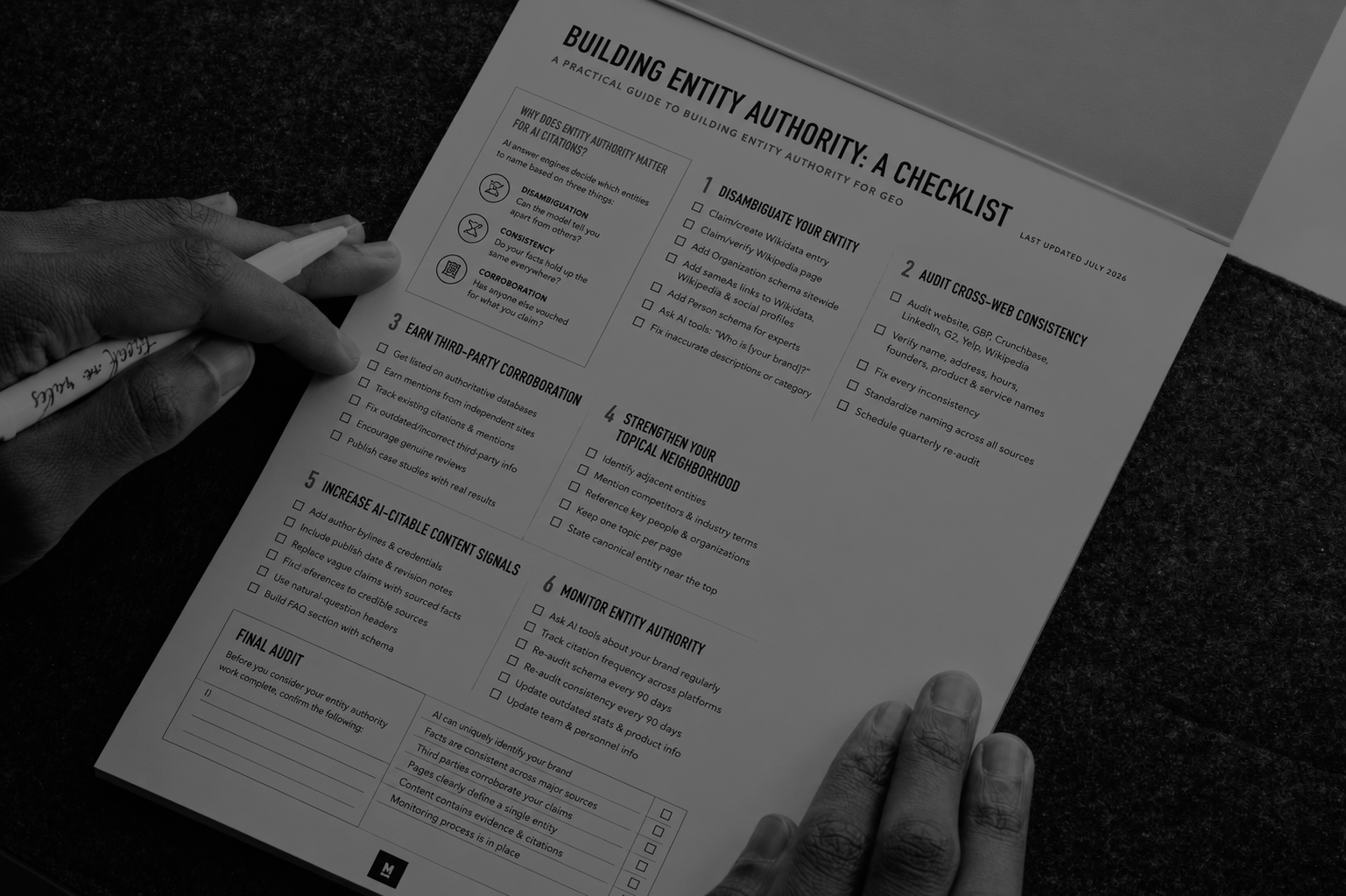

A practical guide to building entity authority for Generative Engine Optimization (GEO). Last updated July 2026.
Why does entity authority matter for AI citations?
Because the mechanics of search have changed, and most brands haven’t caught up.
Google used to hand you a list of ten blue links and let you decide who to trust. AI answer engines – ChatGPT, Gemini, Perplexity, AI Overviews – skip that step. They synthesize one answer and decide, on your behalf, which brands or people are worth naming in it. There’s no page two to fall back on. You’re either in the answer or you don’t exist for that query.
That decision isn’t made on vibes. It’s made on whether the model can confidently resolve who you are (disambiguation), whether your facts hold up the same way everywhere it looks (consistency), and whether anyone besides you has vouched for what you’re claiming (corroboration). Miss any of those, and a model won’t argue with you – it’ll just quietly leave you out to avoid being wrong.
Independent research on generative engines has found that adding concrete statistics, quotations, and citations to a page can lift its visibility in AI-generated answers by as much as 40%.
Your Entity Authority Checklist
Work through each section. If you can’t confidently check every box, you’ve found an area that needs attention.
✓ 1. Disambiguate Your Entity
Goal: Make sure AI knows exactly who you are.
If a model can’t tell you apart from three other companies with almost-your-name, you don’t have an entity problem, you have an existence problem.
Checklist
☐ Claim or create a Wikidata entry for your brand or organization
☐ Claim or verify a Wikipedia page if you meet notability guidelines
☐ Set up Organization schema (JSON-LD) sitewide using the @id pattern
☐ Add sameAs links pointing to Wikidata, Wikipedia and verified social profiles
☐ Add Person schema for key authors and experts
☐ Ask ChatGPT, Gemini and Perplexity “Who is [your company]?”
☐ Correct any inaccurate descriptions or categorization
✓ 2. Audit Cross-Web Consistency
Goal: Ensure every important fact about your business matches everywhere.
Models don’t resolve contradictions, they just get nervous and leave you out.
Checklist
☐ Audit your website
☐ Audit your Google Business Profile
☐ Audit Crunchbase
☐ Audit LinkedIn
☐ Audit G2
☐ Audit Yelp
☐ Audit Wikipedia/Wikidata
For every source, verify:
☐ Company name
☐ Address
☐ Hours
☐ Founder names
☐ Product names
☐ Service names
☐ Correct every inconsistency
☐ Schedule a recurring quarterly audit
✓ 3. Earn Third-Party Corroboration
Goal: Give AI independent evidence that your claims are true.
This is the part the schema-markup evangelists conveniently skip.
Checklist
☐ Build profiles on authoritative industry databases
☐ Earn mentions from independent publications
☐ Earn citations from trusted research
☐ Track existing mentions
☐ Correct outdated third-party information
☐ Collect genuine reviews
☐ Publish case studies containing specific, verifiable outcomes
✓ 4. Strengthen Your Topical Neighborhood
Goal: Make AI understand the ecosystem you belong to.
An entity written about in isolation doesn’t look like a real category player.
Checklist
☐ Identify competitors
☐ Identify adjacent entities
☐ Mention standard industry terminology
☐ Mention important people and organizations
☐ Keep each page focused on one topic
☐ State the canonical entity near the top of the page
✓ 5. Increase AI-Citable Content Signals
Goal: Give AI something worth citing.
Vague thought leadership is filler.
Checklist
☐ Add author bylines
☐ Display author credentials
☐ Add publish dates
☐ Include revision dates
☐ Replace vague claims with sourced facts
☐ Cite external references
☐ Write headers as natural questions
☐ Add FAQ schema
✓ 6. Monitor Entity Authority
Goal: Keep your entity accurate over time.
Entity authority isn’t a project. It’s maintenance.
Checklist
☐ Ask ChatGPT about your company regularly
☐ Ask Gemini about your company regularly
☐ Ask Perplexity about your company regularly
☐ Monitor citation frequency
☐ Re-audit schema every 90 days
☐ Re-audit consistency every 90 days
☐ Update statistics
☐ Update product information
☐ Update personnel information
Final Audit
Before you consider your entity authority work complete, confirm the following:
| Area | Complete |
| AI can uniquely identify your brand | ☐ |
| Facts are consistent across major sources | ☐ |
| Third parties corroborate your claims | ☐ |
| Pages clearly define a single entity | ☐ |
| Content contains evidence and citations | ☐ |
| Monitoring process is in place | ☐ |
FAQ
What is entity authority in simple terms?
It’s whether AI systems can uniquely identify your brand or name and trust the facts they find about it enough to mention you in an answer.
How is entity authority different from traditional SEO authority?
Traditional SEO authority is measured by backlinks and rankings. Entity authority is measured by disambiguation and factual consistency — whether a model knows who you are and believes what it finds, regardless of where you rank.
What’s the fastest way to start building entity authority?
Audit your own facts first: name, hours, founders, and product names across your site and major directories (Google Business Profile, Crunchbase, G2, LinkedIn). Fix every inconsistency before doing anything else — it’s the highest-leverage, lowest-effort step.
Does schema markup alone build entity authority?
No. Schema helps a model parse and disambiguate your entity, but it doesn’t create trust on its own. Third-party corroboration and consistent facts across the web matter just as much, if not more.
How often should entity authority be re-audited?
At least quarterly. Business facts (addresses, hours, personnel, product names) drift over time, and AI systems penalize inconsistency more than staleness.