
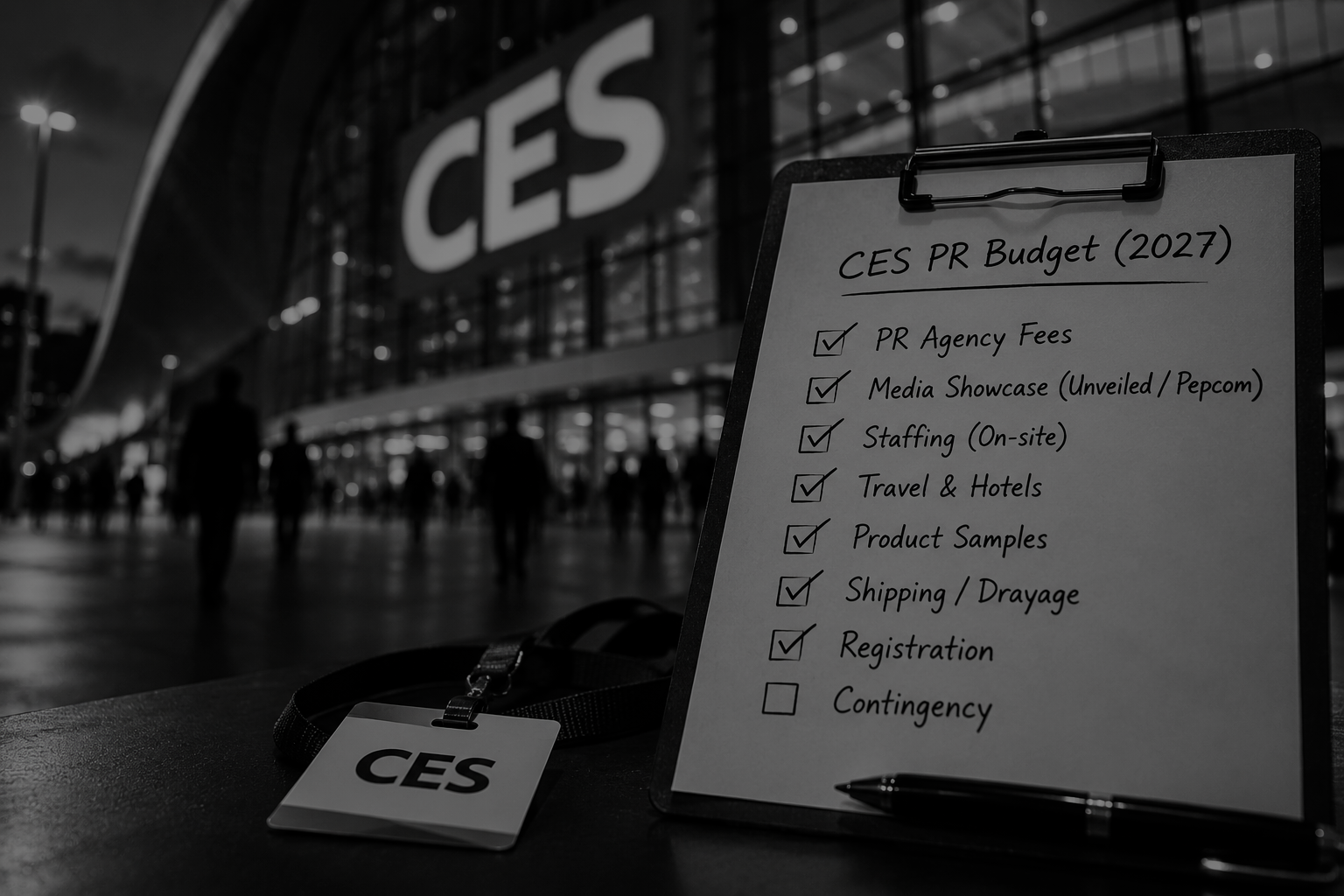

A technology brand should generally budget between $15,000 and $50,000+ for a serious CES 2027 PR campaign, excluding the cost of building and operating a major CES booth.
A focused pre-show PR campaign can sit toward the lower end. Add an experienced agency on-site, CES Unveiled or another media showcase, multiple staff, samples, shipping and six nights in Las Vegas, and a realistic communications budget can quickly reach $40,000 to $60,000.
Large brands running major product launches, private events, multiple media showcases and substantial creator programs can spend considerably more.
The number that matters, however, isn’t simply what the PR agency charges.
It’s the total cost of creating a credible media experience around CES.
That can include:
PR agency fees, media showcases, agency and brand staffing, flights, hotels, meals, local transportation, product samples, shipping, drayage, photography, video and contingency.
And that’s before we start talking about a large booth.
For a growth-stage technology brand, I’d think about CES PR as its own campaign budget rather than treating the agency fee as the whole number.
How much should you budget for CES PR in 2027?
Here’s a reasonable planning framework.
| CES PR model | Approximate PR-related budget | What you’re buying |
| Lean pre-show campaign | 10,000–20,000 | Strategy, media materials, outreach and advance briefings |
| Full CES PR campaign | 20,000–35,000 | Pre-show campaign, media scheduling, on-site support and follow-up |
| PR + media showcase | 30,000–50,000 | Full PR campaign plus Unveiled/Pepcom-type participation and associated logistics |
| Major CES launch | 50,000–100,000+ | Multiple events, larger team, extensive content, creator activity and substantial on-site execution |
These are planning ranges, not official CES prices or a universal agency rate card.
Agency pricing varies substantially.
At Proper Propaganda, our CES projects are generally scoped according to the amount of preparation, outreach and on-site senior support required. For a serious CES campaign, $20,000 is a useful working example for agency fees, although the actual number depends on the mandate.
That still isn’t your CES PR budget.
It’s one line in it.
CES 2027 is a six-day media event disguised as a four-day trade show
This is one of the first budgeting mistakes brands make.
CES 2027 officially runs January 6 through January 9, 2027 in Las Vegas.
But if media is an important objective, your CES begins earlier.
Media Day 1 and CES Unveiled take place on January 4.
Media Day 2 is January 5.
The show floor opens January 6.
So a PR team supporting a brand through the important pre-show media period may arrive January 3 and remain through January 8 or 9.
That’s five or six nights in Las Vegas.
Possibly more.
And CES isn’t a small trade event.
CES says the 2026 show attracted 148,000+ attendees, 4,100+ exhibitors and 1,400 startups in Eureka Park.
Those numbers are exciting and optimistic but not without challenge.
You are bringing your product into one of the most competitive media environments in technology.
1. How much does a CES PR agency cost?
For a serious technology company, I’d budget approximately $15,000 to $30,000 for the agency component of a CES campaign.
The important question is what the mandate includes.
A proper CES PR campaign should begin well before everyone lands in Nevada.
At Proper Propaganda, we generally recommend beginning serious CES PR preparation two to five months before the show, depending on the company, product and scope of the launch.
The agency’s work might include messaging, launch strategy, media lists, press materials, embargo planning, journalist outreach, desksides, remote pre-briefings, spokesperson preparation, activations, media showcase strategy, booth scheduling, on-site briefings and post-show follow-up.
That is considerably different from hiring somebody in December to send a press release.
What should $10,000 to $15,000 buy?
At this level, I’d expect a relatively lean campaign.
The agency may focus primarily on pre-show strategy, media materials, targeted pitching and appointment setting.
On-site support may be limited or excluded.
This can work for a smaller company with a highly novel product, an experienced internal communications team or a founder who can manage meetings once they reach Las Vegas.
Expectations need to match investment.
What should $20,000 to $30,000 buy?
Now we’re talking about a proper CES campaign.
I’d expect meaningful preparation before the show, active media pitching, appointment setting, spokesperson preparation, on-site media management and follow-up.
The agency should understand the geography and rhythm of CES.
That matters more than it sounds.
Moving a journalist from the Venetian to the LVCC for a 15-minute demo is very different from asking someone already covering your hall to walk 100 feet.
Your PR team should also be able to manage the inevitable chaos.
A reporter arrives early.
Another is 20 minutes late.
A product stops working.
A founder disappears into a sales meeting.
A camera crew needs power.
Someone from a major publication walks into the booth unannounced.
CES PR becomes an operations job very quickly.
What should $30,000+ buy?
At this level, the mandate should be broader.
Perhaps you have multiple products.
Multiple spokespeople.
A major corporate announcement.
Several media showcases.
Creator partnerships.
A private event.
A large booth.
Or significant international media activity.
The additional money should purchase scope and senior resources, not simply a more expensive version of the same media list.
2. How much does CES Unveiled cost in 2027?
This one we know.
CES Unveiled Las Vegas takes place January 4, 2027 at Mandalay Bay, two days before the CES show floor opens.
For 2027, CTA lists the following prices:
| CES Unveiled option | 2027 price |
| Standard tabletop | $8,000 |
| Eureka Park highboy table | $1,000 |
| Standard Innovation Award Honoree discount | $800 off |
| Food Tech | $10,000 |
The standard package includes an 8-by-10-foot space, six-foot table, four exhibitor passes, signage, hard-wired internet and electrical service. Eureka Park exhibitors receive a smaller setup.
For startups, that $1,000 Eureka Park rate is worth paying attention to.
For everyone else, $8,000 is a meaningful addition to the CES PR budget.
Is CES Unveiled worth $8,000?
It can be.
The attraction is concentration.
CES describes Unveiled as its official media event and positions it as an opportunity to get products in front of registered media two days before the show floor opens.
Journalists haven’t yet spent three days walking around convention halls looking at robots, AI toothbrushes and smart toilets.
You have a few hours in a room designed around media discovery.
For the right consumer product, that can be enormously useful.
But paying $8,000 doesn’t purchase coverage.
You are purchasing access to an environment where coverage can happen.
The product and story still need to perform.
We’ve seen this repeatedly over more than a decade of attending CES.
As I wrote in our guide to getting CES media coverage with or without a booth, exhibiting, attending Unveiled or participating in another showcase doesn’t guarantee press.
Regular media relations dynamics still apply.
A boring product remains boring when you put it on a table in Mandalay Bay.
3. What about Pepcom and other CES media showcases?
Pepcom Digital Experience takes place January 5, 2027, the night before the CES show floor opens.
The basic proposition is similar to Unveiled.
Put technology companies and a concentrated group of journalists and creators in the same room.
For a product that demonstrates well, these events can be very effective.
Pepcom doesn’t currently publish its CES 2027 exhibitor pricing publicly on its website, so I wouldn’t put an invented number into a budget and pretend it’s official. Brands should request a current exhibitor quote directly from Pepcom.
The same principle applies to other independent CES media events.
Get the actual quote.
Then ask a more important question:
What would we be able to do with that money instead?
An $8,000 showcase could be excellent value.
Or that $8,000 could fund additional agency time, creator activity, travel for an important executive, product seeding or a small private event.
The answer depends on the product.
4. How much should you budget for CES travel and hotels?
This is where budgets get sloppy.
A company approves a $20,000 PR agency fee and then discovers that sending four people to Las Vegas for six nights creates another substantial bill.
CES 2027 hotel accommodations are already open through onPeak, the show’s official housing provider.
CES specifically warns that rates increase as January approaches and that some hotels sell out.
There is no single useful hotel number because the cost depends heavily on property, booking date, room type and location.
For planning purposes, however, I would create a $2,000 to $4,000 per-person CES travel allowance for a five-to-six-night trip, then replace that assumption with actual bookings as soon as possible.
That planning allowance should cover airfare, hotel, meals and local transportation.
It isn’t an official CES rate.
It is a budgeting assumption.
For four people, you’re quickly looking at:
$8,000 to $16,000.
Location also has value.
A cheaper hotel that forces your team into repeated cross-town transportation may save money on paper and create operational problems during the show.
If your meetings are concentrated around the Venetian, staying reasonably close to the Venetian can be worth paying for.
CES days are already exhausting.
Nobody needs to add two unnecessary hours of Las Vegas traffic.
5. How many PR people should you have on-site at CES?
For a serious campaign, two senior PR people on-site is a very useful configuration.
One person can manage scheduled briefings, spokespeople and collecting brand/product sentiment.
The other can deal with incoming media, scheduling changes, follow-ups, photography, samples and the dozen small fires that appear during the day.
Can one person do it?
Yes.
If the schedule is modest.
If you have 20 media meetings over several days, multiple executives, a booth and a showcase, one person becomes a bottleneck.
The same applies to the brand team.
Your head of sales shouldn’t also be responsible for finding a journalist’s sample.
Your CEO shouldn’t be figuring out where the next meeting is.
CES staffing should be designed around what people actually need to accomplish.
6. Budget for product samples
Consumer technology companies routinely underestimate this line.
If you’re launching a $500 product and bringing ten dedicated review units, that’s $5,000 of product at retail value before shipping.
A $1,500 product gets expensive considerably faster.
But samples aren’t simply a cost.
For many consumer technology brands, they’re one of the highest-value CES PR assets.
A journalist can see a product for 15 minutes at CES and write a news item.
Give the right reviewer a production-ready unit and you potentially create a detailed review, video, comparison article, affiliate placement or long-term reference source.
That coverage can continue generating value long after Las Vegas.
For a CES PR campaign, I’d divide product inventory into three groups:
Demo units stay with the booth and media team.
Review units are allocated to qualified media and creators.
Emergency units exist because something will break, disappear or fail to arrive.
For a smaller consumer technology launch, $2,000 to $5,000 worth of product inventory is a reasonable planning allowance.
For expensive hardware, that number can be much higher.
The critical thing is having working production-quality samples.
Ten prototypes that randomly fail are considerably less useful than five reliable units.
7. Budget separately for shipping
Shipping to CES deserves its own budget line.
Sending a FedEx box to a hotel and shipping hundreds of pounds of exhibit materials into a convention center are very different exercises.
CES has already published topline 2027 Freeman service rates.
For example, its exhibitor manual lists material handling at some venues at $1.16 per pound with a 100-pound minimum, while installation, dismantling, forklift and other labor are charged separately. CES says 2027 Freeman rates are generally increasing 3% over 2026, while material-handling rates remain flat.
This is where exhibitors discover the wonderful world of drayage.
For a PR budget involving portable products and samples rather than booth construction, I’d generally hold $1,000 to $3,000 for shipping, handling, returns and emergencies.
Heavy products can blow through that quickly.
International brands should budget more carefully because customs, temporary imports and timing introduce additional risk.
And ship early.
A $400 shipment can become a much more expensive problem when somebody needs to get on a plane carrying the replacement.
8. Don’t forget CES registration
CES 2027 standard attendee registration costs $149 through November 30, 2026, rising to $349 from December 1 through January 9.
The Premium Pass costs $1,450 early and $1,750 later.
Most PR people don’t need the Premium Pass.
Standard access is generally sufficient.
Exhibitors also receive complimentary badges based on exhibit space. CES says exhibitors receive five badges for every 100 square feet of space, with a minimum of ten.
The registration line usually isn’t what breaks a CES budget.
But multiply late registration by several staff members and it becomes another unnecessary expense.
9. A realistic CES 2027 PR budget
Imagine a growth-stage consumer technology company launching a new product at CES 2027.
It has a booth already paid for through another budget.
Media coverage is a major objective.
The company wants to participate in CES Unveiled and have two senior PR people supporting the launch.
Here’s what I would use as an initial planning budget:
| Expense | Planning budget |
| CES PR agency campaign | $20,000 |
| CES Unveiled standard tabletop | $8,000 |
| Travel and accommodation for agency/brand PR team | $12,000 |
| Product samples/review units | $3,000 |
| Shipping and handling | $2,500 |
| Registration and miscellaneous show expenses | $1,000 |
| Local transportation, meals and incidentals | $3,000 |
| Contingency | $5,000 |
| Total | $54,500 |
Only the CES Unveiled figure in this example is an official fixed CES 2027 price. Travel, samples, agency fees, shipping and incidentals are planning assumptions and should be replaced with actual quotes.
But $50,000-ish is a credible number for a serious CES media campaign once all the pieces are included.
And remember:
That does not include the main booth.
10. What should you expect from a $15,000 CES PR investment?
At approximately $10,000 to $15,000, I’d keep the program focused.
You probably aren’t funding a large on-site agency team plus a major showcase.
So prioritize.
Build the story.
Create excellent media materials.
Identify the journalists who genuinely matter.
Begin outreach early.
Arrange remote briefings before CES where possible.
Book a manageable number of meetings.
Have somebody competent handle follow-up.
This level works best when the product itself is highly newsworthy or when the company already has media relationships.
The objective should be targeted coverage and a small number of high-quality media interactions.
Don’t expect omnipresence.
11. What should you expect from a $25,000 to $35,000 CES PR investment?
This is where the program starts becoming substantially more robust.
You can afford meaningful agency preparation and potentially on-site support.
You can conduct pre-show outreach.
You can schedule briefings.
You can prepare executives properly.
You can manage the booth as a media destination.
You can follow up aggressively.
Depending on how the budget is allocated, you may also be able to add a media showcase.
For many growth-stage technology companies, this is the sweet spot if the booth itself is being funded separately.
The objective is to build a credible media program around the show rather than simply generate a few appointments.
12. What should you expect from a $50,000 CES PR investment?
At $50,000 or more, I’d expect a considerably more complete campaign.
You can combine strategies.
Agency.
Media showcase.
Multiple senior people on-site.
Samples.
Pre-show desksides.
Creator activity.
Brand activation.
Photography or video.
Private demonstrations.
Potentially a small media dinner or event.
This is where CES can become a launch platform rather than a four-day trade show appearance.
But bigger budgets create another risk.
Waste.
A company can spend $50,000 very efficiently.
It can also spend $50,000 on an elaborate event that five journalists attend.
The goal isn’t to activate every available CES tactic.
It’s to choose the tactics most likely to put the product in front of the people who matter.
13. Should you spend money on a booth or media showcase?
If media is the primary objective, I’d seriously consider the showcase.
If sales, distributors, retailers, partners, customers and media all matter, the booth becomes much easier to justify.
This distinction matters.
A CES booth gives you a permanent physical presence.
Journalists can visit.
Customers can visit.
Buyers can visit.
Partners can visit.
People can discover you organically.
A media showcase gives you a much more concentrated period of access to journalists and creators.
You don’t necessarily have to choose.
Some of the strongest CES programs combine both.
We discuss the trade-offs in our guide to the five primary CES media strategies.
The right choice depends on the product, story and commercial objectives.
14. Can you get CES coverage without a booth?
Yes.
We’ve done it.
I wouldn’t build the strategy around hope, though.
A company can attend CES and arrange private meetings in hotel suites, restaurants, coffee shops or other convenient locations.
The economics are attractive.
No booth.
No drayage.
No exhibit construction.
No booth staffing.
But virtually every useful media interaction needs to be arranged in advance.
There’s also a credibility problem.
Asking a journalist to walk across Las Vegas to meet an unknown startup in a hotel lobby is a substantially harder sell than inviting them to an established booth or media showcase.
The approach works best when the product is genuinely novel, portable and easy to demonstrate.
If you’re taking this route, spend your money on media relations and advance scheduling.
Your calendar is your CES booth.
15. What about hosting your own CES media event?
This can work brilliantly.
It can also become one of the fastest ways to burn money in Las Vegas.
A private suite, breakfast, dinner or media event gives you control over the environment.
You can spend longer with journalists.
You can bring executives together with media, creators, partners and customers.
You can demonstrate products without thousands of people walking behind you.
But you need the right guest list.
The economics of an event should be judged against who actually attends.
Spending $20,000 on a dinner attended by ten strategically important journalists, creators, buyers and partners might be an excellent investment.
Spending $20,000 on a dinner where your own team fills half the table isn’t.
CES schedules are brutally competitive.
If you’re going to host something, make it close to where your guests already are.
16. Where should you spend if your CES PR budget is limited?
Spend on access and story quality before spectacle.
A beautiful booth doesn’t guarantee media coverage.
A giant booth doesn’t guarantee it either.
Neither does an expensive press release.
If I had a constrained CES PR budget, I would protect the money required for strong media strategy, early outreach, working samples and a credible place to demonstrate the product.
Then I’d look at whether a showcase creates enough additional access to justify its cost.
This is particularly relevant because CES exhibitors already receive access to the show’s pre-registered media list, which becomes available through the exhibitor dashboard on December 1.
That list is useful.
It’s not a substitute for a media strategy.
Thousands of companies can access it.
Your job is to give the journalist a reason to respond to you.
17. When should CES 2027 PR start?
Earlier than most companies think.
We recommend beginning serious planning two to five months before CES.
By October and November, you should know:
Your story.
Your launch products.
Your spokespeople.
Your working samples.
Your showcase plans.
Your priority media.
Your embargo strategy.
Your booth or meeting location.
Your major proof points.
Active pitching should be well underway before Christmas.
Our experience after more than a decade of working at CES is that journalist calendars fill quickly.
CES officially makes its pre-registered media list available to exhibitors on December 1.
Don’t interpret that date as the moment to start thinking about PR.
It is far too late to start building the strategy.
18. How should a CMO measure CES PR?
Don’t judge a CES campaign by the number of business cards collected.
And don’t reduce it to total media impressions.
I’d look at four layers of value.
Media outcomes include quality coverage, product reviews, broadcast appearances, creator content and journalist relationships.
Commercial outcomes include retailer conversations, distributor interest, partnership opportunities, qualified leads and customer activity.
Authority outcomes include category association, executive credibility, awards, product validation and useful third-party references.
AI-search outcomes include whether the resulting coverage becomes part of the information environment surrounding the product and brand.
That last piece is becoming more important.
A strong CES review doesn’t disappear when January ends.
It can rank in search.
It can appear in product research.
It can be cited by other publications.
And it can potentially become one of the sources surfaced by AI systems when customers research the category.
That gives CES coverage a useful life beyond show week.
What does CES PR actually cost in 2027?
Here’s the short answer.
Budget $10,000 to $20,000 for a lean campaign.
Budget $20,000 to $35,000 for a serious, professionally managed CES PR program.
Budget $30,000 to $50,000 if you’re adding a major media showcase and the travel and logistics required to support it.
Budget $50,000 to $100,000+ if CES is a major launch involving multiple activations, creators, private events or extensive on-site support.
And keep your main exhibit budget separate.
CES can be expensive.
That’s hardly news.
The more important question is whether the pieces of the budget support one another.
An $8,000 media showcase without advance outreach can underperform.
A $100,000 booth without a media strategy can become an expensive meeting room.
Twenty review units are useless if nobody has decided who should receive them.
Two PR people in Las Vegas can’t fix a story the company started thinking about on December 20.
The companies that tend to get more from CES start with the outcome they want and build the budget backward.
If the goal is media coverage, spend on the things that create media access.
If the goal is product reviews, budget for samples and follow-up.
If the goal is a major US launch, invest in the authority, media relationships and proof required to make that launch credible.
If the goal is sales and distribution, make sure the booth and commercial team are doing more than serving as scenery for PR.
Your CES budget should reflect what you’re trying to accomplish in Las Vegas.
That’s the number worth getting right.