
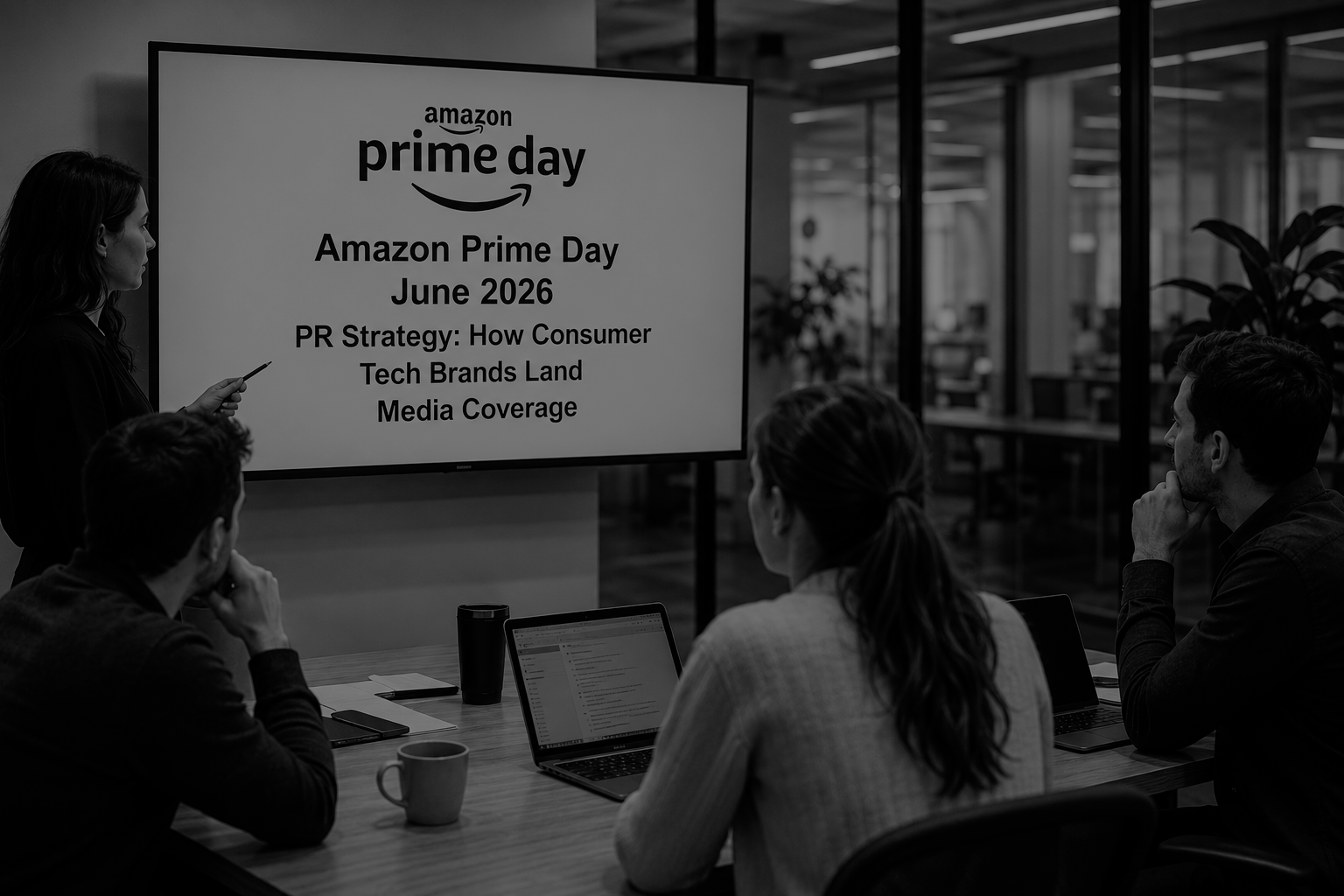

Why the smartest brands start pitching media, publishing deal content, and feeding AI search engines weeks before Amazon Prime Day begins.
Prime Day 2025 was Amazon’s biggest Prime Day ever. Customers saved billions across more than 35 product categories, while independent sellers hit record-breaking sales milestones. Amazon also delivered more than 13 billion items same-day or next-day globally.
Now, Amazon’s flagship summer shopping event, Amazon Prime Day 2026, is returning this June (official dates still TBD), giving Prime members access to major discounts across categories like consumer electronics, beauty, apparel, home goods, and more.
It’s shaping up to be another massive ecommerce event. And if you’re a consumer tech brand waiting until launch week to think about PR, you’re already late.
While Amazon has not yet confirmed whether Prime Day 2026 will follow last year’s extended four-day format or return to the traditional 48-hour structure, brands should already be preparing media outreach and promotional content well in advance.
The technology brands that dominate Prime Day gift guides build search visibility, media momentum, and AI discoverability weeks before discounts go live.
If you want your product featured in Prime Day roundups, “best deals” articles, influencer lists, and AI-generated shopping recommendations, you need a coordinated PR and content strategy long before the sale starts.
Amazon Prime Day June 2026 PR Starts Before the Event
Prime Day gift guide coverage is won before Prime Day starts. Most media outlets finalize coverage earlier than brands realize.
Commerce editors at tech publications, lifestyle outlets, deal sites, and creator-led newsletters are planning roundup content weeks ahead of the event. Some begin building coverage calendars more than a month in advance.
That means your outreach window is smaller than you think.
You should already be pitching if your product is:
- launching near Prime Day
- discounting aggressively
- offering an exclusive bundle
- trending on social
- tied to a seasonal use case
- solving a clear consumer pain point
The strongest Prime Day PR campaigns position products as culturally relevant, giftable, useful, and easy to recommend in roundup formats. Reporters prioritize products readers are likely to purchase during the sale.
4 Things Consumer Tech Brands Should Be Doing 4-6 Weeks Before Prime Day
1. Lock in Your Prime Day Deals Early
Most brands wait way too long to finalize their Prime Day offers. By the time discounts are approved internally, commerce editors are already building roundup lists, creators are planning content calendars, and PR teams are scrambling for information that should’ve existed weeks earlier.
At least six weeks before Prime Day starts, your PR agency should have a clear breakdown of:
- which products are going on sale
- discounted pricing
- percentage off
- Lightning Deals
- bundle offers
- deal windows
- inventory expectations
- any exclusive Amazon promos
And if your catalog is huge, resist the urge to pitch everything. Nobody wants a spreadsheet with 47 SKUs.
Pick three to five products that actually deserve attention. Usually, that means products that:
- already convert well on Amazon
- have strong review volume
- are newer or flagship models
- haven’t been discounted before
- solve an obvious problem
- look good in roundup graphics and gift guides
A lot of brands lose focus here and try to push their entire catalog at once.
Prime Day PR works better when outreach centers around a small group of products most likely to earn coverage and drive purchases.
2. Figure Out Your Creator Connections Strategy Before Outreach Starts
This is one of the most overlooked parts of Prime Day prep.
If your brand is using Amazon Creator Connections, figure out early whether you’re willing to offer commissions above Amazon’s default category rates.
Brands using Amazon Creator Connections should decide early whether they’re willing to offer commissions above Amazon’s default category rates.
Higher commissions can increase:
- Creator pickup
- Affiliate newsletter inclusion
- TikTok recommendations
- YouTube deal coverage
- Influencer storefront placement
You don’t need to throw money around blindly. But you should decide early whether elevated commissions make strategic sense for your category.
Most importantly, your PR team needs this information before pitching starts. Outreach strategy changes considerably when promotional incentives are part of the story.t.
3. Publish Prime Day Content Without Revealing Every Deal
A lot of brands misunderstand how commerce media works.
Journalists do not want every Prime Day discount publicly posted weeks before the event starts. Commerce coverage works best when publishers can share deals as they go live and capture shopping momentum in real time.
Publishing every detail too early weakens the usefulness of the story for reporters and affiliate publishers.
A smarter approach is to confirm participation while holding back the full promotional details until closer to launch.
That content can include:
- product categories participating in Prime Day
- best-selling or most popular models
- early-access signup opportunities
- limited-time offer teasers
- category shopping tips
- mentions of upcoming exclusive discounts
This still helps build:
- indexed Prime Day search visibility
- topical authority
- AI search discoverability
- searchable content tied to the event
- credible reference points for journalists
Simple headlines usually work best:
- “Our Most Popular Wireless Audio Products Are Joining Prime Day 2026”
- “What to Expect From Our Prime Day Smart Home Deals”
- “Get Early Access to Our Biggest Prime Day Discounts”
The goal is to build anticipation early while preserving the actual news value of the deals themselves.
4. Distribute a Press Release Through PR Newswire
Here’s the reality: LLMs ingest massive amounts of syndicated news and structured press release content.
That makes distribution networks like PR Newswire strategically useful far beyond traditional media pickup.
A Prime Day-focused release can help:
- establish temporal relevance
- reinforce promotional messaging
- increase citation opportunities
- improve AI visibility around your deals
- support branded search demand
Your release should include:
- exact Prime Day dates
- participating products
- discount percentages
- quotes from leadership
- direct purchase links
- availability information
- category keywords tied to your products
Lead with the deals. Lead with the products. Lead with the consumer benefit.
Include language that mirrors how people actually search:
- “Prime Day gaming accessories”
- “best Prime Day laptop stand deals”
- “discounted smart home gadgets”
- “portable charger Prime Day offers”
For distribution, use high-authority networks like PR Newswire and make sure the release is indexed before the event begins.
Commerce Editors Care About Conversion Rates More Than Most Brands Realize
One mistake many brands make during Prime Day outreach is assuming reporters are evaluating products purely on editorial merit.
That is no longer how most commerce newsrooms operate.
Today, many publishers have dedicated commerce teams whose performance is tied not only to traffic and readership, but also to the revenue their content generates.
Commerce editors still care about recommending genuinely useful products. Their credibility depends on it. But they are also under increasing pressure to identify products readers are actually likely to purchase.
That changes how Prime Day coverage gets assigned.
A product that consistently converts often has a significant advantage over a product that is simply new or interesting. This is one reason brands should prioritize pitching their strongest-performing products during Prime Day.
That usually means products with:
- Large review volume
- High star ratings
- Amazon’s Choice designation
- Amazon Best Seller badges
- Strong historical sales performance
- Proven conversion rates
When editors are building deal roundups, gift guides, and shopping newsletters, they’re often looking for products that have already demonstrated consumer demand.
The reality is simple: if readers buy a product, publishers are more likely to cover it again.
Why Affiliate Revenue Matters So Much During Prime Day
Commerce content has become a major revenue driver for publishers.
As traditional advertising models have weakened, affiliate revenue has become increasingly important to newsroom economics.
This is why most shopping articles contain affiliate links.
When readers click those links and make purchases, publishers earn commissions. In many organizations, that performance can be tracked down to individual writers, editors, newsletters, and commerce teams.
Commission rates vary based on:
- Product category
- Retailer
- Affiliate network
- Brand commission structure
- Promotional incentives
As a result, products that convert well often become easier for editors to justify covering repeatedly.
The question many commerce teams are asking is no longer simply: “Is this product interesting?”
It’s increasingly: “Will readers actually buy this product?”
Why Amazon Is Different
One reason Amazon remains so dominant during Prime Day is its ability to convert shoppers.
Consumers already trust the platform.
Amazon offers:
- Fast shipping
- Saved payment information
- Familiar checkout flows
- Extensive reviews and ratings
- Strong purchase intent
All of those factors contribute to higher conversion rates compared with many direct-to-consumer websites.
Commerce teams pay close attention to EPC (earnings per click), and Amazon often performs exceptionally well.
Amazon also offers something many affiliate programs cannot match: basket commissions.
For example, a reader may click a Prime Day article featuring a $100 pair of headphones.
After arriving on Amazon, they may also purchase:
- A stand-up paddleboard
- Household supplies
- Pet products
- Kitchen accessories
In many cases, publishers can earn commission on the entire order, not just the original product featured in the article.
That makes Amazon particularly attractive during major shopping events.
Creator Connections Can Influence Coverage Opportunities
Brands should also understand how Amazon Creator Connections fits into the Prime Day ecosystem.
Creator Connections requires a minimum campaign budget of $5,000 and a minimum 10% commission paid to participating creators.
For many products, especially higher-ticket consumer electronics, that commission can be highly attractive.
Prime Day also allows brands to increase commissions beyond baseline levels.
Creators and publishers can view these elevated rates directly inside their dashboards and decide which products deserve promotional attention.
For a commerce publisher, the difference can be significant.
Instead of earning 3% commission on a product, they may have an opportunity to earn 10%, 15%, or even 20% for promoting the exact same item.
That doesn’t guarantee coverage, but it absolutely influences which opportunities receive attention when editors and creators are sorting through hundreds of competing Prime Day pitches.
Build Relationships Around Performance Data
This is another reason long-term relationships with commerce reporters matter.
The best PR teams do not simply pitch products.
They help reporters identify products that are likely to perform well for readers.
When appropriate, share honest information about:
- Best-selling products
- Highest-rated SKUs
- Amazon’s Choice products
- Historical sales performance
- Customer review volume
- Conversion trends
- Strong seasonal performers
Commerce editors appreciate transparency.
If your team consistently helps them identify products readers genuinely want to buy, you become a more valuable source long after Prime Day ends.
The brands that earn repeat coverage are often the brands that make editors’ jobs easier.
And increasingly, that means helping them find products that deliver value for both readers and the publication.
Prime Day Coverage Is Increasingly Influenced by Revenue Potential
This doesn’t mean editorial standards have disappeared. It means commerce journalism has evolved.
Today’s shopping teams are balancing two objectives simultaneously:
- Recommending products readers will genuinely appreciate.
- Generating revenue that supports the publication.
The brands that understand this dynamic are far more likely to secure meaningful Prime Day coverage.
The Media Pitch Angle Most Brands Miss
Prime Day inboxes are flooded with generic pitches.
The first step is not blasting a generic “Prime Day deals” pitch across hundreds of reporters. The first step is identifying the outlets, writers, and creators who have already covered your products.
That matters because most reputable commerce publications strongly prefer featuring products they already know.
If a reviewer tested your headphones six months ago and liked them, that product has a much higher chance of landing in:
- Prime Day deal roundups
- “best tech deals” articles
- editor picks
- shopping newsletters
- creator storefronts
- last-minute deal coverage
Start by building a list of:
- previous product reviews
- past gift guide inclusions
- affiliate roundups
- YouTube reviews
- creator mentions
- newsletter coverage
- TikTok recommendations
- Reddit discussions with strong engagement
Then re-engage those contacts first.
Let them know:
- the product is going on sale
- what the discount will be
- when the deal goes live
- whether review samples are available
- whether promotional incentives or coupons are included
- which newer models or related products are also participating
Once a writer already trusts one product from your brand, it becomes much easier to introduce adjacent models or newer releases into the conversation.
If outreach starts early enough, offer samples. A reviewer who already tested your previous-generation product may be willing to cover the updated model before Prime Day if timing works.
Your pitch should be tight and also immediately answer:
- what the product is
- who it’s for
- why the deal is compelling
- why it matters right now
- how quickly assets or samples can be provided
Include:
- Amazon links
- retail pricing
- discounted pricing
- high-resolution product images
- short product descriptions
- shipping information
- review units, if available
- affiliate information
- coupon details
- Lightning Deal timing if applicable
Commerce editors are sorting through enormous volumes of outreach during Prime Day season. Long founder stories and bloated brand history paragraphs usually get skipped unless they directly strengthen the product narrative.
AI Search Is Changing Prime Day Discovery
A growing number of shoppers now use AI-generated recommendations instead of traditional Google searches.
That changes how brands should think about visibility.
LLMs tend to prioritize:
- structured information
- repeated topic association
- authoritative mentions
- fresh indexed content
- syndicated coverage
- product roundups
- FAQ-style formatting
In other words, your Prime Day PR strategy now directly impacts AI discoverability.
If your product appears across:
- blog posts
- press releases
- media coverage
- affiliate roundups
- creator content
- Reddit discussions
- YouTube reviews
…your odds of surfacing inside AI-generated shopping recommendations increase dramatically.
That visibility loop is becoming more important with every Prime Day cycle.
Prime Day 2026 Is Global. Your PR Strategy Should Be Too.
Amazon confirmed Prime Day 2026 will run across 26 countries, including:
- United States
- Canada
- United Kingdom
- Germany
- France
- Italy
- Spain
- Mexico
- Singapore
- United Arab Emirates
- And more.
That creates major opportunities for consumer tech brands with international shipping capabilities or localized storefronts.
Different markets respond to different narratives:
- U.S. coverage often prioritizes aggressive discounts
- UK media leans practical and value-driven
- European outlets may focus more on sustainability and utility
- Canadian publications often emphasize availability and shipping logistics
A lazy global PR strategy usually underperforms everywhere.
Final Thought: Prime Day Visibility Is Engineered
Brands love pretending great products naturally get discovered.
They don’t.
Prime Day visibility is manufactured through timing, search indexing, media outreach, AI discoverability, and product selection.
The brands winning gift guide coverage are feeding the internet useful, structured, high-intent content before the event even starts.
That means:
- publishing early
- pitching aggressively
- distributing press releases
- optimizing for AI search
- giving reporters easy-to-use assets
- creating content tied directly to consumer intent
The brands preparing now for Amazon Prime Day 2026 will own the conversation later.