


Campaigns that succeed are not the ones with the most visibility. They are the ones where narrative, trust, and transparency are tightly connected.
Media coverage is not a single outcome. It is a network of signals across multiple sources. Trust is built through repeated exposure, consistent messaging, and credible third-party validation. The real challenge is ensuring the story, the source, and audience discovery patterns reinforce one another over time.
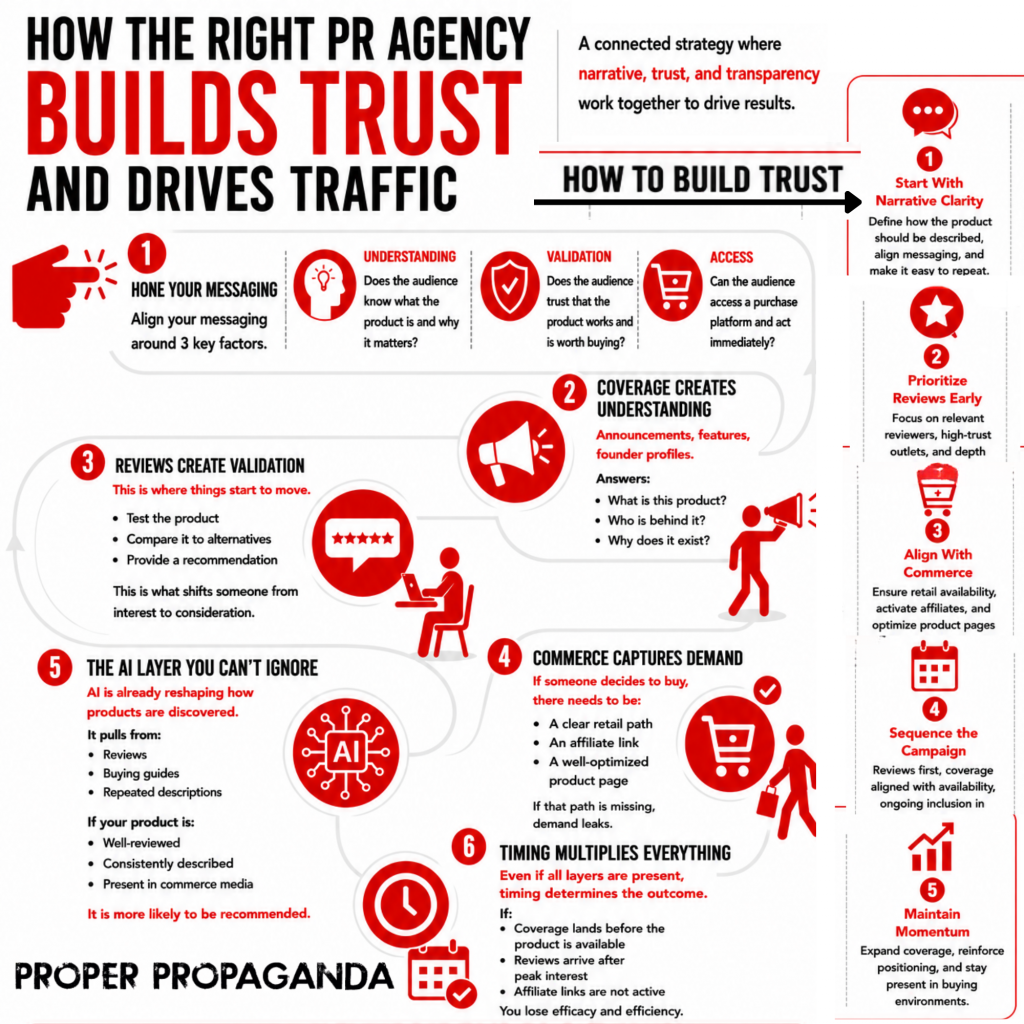
HOW TO HONE YOUR MESSAGING
The quality of coverage goes a long way toward building both credibility and consistency. These are the key factors to consider when aligning your messaging:
- Understanding
Does the audience know what the product is and why it matters
- Validation
Does the audience trusts that the product works and is worth buying
- Access
Can the audience access a purchase platform and act on that decision immediately
HOW TO PUT YOUR MESSAGING TO WORK
Not all media coverage serves the same purpose. Different types of content influence audiences at different stages of the decision-making process. Here’s a look at how coverage, reviews, commerce, and timing work together to drive results.
Coverage Creates Understanding
Announcements, features, founder profiles.
They answer:
- What is this product
- Who is behind it
- Why does it exist
Reviews Create Validation
This is where things start to move.
Reviews:
- Test the product
- Compare it to alternatives
- Provide a recommendation
This is what shifts someone from interest to consideration.
Without this layer, coverage feels incomplete.
Commerce Captures Demand
If someone decides to buy, there needs to be:
- A clear retail path
- An affiliate link
- A well-optimized product page
If that path is missing, demand leaks.
Timing Multiplies Everything
Even if all three layers are present, timing determines the outcome.
If:
- Coverage lands before the product is available
- Reviews arrive after peak interest
- Affiliate links are not active
You lose efficacy and efficiency.
| Layer | Purpose | What It Does | Risk If Missing |
| Coverage Creates Understanding | Introduces the brand, company, or product to the market. | Announcements, features, and founder profiles answer: What is this product? Who is behind it? Why does it exist? | Audiences lack context and awareness. The brand remains unfamiliar. |
| Reviews Create Validation | Builds trust and credibility. | Reviews test the product, compare it to alternatives, and provide recommendations. This is what moves people from interest to consideration. | Coverage feels incomplete. Prospective customers have no independent validation. |
| Commerce Captures Demand | Converts interest into revenue. | Creates a clear path to purchase through retail listings, affiliate links, and optimized product pages. | Demand leaks. Consumers decide to buy but encounter friction or purchase elsewhere. |
| Timing Multiplies Everything | Maximizes the effectiveness of every other layer. | Aligns coverage, reviews, retail availability, and affiliate activation around periods of peak interest. | Even strong coverage underperforms. Interest is generated before customers can act, reducing both efficiency and results. |
How to Build trust
1. Start With Narrative Clarity
Before outreach:
- Define how the product should be described
- Align messaging across all materials
- Make it easy to repeat
2. Prioritize Reviews Early
Focus on:
- Relevant reviewers
- High-trust outlets
- Depth over volume
This is your validation layer.
3. Align With Commerce
Before coverage lands:
- Ensure retail availability
- Activate affiliate programs
- Optimize product pages
This is your capture layer.
4. Sequence the Campaign
Do not stack everything at once.
Build momentum:
- Reviews first
- Coverage aligned with availability
- Ongoing inclusion in guides
5. Maintain Momentum
After launch:
- Expand coverage
- Reinforce positioning
- Stay present in buying environments
This is where compounding happens.
| Step | Objective | Key Actions | Why It Matters |
| 1. Start With Narrative Clarity | Create a consistent, repeatable story. | Define how the product should be described, align messaging across all materials, and make key points easy for media to repeat. | Strong narratives travel further and create consistency across coverage. |
| 2. Prioritize Reviews Early | Build trust and validation. | Focus on relevant reviewers, high-trust outlets, and in-depth evaluations rather than chasing volume. | Reviews provide the independent validation that influences buying decisions. |
| 3. Align With Commerce | Capture demand when it appears. | Ensure retail availability, activate affiliate programs, and optimize product pages before coverage lands. | Interest only creates revenue when there is a frictionless path to purchase. |
| 4. Sequence the Campaign | Build momentum strategically. | Lead with reviews, align broader coverage with product availability, and secure ongoing inclusion in buying guides and recommendation lists. | Proper sequencing amplifies results and prevents interest from being wasted. |
| 5. Maintain Momentum | Create long-term visibility. | Expand coverage, reinforce positioning, and remain visible in buying and discovery environments. | Sustained presence compounds awareness, trust, and purchase intent over time. |
The AI Layer You Cannot Ignore
AI is already reshaping how products are discovered.
It pulls from:
- Reviews
- Buying guides
- Repeated descriptions
If your product is:
- Well-reviewed
- Consistently described
- Present in commerce media
It is more likely to be recommended.