


The good news is, you’ve got options.
If you’ve made the calculation that showing up in the right way across relevant AI platforms and prompts there are several avenues you can explore.
Clients and prospects of ours commonly talk about four, and we’ve seen specific result-patterns repeat over time.
Option 1 – Manage GEO Internally (light)
This option involves pursuing a very limited generative engine optimization (GEO) program using aggregate data as a guide, and either homemade, cobbled together, or no monitoring software.
A company pursuing this option focuses on one or two channels – typically content or PR, in our experience – based on the fact that larger research studies have suggested these matters to AI search presence.
Pros:
- This is the cheapest option
- It can work if you guess right
What tends to happen:
- There is often either no or poor quality intelligence about opportunities and threats because of under-investment in monitoring. Changes in an LLM’s citation preference pattern go unnoticed until too late
- Any gains are tenuous and temporary, especially when bigger, better-funded competitors start taking GEO seriously.
- The strategy involves a narrow focus on one or two channels (when GEO involves at least four) making it akin to a trip to the casino
Option 2 – Manage GEO Internally (heavy)
The second path we see and hear about involves a client playing the quarterback role so essential to GEO. In this scenario they tend to either hire a 6-8 person team to manage GEO’s five core areas – PR, content, SEO, web architecture and metrics – or deal with 3-4 agencies as the hub in a hub and spoke management model.
Pros:
- As with all in-housing, the company can feel in control because its own people are in a central role
- It can work if your team has significant bandwidth and knowledge about GEO.
What tends to happen:
- Because GEO is a multi-channel realm the in-house team becomes stretched as there are a lot of people and teams to manage. Other activities and priorities can fall by the wayside.
- In the event hires go wrong, heavy costs are incurred.
Option 3 – Partner with a traditional PR agency
We’ve seen prospects assume that their existing traditional PR agency can fill the gap and handle GEO work as well. This belief has become more prevalent as the link between earned media’s impact on has been borne out by data.
Pros:
- This option typically means using an agency a company already knows.
What tends to happen:
- GEO is a multi-pronged realm. Agencies tend to gravitate towards what they know. PR agencies – especially those narrowly focused on media relations – tend to reduce GEO to only that. All the press in the world doesn’t fix bad web architecture or a lack of owned content for lower-funnel prompts.
- Absent a player that has the genuine reps in on GEO, who can see the whole field, opportunities are missed. If competitors are doing things well, you can be badly beaten.
Option 4 – Partner with an SEO agency:
This is another choice we’ve seen clients and prospects make. It stems from a belief that “GEO is the new SEO.” That is like saying a car is the new horse, or email is new Pony Express.
Pros:
- SEO is absolutely a key part of GEO.
What tends to happen:
- SEO agencies tend to have little to no capacity in terms of earned media. And journalistic sources are, in aggregate, the most scraped by LLMs. PR skills – especially those around targeting and messaging the right media – are at the core part of any program. Going with an SEO agency to do GEO is like asking an electrician to fix your toilet.
- The typical result for those who go with this option is strong optimization but weak authority signals, creating gaps that competitors can exploit.
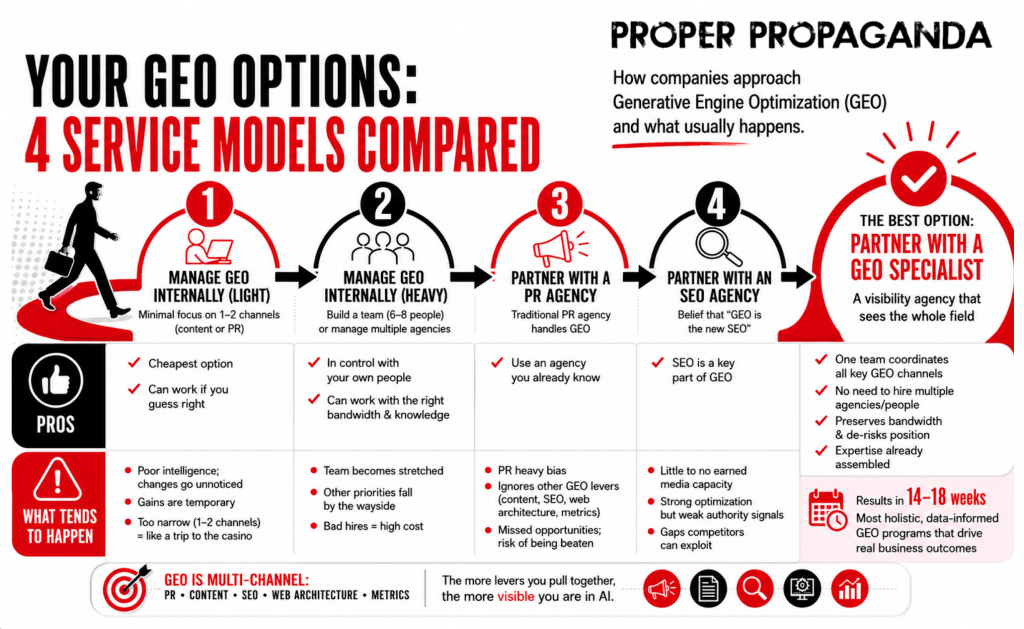
So what should you do? A final option
The final option is working with an agency that understands GEO as a distinct – but multi-input discipline – rather than treating it as an extension of PR or SEO. Firms that get this have typically come from specific backgrounds but been heavily transformed
They view GEO as the visibility challenge it is. They follow the data and let it guide them to the right realms to optimize for versus operating from a cookie-cutter template.
Pros:
- One team coordinates the channels that most influence AI visibility. The client has a central point of contact.
- The client doesn’t have to hire a bunch of agencies or people.
- Client-side bandwidth is preserved and the client’s position is de-risked
- Expertise is already assembled, reducing the need to build a GEO function from scratch.
What tends to happen:
This option tends to deliver results in about 14 to 18 weeks, which requires some internal selling by client-side staff. However, it produces the most holistic and data-informed GEO programs. The kind that tend to drive real business outcomes.
It is the most efficient because it reduces management overhead while increasing the odds that all the major GEO levers are being pulled to the degree they should be.
Options at a glance
| Approach | What it involves | Pros | What tends to happen |
|---|---|---|---|
| Manage GEO Internally (Light) | A limited in-house GEO effort using aggregate research, homemade or basic tools, and little or no monitoring. Typically focuses on one or two channels, usually content or PR. | • Lowest-cost option • Can work if you guess correctly | • Limited or no intelligence on opportunities and threats due to underinvestment in monitoring • Changes in LLM citation patterns often go unnoticed until too late • Any gains are usually temporary, particularly once larger competitors invest in GEO • Focusing on only one or two channels ignores the multi-channel nature of GEO, making success largely dependent on luck |
| Manage GEO Internally (Heavy) | Build a dedicated in-house GEO capability by hiring a 6–8 person team or coordinating 3–4 specialist agencies across PR, content, SEO, web architecture, and measurement. | • Greater sense of control • Can work if the organization has the expertise and bandwidth | • Managing multiple disciplines becomes resource intensive • Internal teams often become stretched, causing other priorities to suffer • Hiring mistakes are expensive and difficult to unwind • Considerable management overhead is required to coordinate all moving parts |
| Partner with a Traditional PR Agency | Extend an existing PR agency’s responsibilities to include GEO, based on the growing importance of earned media for AI visibility. | • Leverages an existing agency relationship • Strong media relations capability | • PR agencies often reduce GEO to earned media alone • Press coverage cannot compensate for poor web architecture, weak owned content, or inadequate measurement • Without expertise across all GEO inputs, important opportunities are missed • Competitors with more complete programs can outperform significantly |
| Partner with an SEO Agency | Treat GEO primarily as an evolution of SEO, focusing heavily on technical optimization and search visibility. | • SEO is an essential component of GEO | • SEO agencies typically have limited earned media capability • Journalistic sources remain among the most cited by LLMs, making PR a critical missing capability • Programs often produce strong optimization but weak authority signals • Competitors with stronger media authority gain an advantage |
| Partner with a Dedicated GEO Agency | Work with a specialist agency that treats GEO as a distinct, multi-input visibility discipline spanning PR, content, SEO, web architecture, and analytics. Programs are guided by data rather than channel bias. | • One team coordinates all major GEO channels • Single point of contact • No need to build a large internal team or manage multiple agencies • Preserves client bandwidth • Reduces execution risk through established expertise | • Requires patience, with meaningful results typically emerging in 14–18 weeks • Produces the most comprehensive and data-informed GEO strategy • Reduces management overhead while ensuring all major AI visibility levers are optimized • Tends to deliver the strongest long-term business outcomes. |