


Today, Founders are expected to represent themselves clearly, confidently, and consistently across a myriad of media environments.
The challenge is that most founders are not trained spokespeople. They are close to the product, deep in the details, and often trying to over communicate points that lack impact.
On top of that, today’s audiences increasingly trust individuals over institutions. A 2025 survey found direct communication from CEOs generates more trust than messages delivered through spokespeople or corporate channels.
We wanted to share our experience with readying founders for the spotlight. Over 15 years we have learned what makes someone quotable, and some of the mistakes we see over and over again when preparation is rushed or treated as an afterthought.
HOW YOU COMMUNICATE MATTERS
What you say is just as important as how you say it. People like certainty and clarity, a founder needs to be able to succinctly communicate the brand’s value propositions and priorities.
If a journalist walks away from your interview unable to explain what problem you solve, you have already lost.
Clear messaging is key. You need sharp language around:
- The problem you are solving
- How your solution is different from the ten others doing something similar
- Some kind of call to action (for example where someone can buy the product)
Every answer needs to get at one of these buckets. Effectively you need different ways of getting at the same three things throughout an interview.
If your message is vague, it will not survive the mental filter they apply. Concise messaging is the difference between interest and indifference.
YOU ARE SPEAKING TO MULTIPLE AUDIENCES
Interviews are meant to address an audience. The hard thign is you have multiple audiences as a Founder. Journalists are trying to understand how a product matters to their audience. Retail partners are assessing products’ potential for sales. Customers are deciding whether the brand is worth exploring as a solution to their problems.
So what tips do we have? Here are 10:
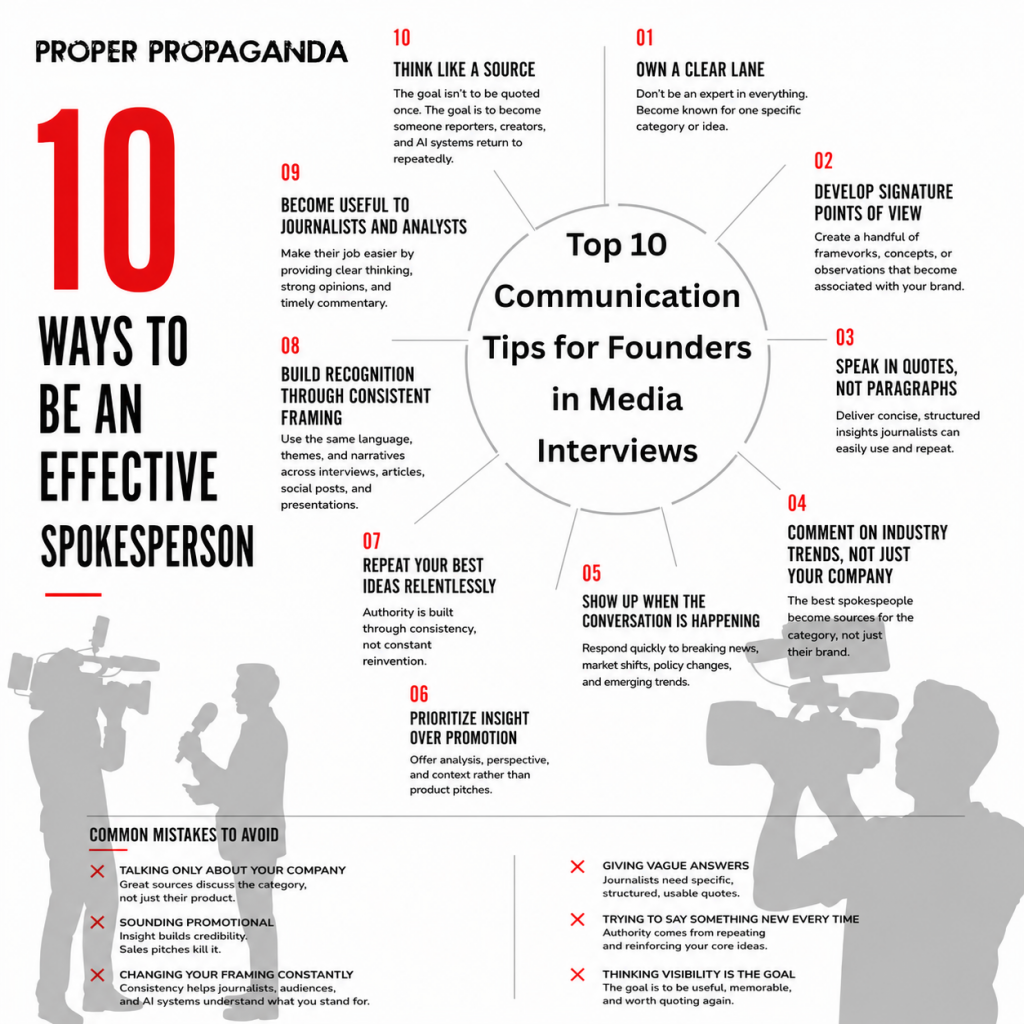
10 WAYS TO BE AN EFFECTIVE SPOKESPERSON
- Own a Clear Lane
Don’t be an expert in everything. Become known for one specific category or idea.
- Develop Signature Points of View
Create a handful of frameworks, concepts, or observations that become associated with your brand.
- Speak in Quotes, Not Paragraphs
Deliver concise, structured insights journalists can easily use and repeat. No answer needs to run more than 30-45 seconds.
- Comment on Industry Trends, Not Just Your Company
The best spokespeople become sources for the category, not just their brand.
- Show Up When the Conversation Is Happening
Respond quickly to breaking news, market shifts, policy changes, and emerging trends.
- Prioritize Insight Over Promotion
Offer analysis, perspective, and context rather than product pitches.
- Repeat Your Best Ideas Relentlessly
Authority is built through consistency, not constant reinvention.
- Build Recognition Through Consistent Framing
Use the same language, themes, and narratives across interviews, articles, social posts, and presentations.
- Become Useful to Journalists and Analysts
Make their job easier by providing clear thinking, strong opinions, and timely commentary.
- Think Like a Source
The goal isn’t to be quoted once. The goal is to become someone reporters, creators, and AI systems return to repeatedly.
There are also pitfalls to avoid.
COMMON MISTAKES TO AVOID
- Talking Only About Your Company
Great sources discuss the category, not just their product.
- Giving Vague Answers
Journalists need specific, structured, usable quotes.
- Sounding Promotional
Insight builds credibility. Sales pitches kill it.
- Trying to Say Something New Every Time
Authority comes from repeating and reinforcing your core ideas.
- Changing Your Framing Constantly
Consistency helps journalists, audiences, and AI systems understand what you stand for.
- Thinking Visibility Is the Goal
The goal is to be useful, memorable, and worth quoting again.
Why Communicating Your Brand Clearly Matters More in 2026
Getting your comms right is no longer just about media coverage and attention.
AI systems increasingly determine what gets surfaced, explained, and recommended. They rely on repeated citations, consistent positioning, and clear explanations that appear across multiple sources.
If a founder consistently communicates their company, category, and point of view in a way that is easy for journalists to understand and repeat, they become more likely to be quoted in articles, referenced by analysts, and included in AI-generated answers.
The way founders communicate with the media is no longer just shaping public perception. It is helping shape how AI systems understand, describe, and retrieve their company. Consistent messaging, clear positioning, and structured insights are becoming competitive advantages that extend far beyond a single interview or media placement.
The End Goal
The strongest founder spokespeople eventually reach a point where they are no longer chasing attention. They become the person journalists call, analysts cite, and AI systems retrieve whenever their category comes up.
That’s when thought leadership stops being a marketing activity and starts becoming a competitive advantage.