
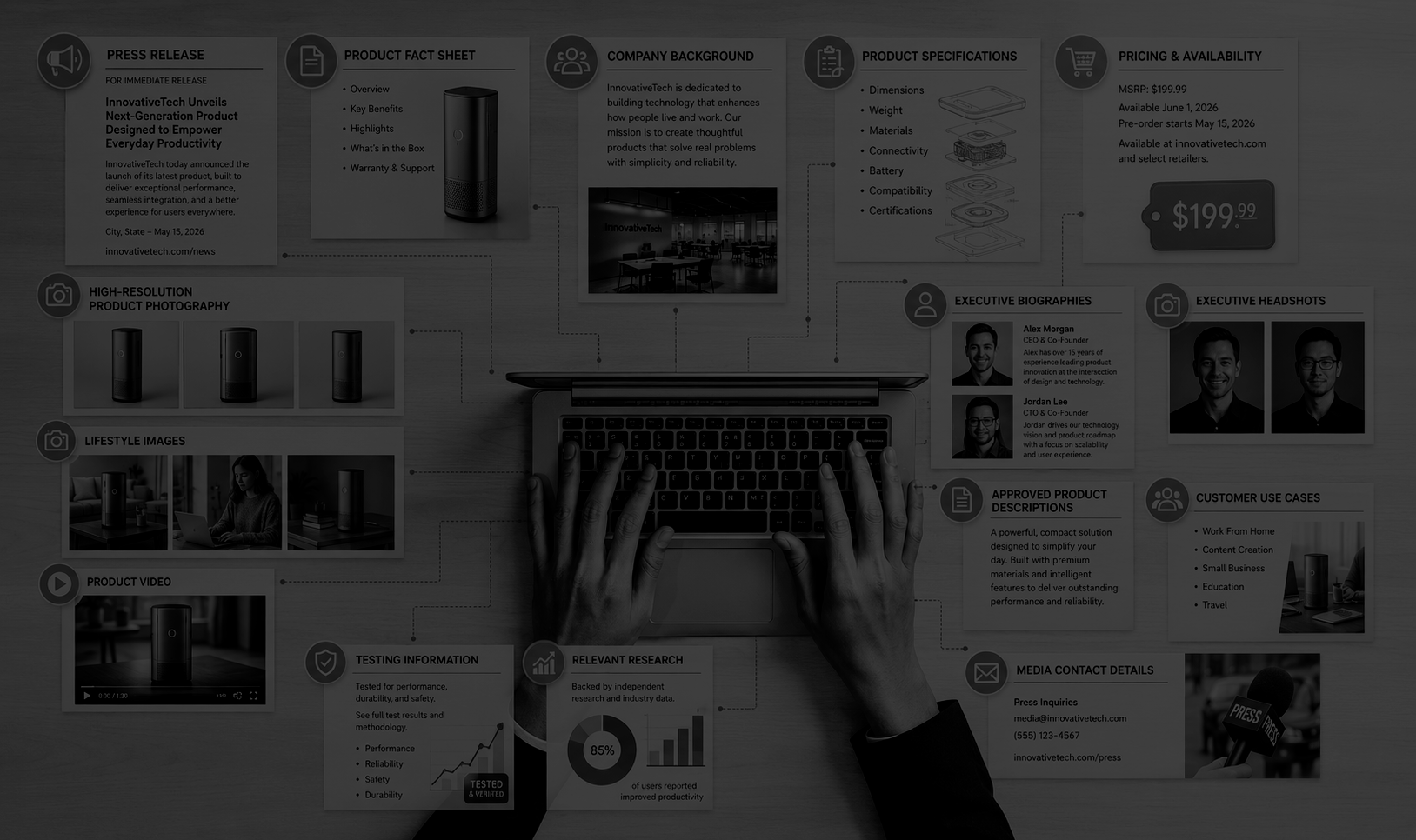

A well-built media kit reduces the amount of work required for journalists, reviewers, and creators to understand a product and cover it accurately.
The reality is most people covering consumer technology are working under pressure. They may be testing several products, filing against a deadline, or updating a buying guide that contains dozens of brands. They are unlikely to spend much time searching through old emails for a price, product dimension, or usable image.
Missing information creates friction. Friction leads to mistakes, delays, and sometimes no coverage at all.
A media kit should provide journalists, creators, reviewers, and AI systems with a single, reliable source for approved information, supporting evidence, and publication-ready assets. Not every brand needs every asset. The right media kit depends on the product, the company, the stage of the business, and the goals of the launch. Some brands may only require a handful of these materials, while others will benefit from a much more comprehensive selection.
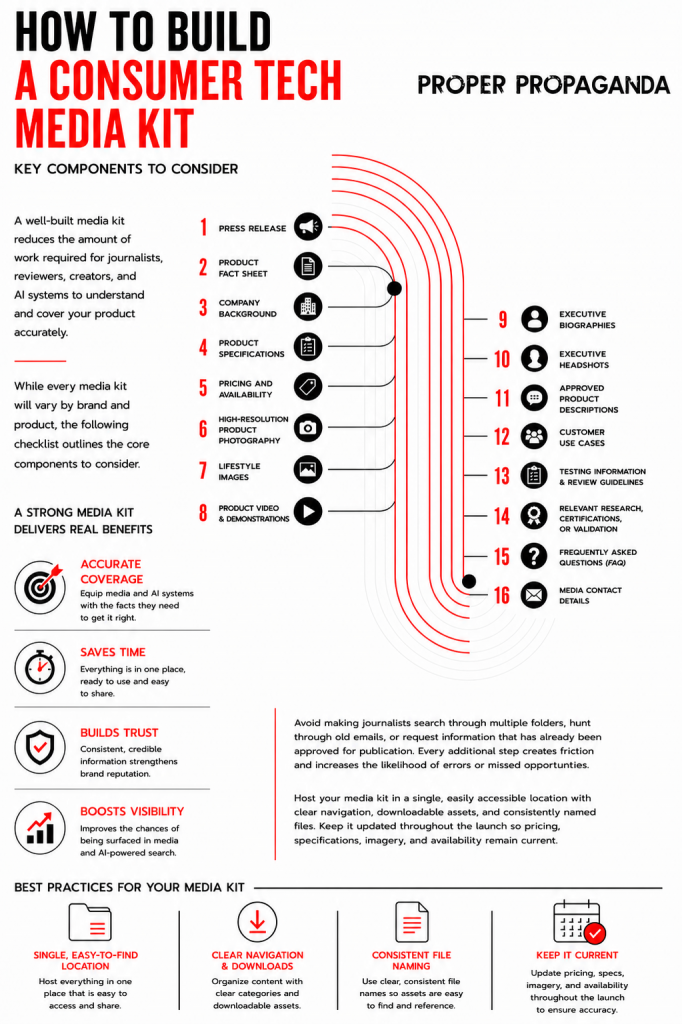
Press Release
The press release provides the official account of the launch. It should clearly state what is being announced, why the product matters, when it becomes available, and where customers can buy it.
Keep the language factual and easy to scan. Journalists should be able to understand the announcement without translating internal product terminology.
Product Fact Sheet
The product fact sheet is the quickest reference document in the kit. It should summarize the product’s main features, intended use, dimensions, compatibility, warranty, and other details a journalist may need to check while writing.
A good fact sheet is usually one or two pages. Its job is to make verification easy.
Company Background
The company background explains who the business is and why it has credibility in the category. Include the company’s location, founding information, relevant experience, market presence, and any facts that help explain its role in the launch.
Avoid turning this section into a corporate autobiography. Include what a journalist needs to place the product in context.
Product Specifications
Provide a complete and current list of technical specifications. Depending on the product, this may include dimensions, weight, battery life, charging time, materials, connectivity, operating requirements, and compatibility.
Check this document carefully before distribution. Specification errors are easily repeated across reviews, retail listings, search results, and AI-generated answers.
Pricing and Availability
State the recommended retail price, currency, release date, and launch markets. Include pre-order details, introductory pricing, subscription fees, optional accessories, or required add-ons when they affect the real cost of ownership.
Availability should be specific. “Coming soon” is rarely useful to someone preparing coverage.
High-Resolution Product Photography
Provide clean, high-resolution images showing the product from several useful angles. Include photographs on a plain background so editors can place them into layouts without extensive cropping or retouching.
Use descriptive filenames. A folder full of assets named “IMG_2048” creates unnecessary work and increases the chance that the wrong image will be published.
Lifestyle Images
Lifestyle photography shows the product being used in a realistic setting. The images should help a reader understand scale, context, and the type of customer the product was designed for.
Avoid images that feel staged beyond recognition. The product should remain the focus.
Product Video and Demonstrations
Video is useful when movement, setup, interface behaviour, or a physical result is difficult to explain with still images. Include short edited footage for quick reference and clean demonstration clips that outlets can use in their own content.
Every demonstration should accurately represent normal product performance. Disclose any unusual testing conditions.
Executive Biographies
Provide short biographies for executives or product specialists available for interviews. Focus on the experience that is relevant to the product, company, or category.
A journalist usually needs enough information to introduce the spokesperson and understand why their perspective is credible. A full career history is rarely necessary.
Executive Headshots
Supply recent, high-resolution headshots for every spokesperson named in the kit. Include both vertical and horizontal options when possible, along with clear usage permissions.
Make sure the photograph matches the person who will appear in interviews. Outdated headshots are surprisingly common.
Approved Product Descriptions
Prepare short and long descriptions of the product using agreed category language. These descriptions should explain what the product is, who it is for, and the main customer problem it addresses.
Consistency matters here. If the press release, website, and media kit describe the product in conflicting ways, coverage will do the same.
Customer Use Cases
Explain how the product fits into a customer’s life. Use cases should describe recognizable situations rather than repeat a list of features.
For example, a portable power station may support camping, remote work, or backup power during an outage. Each use case gives a journalist a clearer route into the story.
Testing Information and Review Guidelines
Give reviewers the information required to set up and test the product properly. Include charging requirements, firmware updates, companion apps, recommended testing periods, and any functions that require specific conditions.
Review guidelines should support accurate evaluation without attempting to dictate the conclusion. Reviewers need room to form their own opinion.
Relevant Research
Include research that helps explain the customer problem, market shift, or category opportunity behind the launch. Use credible original sources and provide enough detail for a journalist to verify every claim.
A statistic without a clear source is more likely to be removed than published.
Certifications and Independent Validation
List any relevant safety certifications, regulatory approvals, laboratory results, or independent validations. Provide links or supporting documents whenever possible.
Be precise about what each certification covers. A certification in one area should not be presented as proof of overall product quality.
Frequently Asked Questions
The FAQ should answer the practical questions most likely to arise during outreach. These may involve pricing, compatibility, privacy, repairability, warranty coverage, regional availability, or product limitations.
Update the FAQ as new questions appear. The best version is often shaped by real conversations with journalists and reviewers.
Media Contact Details
Include the name, email address, phone number, and time zone of the person handling media requests. Make it clear who can arrange interviews, provide review units, answer technical questions, or clarify image rights.
A generic contact form is a poor substitute during an active launch.
How to Organize the Media Kit
The full media kit should live in one easily accessible location.
Use clear folders for press materials, photography, video, executive information, product specifications, and research. File names should be descriptive and consistent so journalists can identify an asset before opening it.
Avoid expired download links and password protection unless there is a genuine need for access control. Every extra step reduces the likelihood that the kit will be used.
The media kit should also be treated as a live resource.
Pricing can change. Retail availability may expand. Firmware updates can affect product functions. New certifications may be approved after launch. Review the kit throughout the campaign and replace outdated files rather than leaving several conflicting versions in circulation.
This discipline has value beyond media relations.
Journalists, retailers, customers, search engines, and AI platforms may all encounter information produced from the same launch materials. Clear and consistent source information increases the likelihood that the product will be described accurately wherever it appears.
Bottom Line
A consumer tech media kit should make accurate coverage easy by giving journalists and reviewers immediate access to current facts, credible evidence, and usable assets.