

A practical framework for building the narrative, earning useful coverage, working with creators, and increasing visibility across search and AI platforms.
Introduction
A consumer tech product launch used to have a fairly recognizable shape.
Write a press release. Brief a handful of technology journalists. Send review units. Coordinate the announcement under embargo. Hope the coverage lands at roughly the same time.
Those activities still have value, however they no longer cover the full path a customer takes before buying a technology product.
Customers may discover a product through a creator, investigate it through reviews, compare it in a buying guide, check Reddit for unfiltered opinions, and ask ChatGPT or Perplexity whether it is worth buying. The sources influencing the purchase may sit well outside the traditional technology press.
Today’s consumer tech product launch has to account for that wider information environment.
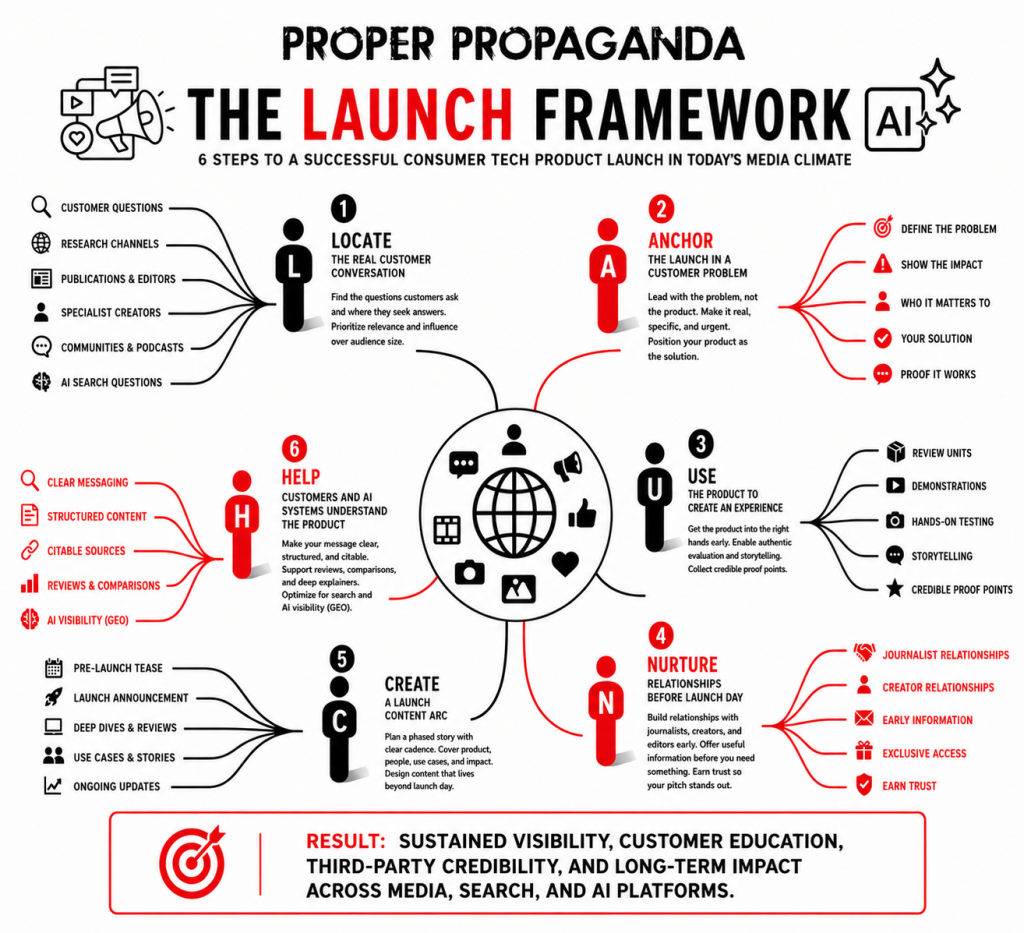
This guide explains how to do it using the LAUNCH framework:
L: Locate the real customer conversation
A: Anchor the launch in a customer problem
U: Use the product to create an experience
N: Nurture relationships before launch day
C: Create a launch content arc
H: Help customers and AI systems understand the product
The framework is designed to turn a product announcement into a sustained program of customer education, independent evaluation, media visibility, and commercial opportunity.
What Should A Consumer Tech Product Launch Look Like?
A consumer tech product launch involves the strategic use of earned media, product reviews, creator relationships, brand narrative, and supporting content to introduce a technology product to the market.
A successful launch helps customers understand what a product does, why it matters, and whether it belongs in their lives.
For technology products, this work often includes:
- Product positioning and brand narrative
- Media and audience research
- Journalist and creator outreach
- Review-unit programs
- Product demonstrations and testing experiences
- Press materials and digital media kits
- Buying-guide and commerce-media outreach
- Influencer relations
- Search and Generative Engine Optimization
- Post-launch media development
Generative Engine Optimization, commonly called GEO, is the practice of increasing a brand’s visibility within AI-generated answers from platforms such as ChatGPT, Perplexity, Gemini, and Google AI Overviews.
GEO & PR have become relevant to product launches because AI platforms increasingly participate in product research. The reviews, comparisons, articles, buying guides, and other earned media sources created around a launch may influence how AI systems understand and recommend the product later.
Your Consumer Tech Launch Strategy Matters
Consumer technology is crowded, and novelty has a short shelf life.
Competitors can reproduce features. Product specifications converge. Journalists who cover a category repeatedly become harder to impress.
The launch period is one of the few moments when a brand has a legitimate reason to command attention. That brief window of awareness has to create something that lasts.
Useful launch coverage can create third-party credibility, support retail conversations, give sales teams independent proof, improve search visibility, and contribute to the information sources AI platforms consult when answering product questions.
Poor launch planning tends to produce a short burst of attention followed by silence.
Good launch planning creates material the market can continue discovering and using.
The LAUNCH Framework for Consumer Tech Product Launches
L: Locate the Real Customer Conversation
The first stage is audience research.
Do not begin by opening an old media list. Instead work on identifying how customers research the category.
A smart running watch may belong to a consumer technology beat, but serious runners may rely more heavily on running podcasts, training channels, race newsletters, specialist publications, and endurance athletes.
A robot lawn mower may attract technology coverage while also being relevant to gardening publications, smart-home reviewers, home-improvement creators, and communities focused on lawn care.
The category assigned to the product inside the company may not reflect the information ecosystem surrounding the customer.
Step 1: List the questions customers ask
Start with the basic research journey.
What is the product?
What problem does it solve?
Does it work?
How does it compare with existing products?
Who is it designed for?
Is it worth the price?
What are its weaknesses?
These questions should shape the launch program because they reveal what information customers need before buying. They also directly correlate with the questions consumers are asking AI search platforms.
Step 2: Identify where customers seek each answer
Map every important question to likely sources.
| Customer question | Likely information source | Potential launch target |
| What is this product? | Technology news, social media, search | Technology journalists, news editors, creators |
| Does it work? | Product reviews, YouTube, Reddit | Reviewers, specialist creators, community voices |
| Is it suitable for me? | Niche publications, podcasts, newsletters | Category experts and specialist media |
| How does it compare? | Buying guides, comparison pages, AI search | Commerce editors, reviewers, authoritative websites |
| Is it worth the price? | Reviews, forums, deal content | Commerce media and customer communities |
Step 3: Prioritize influence over audience size
A large publication may create broad awareness. A specialist reviewer may have more influence over the customers most likely to buy.
Reach is useful. Relevance determines whether the attention matters.
The launch list should reflect the customer’s information habits rather than the PR team’s existing relationships.
GEO consideration
Reviews and comparisons can influence customers directly while contributing to the wider source environment used by AI platforms.
Ask whether each target can help explain the product clearly enough to remain useful after the initial launch period.
Launch output
Create an audience-source map containing:
- Priority customer questions
- Research channels
- Relevant publications
- Journalists and editors
- Specialist creators
- Podcasts and newsletters
- Customer communities
- AI search questions related to the category
A: Anchor the Launch in a Customer Problem
Many launch pitches begin with the product.
“Company X today announced Product Y, featuring Technology Z.”
The sentence records an event. It does not necessarily create an interesting story.
Customers rarely wake up wanting a new specification. They want to improve something, solve something, avoid something, or accomplish something.
The launch narrative should begin there.
Step 1: Define the customer situation
Write a plain-language description of the problem.
Avoid product terminology during this exercise.
For an electric spin scrubber, the problem may involve the bending, reaching, kneeling, and repetitive effort required to deep-clean a bathroom.
For a portable power station, the problem may involve maintaining access to essential electricity during travel or an outage.
For a fitness wearable, the problem may involve turning large amounts of health and training data into useful decisions.
If the problem cannot be explained without describing the product, the narrative probably needs more work.
Step 2: Explain where current solutions fall short
Journalists need context.
Why has the problem persisted?
Why have existing products failed to address it adequately?
What has changed in customer behaviour, technology, price, or market conditions?
This establishes the reason the product deserves attention now.
Step 3: Introduce the product’s approach
Explain how the product changes the customer’s experience.
Technical specifications should support the explanation.
Consider an electric spin scrubber with six cleaning heads and 2.5 Nm of torque.
Those specifications may establish capability. The story is that the product was designed to reduce some of the physical effort involved in deep-cleaning difficult spaces.
The specifications become evidence.
Step 4: Test the narrative against real customer questions
Search behaviour is often conversational.
Potential customers may ask:
- Are electric spin scrubbers worth buying?
- What is the best way to clean a shower without bending?
- What should I look for when buying an electric scrubber?
- Can an electric scrubber reduce the physical effort involved in cleaning?
A launch narrative should contain useful answers to the questions customers already ask.
Launch output
Prepare a one-page narrative brief containing:
- The customer problem
- Why the problem matters
- The weakness in current solutions
- The product’s approach
- Supporting proof
- Real-world customer consequences
- Relevant category language
- Priority customer questions
U: Use the Product to Create an Experience
A product briefing explains what the product does.
A meaningful test gives a journalist or creator something to investigate.
Product journalism has become increasingly experiential. Reviewers test devices in their homes, compare results, document personal use, and make recommendations based on observed performance. Brands should plan for that reality.
LTK’s 2025 research found that 73% of Gen Z consumers and 57% of Millennials rely on creators when making purchase decisions.
Step 1: Identify what can be tested
Ask:
What can the reviewer accomplish?
What change can be observed?
Which product claim can be independently evaluated?
How much time is required for a fair test?
The answers should influence who receives the product and when review units are distributed.
Step 2: Match the experience to the product
| Product | Basic activation | More useful testing experience |
| Robot lawn mower | Product briefing | Maintain a difficult section of lawn over an extended period |
| Portable power station | Standard review unit | Use it during travel without household electricity |
| Smart lighting system | Feature demonstration | Test a room setup designed around sleep or entertainment |
| Fitness wearable | Feature walkthrough | Use its recommendations during a training cycle |
| Electric cleaning tool | Attachment demonstration | Evaluate changes in cleaning time or physical effort |
| Translation device | Controlled demonstration | Use it during real travel situations |
The experience should make sense for the journalist’s format and audience.
Step 3: Protect editorial independence
A testing experience should not come with an expected conclusion.
Reviewers need room to identify weaknesses, compare alternatives, and decide whether the product delivers on its claims.
Credibility depends on independence.
The purpose of the activation is to make a serious evaluation possible.
GEO consideration
Experience-led reviews often contain information absent from launch announcements:
- Real-world applications
- Testing observations
- Product limitations
- Customer suitability
- Competitive comparisons
- Purchase considerations
Those details can make the coverage more useful to customers and more relevant to AI-generated product answers.
Launch output
Develop a product-experience brief covering:
- The proposed use case
- Claims available for independent testing
- Recommended testing period
- Necessary product support
- Relevant customer questions
- Safety or disclosure requirements
N: Nurture Relationships Before Launch Day
Launch outreach works better when the research begins early.
A journalist should not receive a generic pitch because their name appeared in a media database.
The team should understand what the person covers, how they cover it, and why the product may be relevant to their audience.
60 to 90 days before launch
Identify priority journalists, reviewers, creators, podcasts, newsletters, and communities.
Read recent work.
Subscribe to relevant newsletters.
Review previous product coverage.
Document recurring interests and preferred formats.
Identify potential objections to the product.
30 to 60 days before launch
Begin background conversations where appropriate.
Offer access to company leadership or product experts when there is a useful discussion to have.
Ask select contacts what customers in the category currently care about.
Determine whether important product claims require more proof.
Confirm which reviewers need extended testing time.
During launch month
Personalize outreach around demonstrated relevance.
Explain why the product may matter to the person’s audience.
Offer appropriate access.
Provide enough time for meaningful evaluation.
Make supporting materials easy to use.
The objective is to understand the media community well enough to make a relevant contribution.
Launch output
Create a relationship tracker containing:
- Recent relevant coverage
- Audience profile
- Preferred content format
- Category interests
- Potential story angle
- Product-testing requirements
- Outreach history
- Launch timing
C: Create a Launch Content Arc
Announcement day receives too much attention in many launch plans.
A product can support multiple stories. Those stories do not need to appear at once.
Treat the launch as an editorial arc with distinct phases.
Phase 1: Explain the category problem
Before launch, create useful context.
Why does the problem matter?
How are customer expectations changing?
Where are current products falling short?
This phase can support category education, research stories, executive commentary, and background conversations.
Phase 2: Explain why the product was created
The origin story may reveal customer insight, design decisions, engineering challenges, or a market gap.
Use the parts that help people understand the product.
Avoid turning the founder’s biography into the entire story unless it genuinely explains the product’s relevance.
Phase 3: Announce the product
The launch announcement should provide verified information.
Include:
- Product name
- Customer problem
- Primary use case
- Meaningful differentiation
- Important specifications
- Pricing
- Availability
- Supporting evidence
- Images and product assets
- Media contact information
Phase 4: Support independent evaluation
Allow reviews and creator experiences to add evidence.
This phase may produce product tests, demonstrations, comparisons, tutorials, and longer-term assessments.
Phase 5: Extend into commerce and customer research
After launch, pursue opportunities that influence purchase decisions over a longer period.
These may include:
- Buying guides
- Best-product roundups
- Comparison articles
- Seasonal recommendations
- Gift guides
- Long-term reviews
- Category explainers
- Use-case features
Some of the most commercially valuable coverage appears after the launch-day news cycle.
Launch output
Build a six-month editorial calendar containing:
- Pre-launch category stories
- Announcement activity
- Review timing
- Creator content
- Executive commentary
- Commerce opportunities
- Seasonal hooks
- Follow-up product stories
H: Help Customers and AI Systems Understand the Product
A launch creates a large amount of information.
That information should be clear, consistent, accessible, and useful after announcement day.
If the press release uses one category description, the product page uses another, and executive interviews introduce several new claims, the market receives a fragmented picture.
If AI is confused, so is the consumer. We now know that consumers arriving at retail websites through AI platforms generated 53% more revenue per visit than visitors arriving through non-AI sources. In today’s media landscape its imparative to be crystal clear on on all consumer facing fronts.
Step 1: Establish consistent category language
Decide how the product should be described.
Use language customers understand.
Document approved terminology for:
- Product category
- Customer problem
- Primary use case
- Product differentiation
- Important features
- Evidence and proof points
Consistency improves recognition. It should not turn every piece of content into identical copy.
Step 2: Build content around customer questions
Create durable resources that answer common research questions.
Potential topics include:
- What does the product do?
- Who is it designed for?
- How does the technology work?
- What should customers consider before buying?
- How does the product compare with other approaches?
- Which use cases are most relevant?
- What limitations should customers understand?
These pages can support customers, journalists, search engines, and AI platforms.
Step 3: Monitor how AI platforms describe the product
Review relevant prompts before and after launch.
Examples include:
“What are the best products in this category?”
“What should I look for when buying this type of product?”
“Which product is best for this use case?”
“How does Product A compare with Product B?”
Document whether the brand appears, how accurately it is described, and which sources are cited.
AI visibility should be evaluated over time. A single prompt does not provide a complete picture.
Launch output
Create an AI search and content tracker containing:
- Priority customer prompts
- Brand visibility
- Product-description accuracy
- Competitor visibility
- Cited sources
- Missing information
- Content opportunities
What Should Be Included in a Consumer Tech Launch Media Kit?
A useful media kit reduces the amount of work required to cover the product accurately.
Items to consider including:
- Press release
- Product fact sheet
- Company background
- Product specifications
- Pricing and availability
- High-resolution product photography
- Lifestyle images
- Product video
- Executive biographies
- Executive headshots
- Approved product descriptions
- Customer use cases
- Testing information
- Relevant research
- Media contact details
Avoid making journalists search through multiple folders or request basic information already approved for publication.
The media kit should be easy to navigate and updated when product information changes.
How Far in Advance Should Consumer Tech Launch PR Begin?
For most meaningful consumer tech launches, planning should begin at least 90 days before announcement day.
Products requiring extended testing may need a longer runway.
A practical schedule may look like this:
| Timing | Priority |
| 90 or more days before launch | Research, narrative development, audience mapping |
| 60 to 90 days before launch | Relationship development, media planning, asset creation |
| 30 to 60 days before launch | Product seeding, briefings, creator coordination |
| Final 30 days | Personalized outreach, embargo activity, launch preparation |
| Launch week | Announcement, media support, monitoring |
| First 90 days after launch | Reviews, buying guides, follow-up stories, GEO monitoring |
Launching too late creates predictable problems.
Reviewers lack testing time. Assets arrive unfinished. Product claims remain unsupported. Outreach becomes generic because there is no time for proper research.
How to Measure a Consumer Tech Product Launch
Coverage volume provides only a partial view.
Measurement should reflect the business purpose of the launch.
Relevant indicators may include:
- Coverage quality
- Product-review volume
- Message inclusion
- Share of voice
- Referral traffic
- Product-page visits
- Retail interest
- Buying-guide inclusion
- Affiliate performance
- Search visibility
- Branded search activity
- AI recommendation visibility
- Accuracy of AI-generated product descriptions
Set measurement priorities before outreach begins.
A launch designed to support retail expansion should not be evaluated using the same criteria as a launch focused on category education.
Common Consumer Tech Product Launch Mistakes
Starting with the media list
The media list should follow audience research.
Without that work, brands tend to overinvest in familiar technology publications while overlooking specialist sources with stronger customer influence.
Leading with specifications
Specifications are useful evidence.
The customer problem provides the context that makes them meaningful.
Sending review units too late
A serious review takes time.
Late product delivery encourages shallow coverage or removes the possibility of launch-day evaluation entirely.
Treating every journalist the same
A commerce editor, technology reporter, specialist reviewer, and podcast host have different audiences and formats.
The outreach should reflect those differences.
Concentrating the entire campaign on launch day
Announcement coverage fades quickly.
Reviews, comparisons, buying guides, creator content, and category education can extend the commercial life of the launch.
Ignoring AI search visibility
Customers are using AI platforms during product research.
Brands should understand how they appear in those conversations and which sources shape the answers.
The Signal
Customer research is spreading across more sources. Media, creators, communities, commerce content, search engines, and AI platforms now participate in the same purchase journey.
Product experience is becoming more important to coverage. Reviewers need enough access and time to evaluate products in realistic conditions.
Launch content has a longer life than launch news. Useful reviews, comparisons, and buying guides can continue influencing customers after announcement coverage has faded.
Consumer Tech Product Launch FAQ
When should PR begin for a consumer tech launch?
Planning should generally begin at least 90 days before launch. Products requiring extensive testing, complex demonstrations, or large creator programs may require more time.
Does every product launch need a press release?
A press release is useful when there is a clear announcement that requires an official public record. The release should support the wider launch program rather than carry the entire communications strategy.
How many journalists should receive review units?
There is no useful universal number. Review units should go to journalists and creators whose audiences, formats, and category expertise justify the cost and available inventory.
Should product reviews appear on launch day?
Launch-day reviews can create momentum, but timing should not compromise the quality of the evaluation. Some products require longer testing periods.
How does PR support AI search visibility?
Earned media can create credible third-party information about a product. Reviews, comparisons, buying guides, and category explanations may contribute to the sources AI platforms use when generating product answers.
What is the most important part of a consumer tech launch?
The narrative is foundational. Customers and media need a clear explanation of the problem, the product’s relevance, and the evidence supporting its claims.
Bottom Line
A consumer tech product launch in today’s media landscape is multifaceted. Success requires creating useful information and credible, independent evidence across the channels customers use to research products, including traditional media, creator platforms, commerce content, search engines, and AI platforms.
What To Do Next
- Build an audience-source map around real customer research behaviour.
- Develop a customer-centred launch narrative before preparing outreach materials.
- Create a launch arc that continues through reviews, commerce coverage, customer education, and AI search monitoring.
Proper Propaganda works with consumer technology companies on product launch strategy, brand narrative, earned media, performance PR, AI search visibility and influencer relations.