
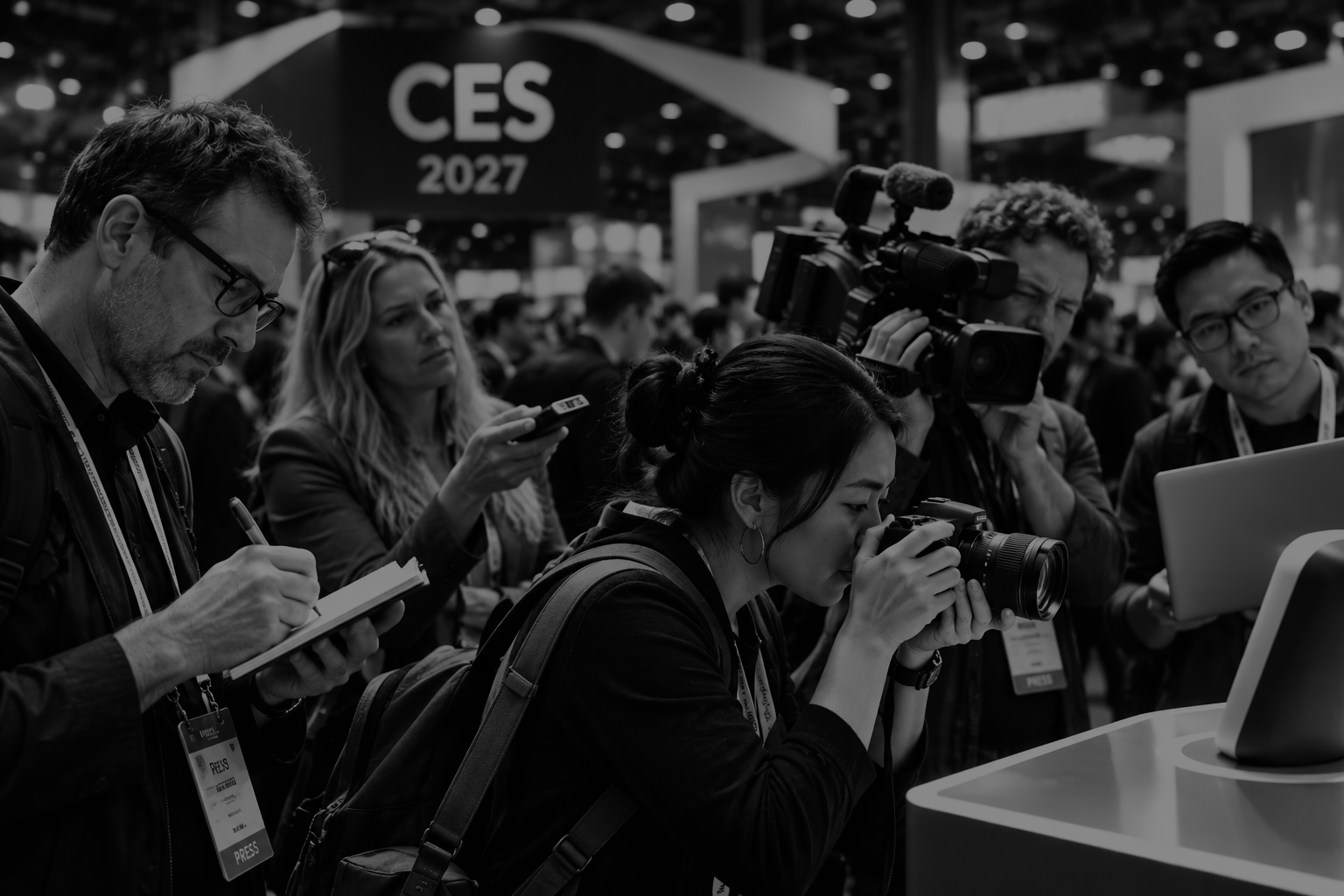

CES 2027 can generate valuable product reviews long after the exhibition closes. For technology brands, the opportunity is to turn short journalist demonstrations in Las Vegas into hands-on product testing, independent reviews, buying-guide placements and, where appropriate, affiliate-driven sales.
CES takes place January 6–9, 2027. During those four days, journalists will encounter hundreds of products, many of which they’ll have only a few minutes to evaluate.
A good demonstration might generate initial interest. Getting a product onto a journalist’s testing schedule requires considerably more work.
At Proper Propaganda, we approach CES product reviews as part of a longer media relations strategy that begins before the show and continues well into the following months.
The preparation matters because independent product reviews can influence purchasing decisions, retail visibility and, increasingly, how technology brands appear in AI-generated product recommendations.
Here’s how I’d approach it.
1. Identify Review Opportunities Before CES
The most useful media targets aren’t necessarily the publications with the largest audiences.
A technology brand selling keyboards, smart home devices or consumer electronics should prioritize journalists who regularly test those categories and publish reviews, comparisons and buying guides.
Before CES, your PR agency should identify:
- Journalists and reviewers covering your specific product category.
- Publications producing hands-on reviews and product comparisons.
- Buying guides where the product could eventually qualify.
- Affiliate-supported publishers with relevant audiences.
- YouTube creators and other independent product reviewers.
The distinction matters. A reporter covering breaking CES announcements may have little interest in conducting a six-week product evaluation.
I’d also look at which journalists have reviewed competing products over the previous year. Their coverage provides a useful indication of editorial interests, testing criteria and the kinds of product claims they’re likely to scrutinize.
For example, a company launching a new mechanical keyboard should know which reviewers regularly evaluate switch feel, build quality, connectivity, latency and ergonomics. A smart home company should identify journalists interested in interoperability, privacy and reliability.
That research makes the eventual pitch more relevant.
Muck Rack’s State of Journalism research has consistently identified irrelevant pitches and overly promotional outreach as major frustrations for journalists. Its 2026 survey reported that 88% of respondents disregard pitches outside their coverage area, while 71% reject pitches they consider overly promotional.
The objective is to identify a manageable list of journalists with a demonstrated interest in evaluating products like yours.
We cover the broader media targeting process in CES Media Relations: 5 Ways to Get Media Coverage at CES With or Without a Booth.
2. Turn CES Demonstrations Into Review Commitments
A short CES demonstration should give journalists enough information to decide whether the product warrants further testing.
That requires a working product, a clear explanation of its differentiating features and an honest account of what is ready for evaluation.
Your team should be prepared to answer:
- What does the product do, and what problem does it solve?
- How does it compare with existing alternatives?
- What does it cost?
- When can consumers buy it?
- Is a production-ready review sample available?
- How long can a journalist keep the product for testing?
Where possible, let journalists experience the product rather than watch a lengthy presentation.
A mechanical keyboard manufacturer might allow a journalist to compare switch types. A portable monitor brand might demonstrate screen brightness and connectivity. A smart home company should be prepared to show its product working in a realistic environment.
A demonstration should also establish what the journalist would learn from a longer evaluation. That might involve battery life, durability, compatibility, performance under everyday conditions or comparisons with competing products.
If the journalist expresses interest, establish the next step while the conversation is fresh.
Record the product requested, delivery address, expected sample availability and any technical questions that need answering.
I’d distinguish between three levels of interest:
| Journalist response | Recommended action |
| General interest | Send relevant product information and maintain the relationship |
| Sample requested | Confirm shipping details and allocate a review unit |
| Testing planned | Confirm delivery, support requirements and the likely evaluation window |
A sample request is encouraging, but it shouldn’t be recorded as a confirmed published review.
The objective is to leave CES with identifiable review opportunities, rather than a collection of business cards and vague expressions of interest.
For additional preparation considerations, see The 4 Pillars of a Successful CES 2027 PR Strategy.
3. Have Review Samples Ready to Ship
This is where otherwise promising CES campaigns frequently lose momentum.
A journalist agrees to test the product, but samples won’t be available for another two months. By then, the editorial calendar may have moved on.
Before the show, confirm:
- The number of review samples available.
- Whether samples are production-ready.
- Which countries can receive them.
- Shipping dates, costs and customs requirements.
- Setup instructions and technical support.
- Firmware or software limitations.
- Sample return arrangements.
Maintain a centralized sample tracker recording the journalist, publication, product, shipping status, delivery confirmation and follow-up date.
I’d also recommend reserving a portion of the available inventory for journalists who express interest during CES. Otherwise, samples can disappear into sales demonstrations, partner requests and other internal priorities.
A sample should arrive with everything necessary to evaluate the product properly, including accessories, setup instructions and access to technical support.
The agency should understand whether the sample is a loan or a unit the journalist may retain, and follow the publication’s policies.
For international brands, shipping deserves particular attention. Customs documentation, battery restrictions, duties and delivery delays can complicate sample distribution, especially when products are being shipped from Asia to North American or European journalists.
There should also be a clear process for replacing defective units. A journalist who encounters a technical problem needs access to someone who can help resolve it without attempting to influence the review.
Our CES 2027 PR budget guide covers why product samples, shipping and post-show follow-up should be included in the campaign budget from the beginning.
4. Follow Up With Journalists After CES
Journalists return from CES to crowded inboxes and substantial backlogs.
Your follow-up needs to be useful and specific.
Within the first few working days after the show, prioritize journalists who requested samples or expressed a clear interest in reviewing the product.
Confirm availability, provide the relevant technical materials and establish the next step.
Avoid sending every journalist the same generic CES recap.
A sensible follow-up sequence might look like this:
| Timing | Recommended action |
| During CES | Record review interest and confirm sample requirements |
| First week after CES | Follow up with interested journalists and arrange shipments |
| Weeks 2–4 | Confirm delivery, provide technical support and answer questions |
| Following months | Track review progress and respond to editorial requests |
Review timelines vary by publication and product category. A complex product may require several weeks of testing.
There is also a difference between a journalist agreeing to consider a product and a publication committing to publish a review.
I’d distinguish those stages in the reporting.
For example, if 30 journalists express interest, 18 request samples and 12 ultimately publish reviews, the campaign has produced several different outcomes worth tracking.
That information can help the agency understand which publications, product categories and outreach approaches are producing results.
Once a journalist has the product, give them the space to evaluate it independently. Persistent requests for publication dates or favourable conclusions rarely improve the relationship.
5. Target Buying Guides and Comparison Articles
Individual product reviews are useful, but buying guides can create a longer commercial opportunity.
Think about the types of questions customers ask when they’re ready to purchase:
- What are the best mechanical keyboards for work?
- Which smart home devices are worth buying?
- What are the best portable monitors for travel?
- Which wireless headphones offer the best value under $200?
Publications frequently maintain and update these articles as products are tested and new models become available.
Your PR agency should identify relevant buying guides, understand their testing criteria and establish relationships with the journalists responsible.
A product may first receive a standalone review and subsequently be considered for a category recommendation or comparison article.
The process can take months, particularly when publications maintain testing queues or require comparisons with several competing products.
I’d also distinguish between evergreen buying guides and seasonal commerce opportunities.
An evergreen guide might recommend the best ergonomic keyboards for office workers. A seasonal article could cover holiday gifts, back-to-school technology or Black Friday deals.
For a brand launching at CES in January, the following months can create opportunities to enter both types of coverage.
These placements can be commercially useful because they reach readers who are actively evaluating purchase options.
Inclusion remains an editorial decision. The product needs to earn its place through independent evaluation.
Buying guides also have potential value for Generative Engine Optimization (GEO), since third-party product comparisons may be retrieved or cited by AI search systems answering purchase-related questions.
Our GEO buyer journey framework explains how AI influences customers across discovery, evaluation, validation and purchase.
6. Understand Affiliate Opportunities
Many consumer technology publications operate affiliate commerce programs.
When readers purchase products through eligible links, the publisher may receive a commission.
For brands, affiliate participation can make it easier for commerce teams to monetize product recommendations, particularly when the product is already available through established retailers.
Before CES, confirm:
- Whether the brand has an affiliate program.
- Which affiliate networks or retail partners are supported.
- Whether products have functioning purchase links.
- Whether inventory and pricing are stable.
- Whether the brand can provide accurate product feeds and commercial information.
- Whether affiliate sales and referrals can be measured.
Affiliate participation doesn’t guarantee coverage or favourable reviews. Editorial decisions should remain independent of commercial arrangements.
It is also worth understanding how individual publications organize their editorial and commerce operations. Some have separate teams responsible for product testing and affiliate relationships.
For technology brands, the opportunity is strongest when a product has already demonstrated its relevance to a publication’s audience.
A favourable independent review, combined with reliable availability and appropriate commerce infrastructure, can support sales well beyond CES.
The commercial infrastructure matters here. A publication may be interested in recommending a product but have limited options if it isn’t available through a supported retailer or affiliate network.
I’d encourage brands to resolve these questions before CES rather than trying to establish an affiliate program after the reviews begin appearing.
7. Product Availability Matters More Than Many Brands Realize
There’s a substantial difference between generating interest in a product and giving readers a way to buy it.
Journalists may cover prototypes and products that won’t ship for months. But reviews, buying guides and commerce coverage generally become more useful when pricing and availability are established.
Before pursuing post-CES reviews, confirm:
- Final retail pricing.
- Product availability dates.
- Supported markets and retailers.
- Purchase and product information pages.
- Inventory and fulfilment arrangements.
- Any regional product differences.
For a startup still finalizing manufacturing, it may make sense to prioritize announcement coverage at CES and pursue reviews closer to commercial availability.
This is particularly important for products seeking inclusion in buying guides. A journalist may like the product but hesitate to recommend something readers cannot purchase.
Availability can also influence the commercial performance of coverage.
A product review that links to an unavailable item may generate awareness without creating an immediate sales opportunity. By the time inventory arrives, the initial interest may have diminished.
For brands selling through Amazon, Best Buy or other retailers, the PR team should coordinate with sales and e-commerce teams to ensure product pages, pricing and inventory are accurate.
If availability changes, communicate that information promptly to journalists who have received samples.
For companies evaluating whether the investment makes commercial sense in the first place, our broader CES PR resources address media relations, launch preparation and budgeting.
8. Product Reviews Can Influence AI Search Visibility
There is another reason to think beyond the initial CES announcement.
Independent product reviews, comparisons and buying guides contribute to the information available about a brand across the web.
That matters as consumers increasingly use AI systems to research products, compare alternatives and make purchasing decisions.
Muck Rack’s October 2026 What Is AI Reading? study found that more than 84% of citations in AI-generated answers came from earned and third-party sources, including journalism, academic research, encyclopedic sources and third-party corporate websites.
Journalism accounted for approximately 22% of citations in its September sample, compared with 27% in May. The broader third-party category remained dominant.
For technology brands, the implication is worth considering.
A CES announcement may generate a brief news article. A detailed product review can provide additional information about performance, usability, competitive differences and value.
A buying guide may place that product alongside several alternatives in a commercially relevant context.
These are precisely the kinds of questions consumers also ask AI systems.
Additional research from Ahrefs reinforces the relationship between third-party brand visibility and AI-generated answers.
In a study examining 75,000 brands across ChatGPT, Google AI Mode and AI Overviews, Ahrefs found:
- YouTube mentions: Approximately 0.737 correlation with AI visibility.
- Branded web mentions: Correlations of approximately 0.66–0.71.
- Number of website pages: A much weaker correlation of approximately 0.194.
These are correlations rather than evidence that any individual review causes an AI recommendation. They nevertheless suggest that a brand’s presence across the wider web is associated with its visibility in AI search.
For a technology company launching at CES, this creates a useful connection between traditional media relations and GEO.
An independent review may introduce product attributes and competitive comparisons that aren’t fully addressed on the manufacturer’s website. Video reviews can provide additional demonstrations, testing observations and category context.
Brands should monitor whether that information appears in AI-generated answers and whether the sources are cited.
Our GEO framework for optimization and measurement explains how earned media, owned content, technical foundations and measurement contribute to AI search visibility.
9. Connect Product Reviews to Commercial Outcomes
For CMOs and founders, the question eventually becomes whether the coverage contributed to the business.
That requires looking beyond the number of articles published.
A product review may introduce a brand to new customers, generate referral traffic, support retail conversations or influence purchasing decisions that happen weeks later.
The challenge is distinguishing measurable outcomes from assumptions.
I’d establish a few practical tracking mechanisms before CES.
Referral traffic: Use Google Analytics 4 to identify visitors arriving from relevant publications, review sites and other referral sources. Examine engaged sessions, product page activity and recorded conversions.
Affiliate performance: Where applicable, track affiliate clicks, attributed orders and sales through the relevant affiliate platform.
Retail interest: Record distributor enquiries, buyer meetings and listing discussions that reference CES coverage.
Product discovery: Monitor changes in branded searches, product page visits and other indicators of growing interest, while recognizing that CES activity and other marketing channels may contribute.
AI search visibility: Track whether the product appears in relevant non-branded recommendations, which sources are cited and how its visibility compares with competing products.
Google’s GA4 traffic acquisition documentation provides a useful starting point for evaluating how different traffic sources contribute to website engagement.
No single metric will capture the entire commercial contribution of a CES review campaign.
A customer might discover a product through a buying guide, research it through ChatGPT, compare prices on a retailer’s website and purchase several days later.
The available analytics may only capture part of that sequence.
For that reason, I’d combine direct attribution with broader indicators of commercial progress and avoid assigning revenue to PR without supporting evidence.
10. Measure the Review Pipeline, Not Just Published Coverage
A useful post-CES report should show what happened to the opportunities generated during the show.
I’d track the review pipeline from initial interest through to publication.
| Metric | What it tells you |
| Qualified review interest | Journalists who expressed a specific interest in testing |
| Samples requested | Reviewers who asked to receive the product |
| Samples delivered | Products successfully placed with reviewers |
| Published reviews | Completed independent evaluations |
| Buying-guide placements | Inclusion in relevant product recommendation articles |
| Affiliate referrals and sales | Commerce activity where reporting is available |
| Referral traffic | Website visits and engagement generated by coverage |
| AI search visibility | Brand mentions, citations and recommendations in relevant prompts |
A useful operational metric is the review sample conversion rate:
Published reviews ÷ delivered review samples × 100.
For example, if a company delivers 20 review samples and 12 independent reviews are eventually published, the sample-to-review conversion rate is 60%.
That is an illustrative calculation, not a recommended industry benchmark. Some publications take considerably longer to publish, and receiving a sample never obligates a journalist to produce coverage.
I’d also look at the quality of the reviews.
Did the publication reach the intended audience? Was the product evaluated in sufficient detail? Were its differentiating features discussed? Did the review link to a product page or retailer? Was the product subsequently included in a buying guide?
Those questions provide more commercial context than a simple coverage count.
11. Establish a 30-, 90- and 180-Day Post-CES Reporting Plan
One of the recurring problems with CES measurement is that companies evaluate the campaign too early.
The show ends in January, but reviews, product comparisons and buying-guide placements may continue appearing throughout the year.
I’d use three reporting checkpoints.
30 Days After CES: February 2027
Focus on the immediate review pipeline.
- Confirm sample shipments and deliveries.
- Track journalist testing activity.
- Identify outstanding technical questions.
- Record published reviews and initial buying-guide opportunities.
- Establish early referral traffic and AI visibility changes.
90 Days After CES: April 2027
Evaluate the development of the campaign.
- Review completed product evaluations.
- Identify buying-guide placements and comparison coverage.
- Examine affiliate referrals and attributed sales.
- Measure competitive Share of Voice.
- Compare AI search visibility with the pre-CES baseline.
- Assess retail and distribution opportunities.
180 Days After CES: July 2027
Examine the longer-term contribution.
- Review the cumulative volume and quality of coverage.
- Evaluate evergreen buying-guide inclusion.
- Track ongoing affiliate performance where available.
- Assess commercial opportunities influenced by CES.
- Compare brand and product visibility across relevant AI search prompts.
- Identify publications and reviewers worth maintaining relationships with for future launches.
This reporting structure gives technology companies a more complete picture of what the campaign produced.
It also helps determine whether future CES investments should prioritize a traditional booth, independent media showcases, private briefings or a more focused review program.
12. What Proper Propaganda’s Work With Keychron Illustrates
Our work with Keychron offers a useful example of how technology PR can extend well beyond a trade show.
Keychron operates in a highly competitive product category where independent reviews, comparisons and buying guides are particularly relevant to consumers.
A successful campaign requires relationships with journalists who understand the category, access to working review units and a steady flow of relevant product information.
The longer-term opportunity comes from maintaining those relationships as new products are introduced.
For technology brands preparing for CES 2027, the lesson is that journalist relationships developed during the show can support coverage over subsequent months, particularly when companies have a pipeline of products and the resources to support independent testing.
Read our CES strategy lessons from Keychron’s 2025 campaign for additional context.
The Real Value of CES Product Reviews Comes Later
CES creates an unusually concentrated opportunity to introduce technology products to journalists.
But four days in Las Vegas won’t necessarily produce the reviews that influence purchase decisions over the following year.
That requires working products, appropriate media targeting, reliable sample logistics and sustained follow-up.
The commercial opportunity also extends beyond the initial review. Independent evaluations can lead to buying-guide consideration, affiliate commerce opportunities, retailer interest and additional third-party information that may influence AI-generated recommendations.
For technology companies investing in CES 2027, I’d make the post-show review program part of the strategy from the beginning.
I’d also make sure the agency and client agree on what constitutes a successful outcome, how review opportunities will be tracked and when results will be evaluated.
The most useful outcome of a CES demonstration may be the product review that appears two months later, when a customer is actively deciding what to buy.