

The Traditional PR Retainer Model
Traditional PR pricing was built for a world that no longer exists.
There was a time when activity was enough. A press hit introduced your brand and validated it in one move. Nobody looked too closely at what happened after.
That worked when discovery and credibility lived in the same place.
They don’t anymore.
Now buyers ask ChatGPT.
They get a synthesized answer, not a list of links.
And that answer is built from sources models trust.
If your PR does not feed that system, it does not matter how much of it you produce.
In a traditional service based retainer model a client receives:
- Media strategy
- Press releases
- Journalist outreach
- Reporting and monitoring
Those are then measured by metrics like:
- Impressions
- Reach
- Article Count
The problem is, none of these metrics tie clearly to business outcomes.
This has been showing up in industry data for years. Growth has slowed and pressure is mounting to prove impact beyond awareness (see reporting from PRWeek).
Why AI Search Breaks the Fixed Retainer Model
AI engines pull from multiple sources, weigh credibility, and generate a single response.
Research from Muck Rack shows that most AI-cited content comes from earned and third-party media.
Work from Yext shows that structured, brand-controlled data also plays a significant role.
Further analysis from Visively Research confirms that models synthesize across both, rather than ranking individual sources.
Put together, the system looks like this:
- Owned content establishes facts
- Earned media establishes credibility
- AI systems combine both into answers
That is the operating model.
And it redefines the job PR is actually responsible for.
The Rise of the Hybrid PR Model
Pure retainers do not align with outcomes.
Pure performance models can miss the foundational work required to make PR sustainable.
The market is converging on a middle ground.
A hybrid model.
Typical structure:
- Fixed monthly fee for baseline work
- Performance-based fees tied to outcomes
This creates:
- Accountability
- Measurable impact
- Alignment with business goals
Hybrid PR vs Traditional Retainers
| Factor | Traditional Retainer Model | Hybrid PR Model |
| Pricing Structure | Fixed monthly fee regardless of results | Fixed base + performance-based upside |
| Incentives | Activity | Activity + outcomes |
| Risk to Client | High (pay regardless of impact) | Reduced (portion tied to results) |
| Agency Alignment | Indirect | Partially aligned with client business outcomes |
| What Gets Optimized | Coverage volume + activity | Coverage + impact |
| Measurement | Impressions, reach, article count | Revenue, visibility, share of answer, performance |
| AI Search Readiness | Limited | Built into execution (GEO + earned media) |
| Accountability | Low | Moderate to high |
| Typical Outcome | Activity reported | Activity + measurable movement |
What Actually Drives Results in 2026
The shift toward hybrid and performance-based PR is driven by how discovery works now.
Reporting from TechCrunch and others has highlighted the scale of AI usage, with platforms like ChatGPT reaching hundreds of millions of weekly users.
The first impression is often an AI-generated answer. AI systems synthesize answers directly instead of sending users to links. These systems then act as “answer engines” that generate summaries from multiple sources.
If discovery is mediated by AI systems, then PR must shift toward influencing those systems , not just generating coverage.
Let’s look at it through the lens of a marketing funnel:
- The first impression is often an AI-generated answer
- The shortlist is created before a website visit
- The decision is shaped by cited sources
That leads to a different set of success drivers.
The Inputs That Actually Matter
| Driver | What It Means | Why It Matters |
| Earned Media Presence | Coverage in credible, third-party publications | AI systems rely heavily on these sources for citations |
| Structured Brand Content | Clear, consistent information across owned channels | Provides baseline facts models can extract |
| Narrative Consistency | Same positioning repeated across sources | Increases likelihood of inclusion in answers |
| Citation Frequency | How often your brand is referenced in trusted sources | Drives visibility in AI-generated outputs |
| Product-Level Visibility | Presence in comparisons, reviews, and buying guides | Directly impacts purchase decisions |
| AI Inclusion | Whether your brand appears in generated answers | Determines if you are considered at all |
| Conversion Impact | Revenue, sales lift, and performance improvements | Proves PR is driving business outcomes |
Proper Propaganda: The Hybrid PR Model
Proper Propaganda bills clients with a hybrid model
It combines a fixed fee with performance-based upside tied to media placement outcomes. Total potential compensation is capped
Pricing Structure
PR pricing at Proper Propaganda is structured differently from the traditional retainer model.
The goal is not activity for its own sake, but to produce measurable impact across revenue, visibility, and category position.
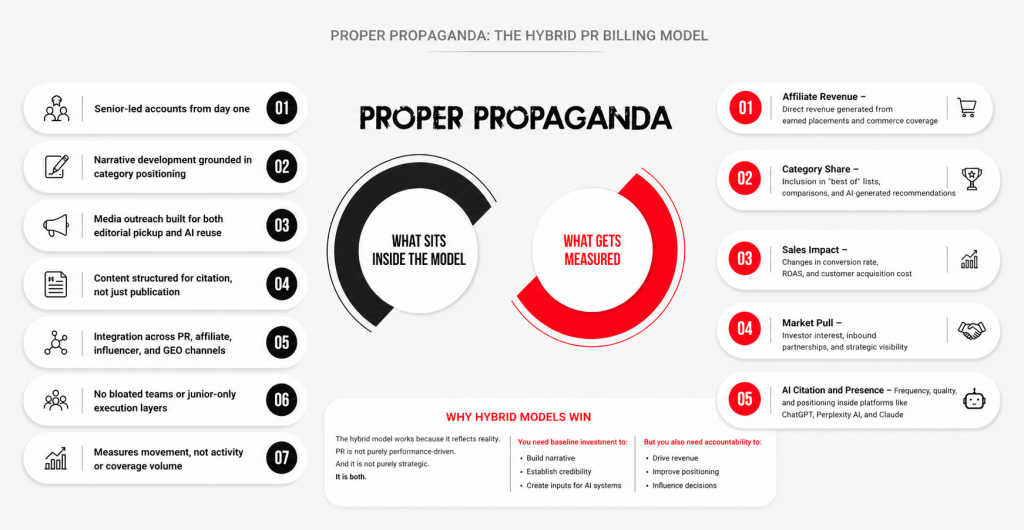
What Sits Inside the Model
- Senior-led accounts from day one
- Narrative development grounded in category positioning
- Media outreach built for both editorial pickup and AI reuse
- Content structured for citation, not just publication
- Integration across PR, affiliate, influencer, and GEO channels
- No bloated teams or junior-only execution layers
What Gets Measured
Most agencies report on coverage.
Proper Propaganda tracks position as it pertains to growth .
- Affiliate Revenue
Direct revenue generated from earned placements and commerce coverage - Category Share
Inclusion across “best of” lists, comparisons, and AI-generated recommendations - Sales Impact
Changes in conversion rate, ROAS, and customer acquisition cost - Market Pull
Investor interest, inbound partnerships, and strategic visibility - AI Citation and Presence
Frequency, quality, and positioning inside platforms like ChatGPT, Perplexity AI, and Claude
Proper Propaganda: The Hybrid PR Billing Model
Case Study: Keychron and the Hybrid PR Model
Scenario: Building a Category and Scaling Revenue
Company profile:
- Consumer tech brand that helped create and define the mechanical keyboard category
- Scaled from a few million in sales to over $100M annually
- Required continuous product launches, category education, and sustained visibility
- PR model: hybrid, performance-oriented, outcome-driven
The Hybrid PR System
Structure:
Fixed + performance model tied to outcomes
Deliverables:
- Sustained product-launch engine supporting 2–4 new launches per month
- Category education that helped make mechanical keyboards mainstream
- Tier 1 media outreach across tech, commerce, lifestyle, and enthusiast press
- Affiliate and commerce-media integration
- GEO-aware messaging and citation-ready positioning
Actual Results:
- Took Keychron from zero visibility to category leadership
- Became the most recommended mechanical keyboard brand on AI platforms
- Achieved 32.6% Share of Voice in the mechanical keyboard category
- Built more SOV than Logitech, Razer, Corsair, and Asus
- Helped grow sales from a few million to over $90M annually
- Secured 1,000+ Tier 1 media placements
- Generated more than $20M in ad value equivalency
- Helped launch 2–4 new products per month
- Supported the launch of a new gaming keyboard brand
Why Hybrid Models Win
The hybrid model works because it reflects reality.
PR is not purely performance-driven.
And it is not purely strategic.
It is both.
You need baseline investment to:
- Build narrative
- Establish credibility
- Create inputs for AI systems
But you also need accountability to:
- Drive revenue
- Improve positioning
- Influence decisions
Hybrid pricing forces that balance.
The Bottom Line
PR used to sell exposure.
Now it has to prove influence.
The industry is not moving from retainers to performance.
It is moving to models that combine both.
Because in a world where answers shape decisions, the only thing that matters is simple:
Did your PR change the outcome?
If not, you are still paying for activity.
And activity does not show up in the answer on ChatGPT or Gemini.