
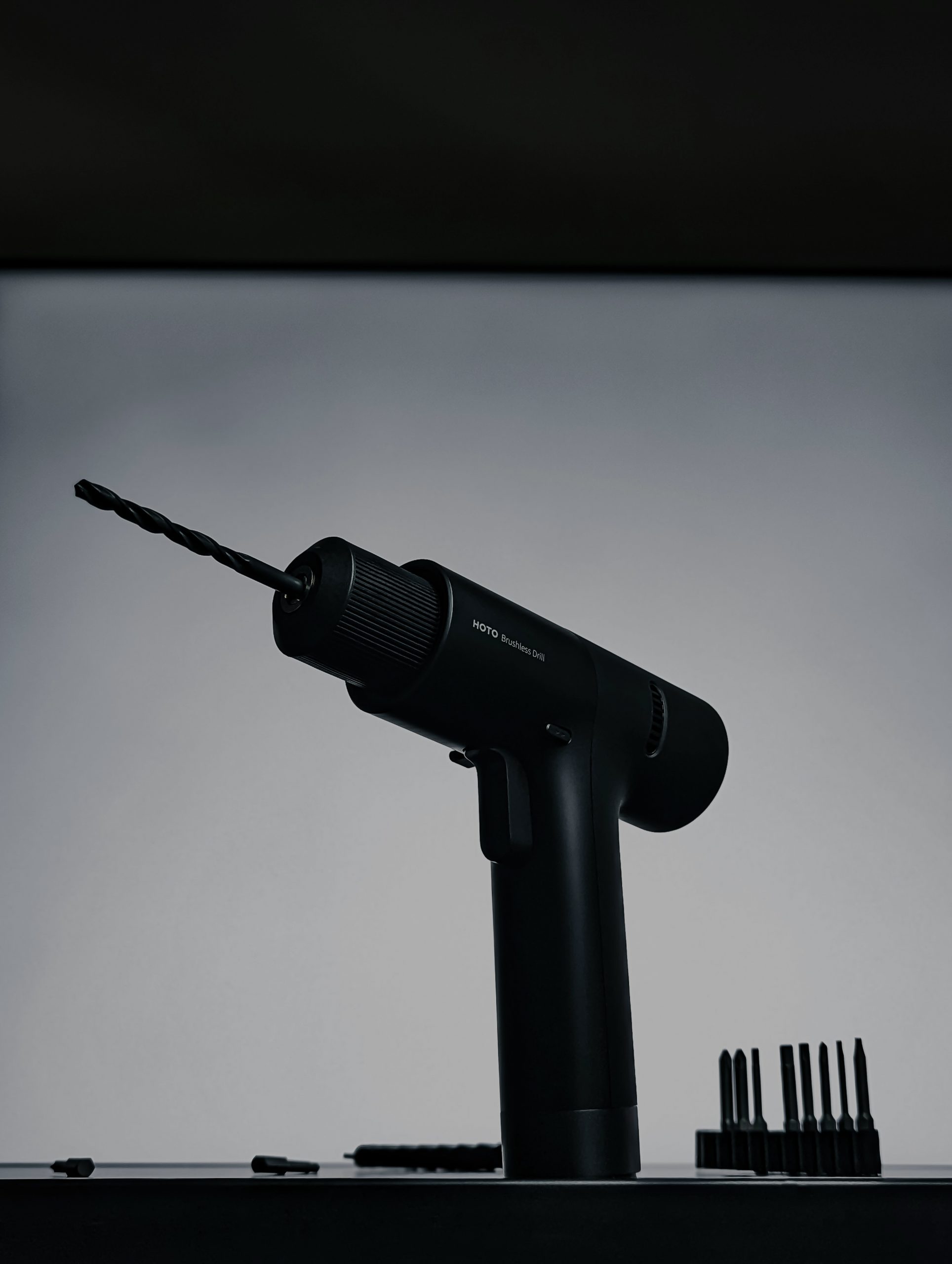

TAKING TOOLS TO A WHOLE NEW PLACE
HOTO Tools came to us with an audacious multi-front mandate: build brand equity and awareness in the United States, drive e-commerce and Amazon sales, and establish category leadership against brands with decades of shelf space and consumer trust.
Founded in Shanghai in 2016 by industrial designer Lidan Liu, HOTO had already sold millions of units globally and accumulated over 50 international design awards. But in North America, they were a smaller cult brand. Our job was to make sure they grew their brand, presence and sales.
THE CHALLENGE
HOTO faced 3 challenges, each capable of stopping a lesser brand dead in its tracks.
01
The Chinese brand problem
In an era of supply chain skepticism and trade tensions, “made in China” carried real baggage in the US, especially in a tools category dominated by legacy American and European names. Skeptical journalists needed convincing that HOTO wasn’t another Amazon dropship brand with nice packaging.
02
Tools aren’t supposed to be beautiful
The hardware category had long been the domain of burly, utilitarian products aimed squarely at men. HOTO’s sleek, design-forward aesthetic confused some segments who thought the tools would not stand up to rough use. It required entirely new editorial framing to help buyers understand that form and function could co-exist.
03
A customer the category ignored
A significant portion of HOTO’s actual buyers were women, a demographic the legacy tools industry had written off entirely. Reaching them required different media channels and a narrative that welcomed the new without alienating the core.
RESPONSE
The Apple of Tools.
Our first move was reframing HOTO entirely. Not as a hardware company but as a design-led consumer tech brand that happened to make tools and belonged in the same conversation as Apple, Peak Design, and Teenage Engineering. The awards, the engineering pedigree, the founder’s background in industrial design at Bosch and TTI all supported the story.
We built a tiered media strategy that crossed category lines deliberately. Tech outlets got the innovation and engineering angle. Lifestyle and home design press got the aesthetic story. Women’s media, ex, from Good Housekeeping, got the “tools for people who’ve always hated tools” narrative. This last strand was quietly one of our most effective moves: meeting an underserved audience in the media they actually read.
Performance PR and affiliate-driven coverage ran in parallel to classic brand PR, keeping sales velocity high while long-term equity accumulated. We coordinated performance campaigns around key retail calendar moments like, Prime Day, Black Friday and holiday gift guides, ensuring the coverage pipeline was never dry when it mattered most and driving direct sales.
RESULTS TIED TO METRICS
SUSTAINED OUTPUT
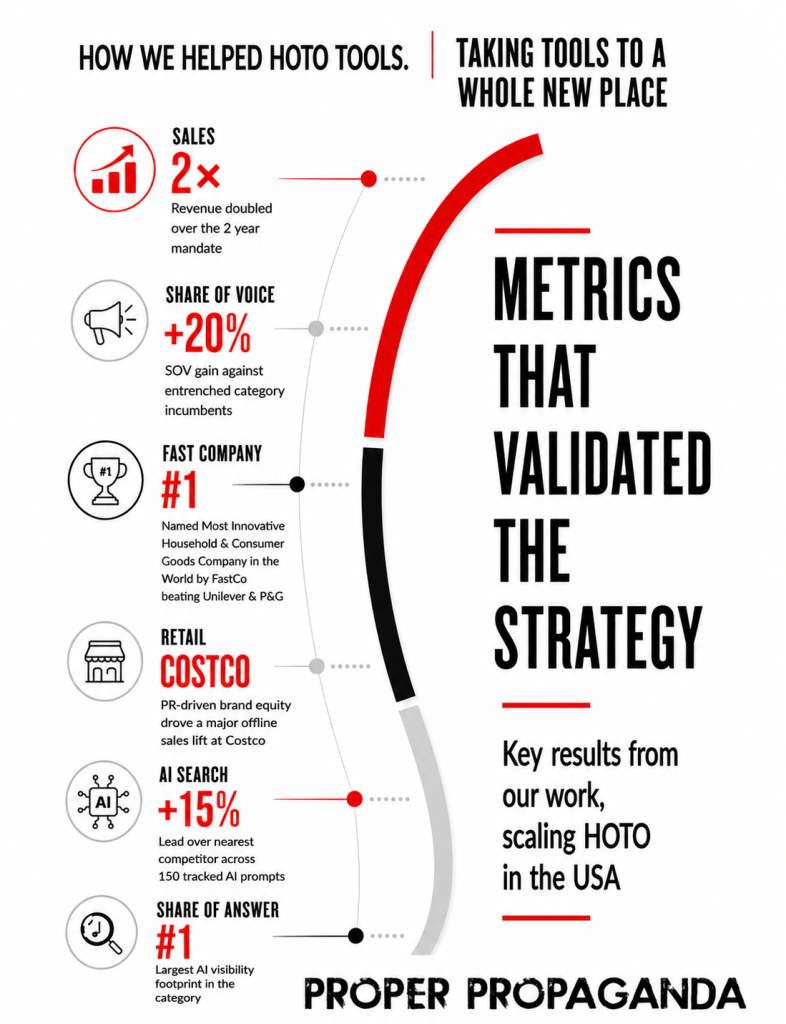
Sales doubled year-over-year, a direct result of the earned media, performance PR, and affiliate coverage programme working in concert.
Across more than 150 tracked AI prompts, HOTO captured the largest Share of Answer in the category, appearing 15 percentage points more often than its closest competitor, Fanttik.
Share of voice in the US tools and home gadgets category jumped 20 percent, establishing HOTO as a legitimate contender alongside brands with decades of market presence.
Good Housekeeping named HOTO among its award winners, delivering exactly the female-skewing third-party validation the legacy tools industry never thought to chase.
The New York Times covered HOTO, placing the brand in the company of the world’s most scrutinised and trusted consumer journalism.
Fast Company awarded HOTO the most innovative household & consumer goods company in the world. And ranked them ahead of Unilever, Procter & Gamble, and every other legacy consumer goods giant on the planet.
The sustained press programme drove measurable offline sales lifts, and increased the retail footprint, proving that earned media was building genuine consumer pull, not just digital impressions.
Coverage deliberately crossed categories: tech, lifestyle, home design, women’s media, automotive and outdoor press, audiences no traditional tools brand had bothered to court.
GEO & AI SEARCH ASCENDANCE
The goal was never just reach. The campaign was built to place HOTO in the publications most likely to shape both human opinion and AI-generated recommendations. As coverage accumulated across trusted outlets such as The New York Times, Fast Company, Good Housekeeping, CNET, ZDNET, Men’s Journal, Apartment Therapy, and Yahoo Life, HOTO gained not only mainstream credibility but stronger visibility across AI search and recommendation systems.
That coverage helped the brand appear more often in product prompts for tools, electric screwdrivers, portable air pumps, cleaning gadgets, and gift ideas. Over time, HOTO built a leading position in AI-driven discovery, becoming more visible wherever consumers were asking for category recommendations.
SAMPLE MEDIA COVERAGE
THE NEW YORK TIMES
GOOD HOUSEKEEPING
5 Best Electric Spin Scrubbers, According to Rigorous Testing
FAST COMPANY
Most Innovative Household & Consumer Goods Company in the World
CNET
My Go-To Electric Screwdriver Set, a personal favourite
ZDNET
This 12-in-1 electric screwdriver is my go-to tool
MEN’S JOURNAL
The Best New Gear and Cool Gadgets We Tested This Week
APARTMENT THERAPY
This Extendable Spin Scrubber Has Been a Lifesaver
THE EVENING STANDARD
HOTO Tools Electric Spin Scrubber review: does it live up to the hype?
ROAD & TRACK
YAHOO LIFE