

A Collection of Useful Articles Related to PR, Marketing and AI Search Tactics for Prime Day
Prime Day has become more than a shopping day. It is now one of the most important visibility opportunities of the year for brands. As the event draws closer, we’ve been writing quite a bit about it.
Given how much ground there is to cover with the event, we thought it was worth doing what we did with our CES content. So this piece is an index of our best Prime Day material, plus some data from our own primary research about how and why U.S. consumers shop on Amazon.
Get in touch if you want to talk through any of it.
1) Start Here: Why Prime Day is a PR and discoverability problem, not just a sales event
Amazon Prime Day June 2026 PR Strategy: How Consumer Tech Brands Land Media Coverage
This is the foundational piece. It covers why the brands that get Prime Day listicle coverage and roundup placements start building their media and content strategy weeks before the event begins. We get into detail about what the strategy actually looks like in practice.
2) AI Search: How LLMs are reshaping Prime Day discovery
How to Refresh Your Owned Media Content for AI Search Before Prime Day 2026
A growing number of shoppers now use ChatGPT, Perplexity, and other AI tools to find deals before they ever visit Amazon directly. This piece walks through what AI crawlers are actually looking for, why owned content freshness matters more than most brands realize, and a practical checklist for getting your pages into AI-generated recommendations before the event starts.
3) Portable Lessons From The Fall Event: Tactics you can borrow from Prime Big Deal Days to get into gift guides on Prime Day
How to Get Your Product Featured in Amazon Fall Prime Big Deal Days Gift Guides (October 2026)
Amazon runs a second major shopping event called Big Deal Days. Some of the tactics that work there also work for Prime Day. This one covers affiliate readiness, why commerce editors are the right targets rather than long-form reviewers, pitch timing, what a press-ready media kit needs to include, and how to handle samples when your budget does not stretch across your entire catalog.
4) Primary Data: Amazon’s special place in Americans’ hearts
In February 2025, we surveyed 1,001 U.S. consumers who had purchased a consumer technology product in the previous six months. The data covers retail channel preferences, purchase drivers, and shopping frustrations. A few findings are directly relevant to Prime Day strategy:
Amazon’s dominance is real, and it is not just about price. General e-commerce platforms like Amazon account for the preferred shopping channel of 66.6% of U.S. consumers for consumer tech. Amazon specifically converts so well during events like Prime Day because consumers already trust the platform: they have saved payment information on it, are familiar with checkout flows, love fast delivery, and they put stock in the reviews.
Reviews are doing more work than most brands give them credit for. Before purchasing a $100 consumer tech product, we found 59.3% of consumers check buyer ratings and reviews on Amazon. Among Asian consumers, that figure rises to 77.8%. Among consumers aged 60 and older, 61.2% consult Amazon reviews before buying. For brands, this means your review volume and star rating are not vanity metrics during Prime Day: they are a material factor in whether commerce editors pitch your products to their audiences, and whether those audiences actually convert.
Amazon’s listings are trusted nearly as much as manufacturer websites. A full 59.8% of consumers feel equally confident in a product’s quality whether it appears on Amazon or a manufacturer’s direct site. That finding matters for how brands think about their investment in Amazon product page quality versus their DTC presence, particularly during a high-intent shopping event like Prime Day.
Delivery speed is a conversion factor, not a nice-to-have. 42.6% of consumers say they are less likely to buy from a manufacturer if delivery is slower than Amazon’s standard. Among consumers aged 60 and older, that sensitivity rises to 48.5%. Any brand relying primarily on a DTC channel during Prime Day is competing against Amazon’s logistics infrastructure, which is a genuinely difficult position.
The full briefing note is available here: Briefing Note: How and Where U.S. Consumers Buy Tech
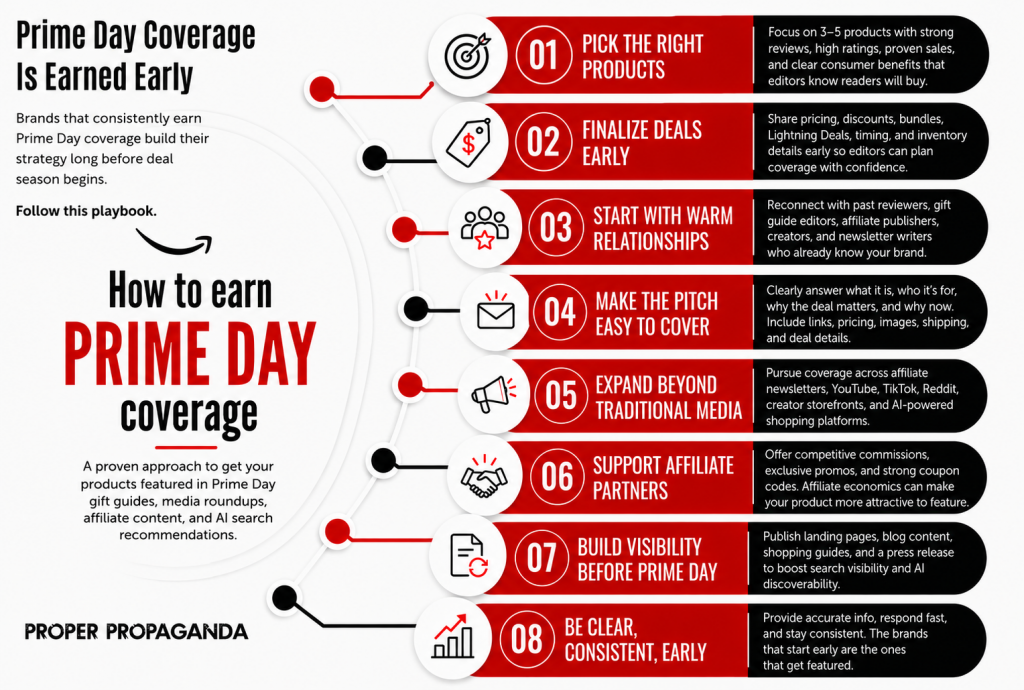
5) Proper Propaganda’s Prime Day Coverage Playbook
Looking to land Prime Day coverage of your own? We’ve created a quick reference infographic that maps out the steps brands take to earn spots in gift guides, commerce roundups, and increasingly, AI-generated recommendations.
We hope this content library is useful. If you are preparing for Prime Day and want to talk through media strategy, AI search, or how to position your products for coverage, reach out at info@properpropaganda.net or book some time here.