


Understanding how AI influences customer decisions from education through post-purchase support.
Generative Engine Optimization (GEO) has become one of the fastest evolving disciplines in marketing. As brands work to increase their visibility in ChatGPT, Perplexity, Google’s AI Overviews, and other AI-powered search experiences, new metrics, tools, and methodologies continue to emerge.
Most discussions focus on visibility within AI-generated responses. That visibility remains an important outcome, but it represents only one part of a much larger customer journey.
Consumers use AI long before they decide which brand to buy. They use it to understand unfamiliar topics, discover products, compare alternatives, validate purchasing decisions, identify retailers, and solve problems after becoming customers.
The GEO Buyer Journey Framework provides a way to understand those interactions and measure how brands perform throughout the entire decision-making process.
Why It Matters
Marketing teams have always aligned strategy with customer intent. Marketing campagins build awareness, familiarity, they answer questions and remove friction. Customer success supports long-term loyalty.
AI now influences every one of those stages.
Understanding where those interactions occur and how they contribute to commercial outcomes is becoming an essential part of a modern marketing strategy.
The GEO Buyer Journey Framework
The GEO Buyer Journey Framework maps how people use AI throughout the buying process.
Rather than treating every prompt as a search query, the framework recognizes that customers ask different questions as their knowledge, confidence, and purchase intent evolve. Those changing objectives influence the sources AI retrieves, the information it prioritizes, and the metrics marketers should use to evaluate performance.
The framework maps the six stages buyers move through when using AI throughout the purchasing journey. Each stage has a distinct objective, a different type of AI interaction, and its own set of GEO measurement priorities. We’ve broken each one down below.
Education
The customer is learning about a problem or category.
Typical prompt:
“How do I choose the right kite for a beginner?”
Objective:
Become a trusted source of information.
Discovery
The customer begins identifying potential solutions.
Typical prompt:
“What are the best beginner kites?”
Objective:
Enter the consideration set.
Evaluation
The customer compares competing products or brands.
Typical prompt:
“Brand X versus Brand Y.”
Objective:
Win comparative consideration.
Validation
The customer seeks reassurance before making a purchase.
Typical prompts:
“Is Brand X reliable?”
“Is Brand X worth the money?”
Objective:
Reinforce confidence.
Purchase
The customer is ready to buy.
Typical prompts:
“Where can I buy Brand X?”
“Who has the best price?”
Objective:
Remove friction and support purchase decisions.
Post-Purchase
The customer owns the product and needs information or support.
Typical prompts:
“How do I replace the valve?”
“How do I repair Brand X?”
Objective:
Support ownership and strengthen long-term trust.
The GEO Buyer Journey Framework in Practice
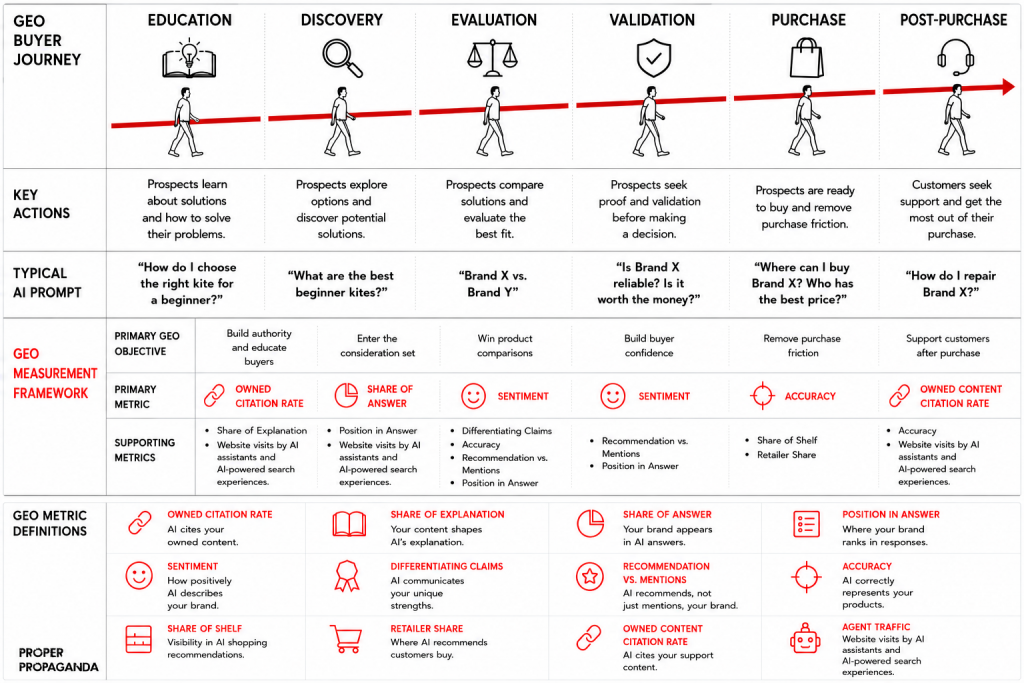
The GEO Buyer Journey Overview
| Buyer Journey Stage | Typical AI Prompt | Primary Objective | Primary Metric | Supporting Metrics |
| Education | How do I choose the right kite for a beginner? | Become a trusted source of information | Owned Citation Rate | Share of Explanation, Agent Traffic |
| Discovery | What are the best beginner kites? | Enter the consideration set | Share of Answer | Position in Answer, Agent Traffic |
| Evaluation | Brand X vs. Brand Y | Win comparative consideration | Sentiment | Presence of Differentiating Claims, Accuracy, Recommendation vs. Mentions, Position in Answer |
| Validation | Is Brand X reliable?Is Brand X worth the money? | Reinforce buyer confidence | Sentiment | Recommendation vs. Mentions |
| Purchase | Where can I buy Brand X?Who has the best price?Should I buy from Amazon or the manufacturer’s website? | Support purchase decisions | Accuracy | Share of Shelf, Retailer Share |
| Post-Purchase | How do I repair Brand X?How do I replace the valve? | Support ownership | Owned Content Citation Rate | Accuracy, Agent Traffic |
Each stage reflects a different customer need.
As those needs change, the information AI retrieves and the signals it relies on also change.
Every Stage Rewards Different Marketing Assets
Educational prompts often rely on explanatory content, original research, subject matter expertise, and authoritative owned resources.
Discovery prompts draw heavily from earned media, category authority, and widely referenced third-party sources.
Evaluation depends on reviews, product comparisons, editorial coverage, analyst opinions, and clearly communicated product differentiation.
Validation relies on reputation, customer confidence, and consistent messaging across trusted sources.
Purchase prompts prioritize accurate product information, retailer availability, pricing, and reliable commerce data.
Post-purchase interactions frequently reference knowledge bases, manuals, support documentation, troubleshooting guides, and FAQs.
Viewed together, these stages illustrate why GEO extends well beyond content optimization. Public relations, owned media, technical documentation, commerce information, and customer support all contribute to how AI represents a brand throughout the buyer journey.
| Buyer Journey Stage | What AI Typically Relies On |
|---|---|
| Education | Explanatory content, original research, subject matter expertise, educational resources, and authoritative owned content. |
| Discovery | Earned media, category authority, third-party publications, expert recommendations, and widely cited sources. |
| Evaluation | Product reviews, comparison articles, editorial coverage, analyst opinions, and clearly communicated differentiators. |
| Validation | Brand reputation, customer reviews, trust signals, testimonials, and consistent messaging across trusted sources. |
| Purchase | Accurate product information, retailer listings, pricing, inventory, product feeds, and reliable commerce data. |
| Post-Purchase | Knowledge bases, user manuals, support documentation, troubleshooting guides, FAQs, and customer service resources. |
The GEO Measurement Framework
The GEO Buyer Journey explains how customers interact with AI.
The GEO Measurement Framework identifies the metrics that matter at each stage.
Together they provide a structured approach for evaluating AI visibility throughout the customer journey.
The metrics below measure different aspects of AI visibility, helping you understand how your brand is represented at each stage of the buyer journey.
GEO Metrics
Owned Citation Rate
Measures how frequently AI cites your owned content when answering educational or support-related questions.
Share of Explanation
Measures how often your content contributes to AI’s understanding of a topic before products or brands enter the conversation.
Share of Answer
Measures the percentage of relevant AI-generated answers in which your brand appears.
Position in Answer
Measures where your brand appears within AI-generated responses.
Sentiment
Measures whether AI describes your brand positively, negatively, or neutrally relative to competitors.
Presence of Differentiating Claims
Measures whether AI consistently communicates the characteristics that distinguish your brand from competing products.
Recommendation vs. Mentions
Measures how frequently AI recommends your brand compared with simply mentioning it.
Accuracy
Measures whether AI presents correct information about your products, pricing, specifications, and positioning.
Share of Shelf
Measures how product recommendations are distributed across competing brands within AI-generated shopping responses.
Retailer Share
Measures which retailers AI recommends when users ask where to purchase a product.
Owned Content Citation Rate
Measures how frequently AI relies on your documentation and support content when answering post-purchase questions.
Agent Traffic
Measures which AI agents visit your website, the pages they retrieve, and how frequently those resources are accessed.
Measuring Success Across the GEO Buyer Journey
Performance becomes easier to understand when measurement aligns with customer intent.
Educational content should increase owned citations and strengthen Share of Explanation.
Discovery should expand Share of Answer and improve Position in Answer.
Evaluation should strengthen sentiment while reinforcing the claims that differentiate the brand.
Validation should increase recommendation rates and build buyer confidence.
Purchase should improve accuracy while expanding retailer visibility.
Post-purchase should strengthen the role of owned content as an authoritative source for customer support.
Viewed together, these measurements provide a broader understanding of AI visibility than any single KPI can offer.
The Context
- AI has become part of every stage of the buyer journey, from education through customer support.
- Customer intent changes throughout the buying process, requiring different content strategies and different methods of measurement.
- The GEO Buyer Journey Framework provides a practical model for understanding how AI influences purchasing decisions.
By the Numbers
- 39% of U.S. consumers have already used generative AI for shopping, while 53% expect to use it this year.
- 55% of AI-assisted shoppers use generative AI for product research and 47% use it for product recommendations.
- Traffic from generative AI platforms to U.S. retail websites increased by 1,200% between July 2024 and February 2025, highlighting the growing commercial influence of AI search.
Bottom Line
The organizations that perform well in AI search will understand how customers use AI throughout the buying process, create content that supports each stage of the journey, and measure performance using objectives that reflect customer intent rather than a single visibility metric.