


Discovery-level prompts are where the sex lives.
It’s natural. Everyone gets excited when a company begins to show up in unbranded prompts like “What is the best X for Y.” When inbound leads jump, the happy fervor gets more intense.
And so we worship at the altar of Share of Answer (SOA).
Don’t get me wrong, I like both sex and Share of Answer. However, I’ve come to believe we’re overindexing on the latter.
Data suggests GEO is a full-funnel enterprise, where a company must monitor relevant prompts across the entire buyer journey and into post-purchase. For complex purchases, AI is effectively a passenger in the sidecar of a buyer’s motorcycle.
Presence in answers, the metric central to most GEO programs alongside citation rate, matters ONLY at the top of the funnel for discovery-level, unbranded, prompts. It’s a critical ingredient, but you need other things to bake the cake.
Let’s unpack this with an example.
If someone has just started kitesurfing and wants to go deeper with the sport, they might ask ChatGPT “What is the best kite for a beginner learning kitesurfing?”
If you make kites, being in the answer to that prompt is table stakes. To even be in the running for a sale, presence is required.
However, once AI gives the prospect a few brands to consider – including yours, if you are a kite maker- the problem of presence is largely settled. Share of Answer becomes a less relevant metric because the prospect has names (including yours) and is further down the funnel.
But because a new kite for kitesurfing costs upwards of $2k to 3k USD, the interaction between the prospect and AI is far from done.
The prospect now asks, “Between Kite Brand X and Kite Brand Y, which is better.” AI spits out another answer. But we aint done yet.
The prospect next asks about any active sales for both Kite Brand X and Kite Brand Y. AI replies again.
The prospect is now closer to purchase, but wants to make sure of a few things. So they ask “How easy is it to repair kites made by Brand X vs Brand Y?”
Again more info arrives. Finally the prospect buys a kite.
This example had 4 prompts (and frankly could easily have been a 6-10 prompt journey given the price and implications of purchasing a kite for kitesurfing). Presence was only a problem in one of the prompts. In other words, in 75% of this fictitious buying journey, the concept Share of Answer measures was irrelevant.
Yet it is where most GEO programs focus their energy and define success. That’s a big problem built on assumptions about GEO being an upper-funnel game.
So what should you do?
The first thing is to monitor the entire funnel. Make sure your prompt universe has a meaningful amount of mid, bottom and post-purchase-level queries in it, because a complex sale can be lost at any stage.
Second, understand that measurement hierarchy changes through the funnel. For example, as you move to evaluation-level and lower-funnel prompts, things like sentiment and position in the answer matter more than SOA. You might even assess whether AI responses at the mid-funnel contain a differentiating claim about your company or products. Certainly, when you get to post-purchase-stage queries, how often your content is cited is a key metric.
Third, if you are working with an agency, tie part of their comp to a set of metrics that capture performance across the entire funnel and not just SOA.
SOA is a key GEO metric. But it’s over-indexed because it is the closest thing we have to old-school SEO metrics and PR’s old love, Share of Voice. Almost every monitoring tool can give you good data on it. However, complex purchases involve long and winding roads that require you to think beyond obvious metrics and account for how measurement priorities change.
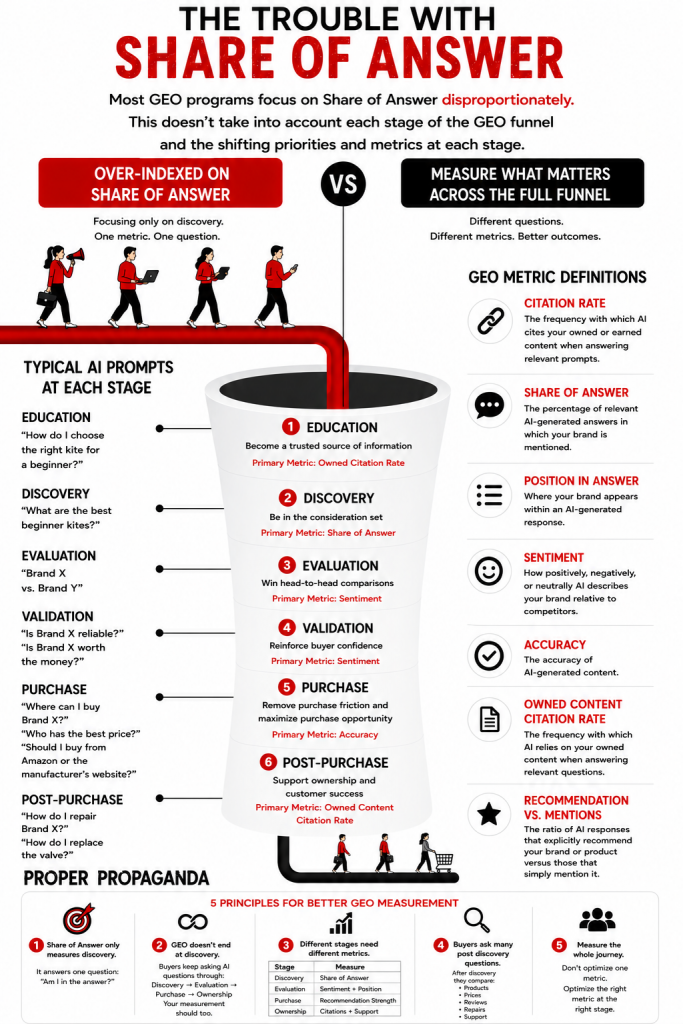
The key takeaway is simple.
Share of Answer is only one piece of the puzzle. Here are five principles to keep in mind when considering a GEO measurment.
1. Share of Answer only measures discovery.
It answers one question:
“Am I in the answer?”
2. GEO doesn’t end at discovery.
Buyers keep asking AI questions through:
Discovery → Evaluation → Purchase → Ownership
Your measurement should too.
3. Different stages need different metrics.
| Stage | Measure |
|---|---|
| Discovery | Share of Answer |
| Evaluation | Sentiment + Position |
| Purchase | Recommendation Strength |
| Ownership | Citations + Support |
4. Buyers ask many questions.
After discovery they compare:
- Products
- Prices
- Reviews
- Repairs
- Support
5. Measure the whole journey.
Don’t optimize one metric.
Optimize the right metric at the right stage.
The Bottom Line
Presence gets you in.
Performance gets you chosen.