


An editorial comparison of nine boutique and independent technology PR agencies for growth-stage companies, examining senior involvement, specialist expertise, responsiveness, GEO capabilities, pricing and accountability.
Choosing a boutique technology PR agency should be relatively straightforward. Find a firm that understands your business, knows the right journalists, assigns experienced people to your account and can demonstrate that its work is making a difference.
In practice, it rarely works that way.
Growth-stage CMOs are presented with an enormous selection of agencies, many offering similar services, making similar promises and showing similar collections of client logos.
Large communications firms have obvious advantages. They offer international offices, extensive resources and specialist departments capable of managing complicated programs across multiple markets.
But a technology company spending $10,000 or $15,000 per month on PR may find that a smaller, more specialized team offers better value.
The appeal is direct access to experienced practitioners, deeper knowledge of a particular technology category, fewer management layers and a clearer understanding of where the money goes.
There is also the question of accountability.
PR has traditionally been measured through coverage volume, estimated reach and share of voice. Those metrics remain useful, but growth-stage companies increasingly want to understand how earned media contributes to product discovery, market credibility, commercial opportunities and visibility in AI-generated answers.
That has brought Generative Engine Optimization (GEO) into the agency selection process.
A growing number of technology PR firms now offer some combination of earned media, content strategy, AI-search visibility and citation measurement. The depth of those capabilities varies considerably.
This guide compares nine boutique and independent specialist technology PR agencies serving North American companies. It examines where each agency is strongest, who should consider hiring it, where it may be less suitable and what CMOs should ask before signing.
Key Takeaways (TL;DR)
- Best for consumer technology, hardware and integrated PR/GEO: Proper Propaganda, particularly for consumer electronics, product launches, affiliate and commerce media, and international brands entering North America.
- Best for integrated B2B and consumer technology communications: SourceCode Communications, with experience in enterprise technology, consumer technology, fintech and AI visibility.
- Best for consumer electronics launches: BIG FISH PR, particularly product reviews, CES and national technology media.
- Best for venture-backed B2B startups: Beantown Media Ventures (BMV), with a focus on startup storytelling, media relations and content marketing.
- Best for complex B2B technology: Corporate Ink, which combines technical communications with a dedicated interest in GEO and AI visibility.
- Best for founder storytelling and category creation: LaunchSquad, particularly for emerging technology companies developing new market narratives.
- Best for B2B startup PR and content: Firebrand Communications, especially companies with small internal marketing teams.
- Best for AI, cybersecurity and climate technology: V2 Communications, with specialist B2B communications and GEO capabilities.
- Best for creative national media campaigns: Bospar, an established independent technology PR agency with a larger operating model than a traditional boutique.
For growth-stage CMOs, the most important considerations are the experience of the actual account team, relevant sector knowledge, responsiveness, measurable outcomes and the services included in the retainer.
Top Boutique Tech PR Agencies in North America at a Glance
| Agency | Best For | Key Strengths |
| Proper Propaganda | Consumer tech, hardware, North American market entry | Senior-led PR, earned media, affiliate/commerce PR, GEO |
| SourceCode Communications | B2B and consumer technology, fintech | Integrated communications, technology PR, AI visibility |
| BIG FISH PR | Consumer electronics and product launches | Product reviews, CES, consumer technology media |
| Beantown Media Ventures | Venture-backed B2B technology | Startup storytelling, media relations, content |
| Corporate Ink | Complex B2B technology | Technical storytelling, strategic communications, GEO |
| LaunchSquad | Startups and category creation | Founder narratives, creative campaigns, technology PR |
| Firebrand Communications | B2B startups and scaleups | PR, content marketing, integrated communications |
| V2 Communications | AI, cybersecurity and climate tech | Technology PR, integrated communications, GEO |
| Bospar | B2B technology and executive visibility | National media relations, executive positioning, creative campaigns |
The table summarizes agency positioning and potential fit. It does not represent independently verified performance rankings. GEO capabilities should be evaluated through current service descriptions, methodology and client examples.
What Is a Boutique Tech PR Agency?
A boutique technology PR agency is a smaller or highly specialized communications firm that focuses on technology companies and generally offers a more direct relationship between clients and experienced communications professionals.
There is no universally accepted employee-count threshold for the term boutique.
Some agencies define themselves through a small team and a limited client roster. Others have grown considerably while retaining a specialist focus, independent ownership and senior-led account management.
For this comparison, boutique refers primarily to specialist, independent agencies with a focused technology communications offering, rather than a strict number of employees.
The typical characteristics include:
- Direct access to senior communications professionals.
- Experience in a specific technology sector.
- A relatively consistent account team.
- Fewer layers between strategy and execution.
- Specialist relationships with relevant journalists.
- Flexible communications programs.
- Reporting aligned with client objectives.
These qualities should be evaluated rather than assumed.
A small agency can still provide poor service. A larger independent firm can deliver excellent senior-level attention.
The relevant distinction for a growth-stage CMO is how the agency operates and whether that model suits the company’s requirements.
Why Growth-Stage Technology Companies Choose Boutique PR Agencies
1. Senior Involvement Can Make a Meaningful Difference
One of the frustrations with agency relationships is the difference between the people who win the business and those who actually manage the account.
A prospective client may spend several hours with senior executives during the pitch process, only to discover that the daily work is being handled by a much less experienced team.
Junior professionals have an important role in agency operations. But technology companies often need experienced judgment.
That includes knowing whether an announcement is genuinely newsworthy, understanding how journalists evaluate stories, recognizing weaknesses in positioning and being prepared to challenge the client’s assumptions.
For a growth-stage business, those decisions can be more valuable than having access to a large agency’s entire service portfolio.
2. Specialist Expertise Reduces the Learning Curve
Technology is an enormous category.
Consumer electronics, cybersecurity, enterprise software, AI infrastructure, fintech, mobility and climate technology operate in different markets.
Their buyers are different. Their journalists are different. Their communications opportunities are different.
A consumer electronics agency needs to understand product reviews, buying guides, affiliate commerce, retail launches and product sampling.
An enterprise cybersecurity agency needs technical knowledge, relevant trade media relationships and an understanding of how enterprise buyers evaluate security products.
An agency that already understands the category should require less time to develop a credible communications program.
3. Smaller Teams Can Be More Responsive
Growth-stage companies move quickly.
Product launches get delayed. Competitors make announcements. Journalists request interviews on short notice. New partnerships and commercial opportunities create unexpected communications needs.
An agency with fewer internal approval layers may be able to respond faster.
But responsiveness should be established before signing a contract.
Ask who handles urgent requests, what the expected response time is and how the agency manages periods when the lead account person is unavailable.
4. Accountability Matters When Budgets Are Limited
A $12,000 monthly PR retainer represents $144,000 annually.
That is a meaningful investment for most growth-stage technology companies.
CMOs need to understand what the agency is doing, how resources are being allocated and whether the work is improving the company’s position in the market.
Coverage reports are useful, but they should be connected to broader objectives.
Depending on the business, those might include product review inclusion, competitive share of voice, executive visibility, referral traffic, AI citations, Share of Answer, branded search and commercial opportunities influenced by communications.
5. AI Search Has Added Another Dimension to PR
Technology buyers increasingly use ChatGPT, Gemini, Perplexity and Google AI experiences to research companies, compare products and build shortlists.
That changes the questions CMOs should ask prospective PR agencies.
Relevant earned media can contribute to the third-party information available to AI systems. Product reviews, independent comparisons, industry reporting and expert commentary may all help establish how a brand is described and understood.
Some technology PR agencies have responded by introducing dedicated GEO services.
Others offer related services through content, digital PR and strategic communications.
The important distinction is whether an agency can explain how it measures AI visibility, which activities it believes can improve that visibility and what evidence supports its approach.
No credible agency can guarantee that a specific article will be cited in an AI-generated answer.
How We Selected These Boutique Tech PR Agencies
This comparison was prepared by Proper Propaganda, a technology PR and GEO agency that is also included in the list.
Proper Propaganda is the publisher and a participant in this comparison. Readers should take that commercial interest into account when evaluating our recommendations.
The shortlist was developed using the following editorial criteria:
- Technology specialization: Demonstrable focus on technology companies rather than general corporate communications.
- North American market relevance: An established presence in, or meaningful service offering for, the United States and Canada.
- Growth-stage suitability: Experience or positioning relevant to startups, scaleups and established technology companies pursuing growth.
- Service capabilities: Relevant offerings in earned media, strategic communications, product launches, content, executive visibility or GEO.
- Specialist operating model: Independent ownership, focused expertise or a differentiated account-management approach.
- Publicly available information: Agency websites, service descriptions, case studies, published pricing where available and other relevant materials.
The agencies were selected to represent different technology sectors and communications requirements.
This is an editorial comparison, not an independently audited ranking. We did not conduct a standardized client-satisfaction survey, independently verify every agency’s placement results or obtain confidential pricing proposals from each firm.
The order reflects editorial judgment and category fit. It should not be interpreted as a statistically established performance ranking.
Bospar is included as a larger independent specialist agency for comparison. Its size and international operating model mean it does not fit the narrowest definition of a small boutique.
Pricing is identified as custom where a reliable public figure has not been established.
Best Boutique Tech PR Agencies in North America: In-Depth Review & Comparison
1. Proper Propaganda

Best for: Consumer technology, hardware, North American market entry and integrated PR/GEO
Website: https://properpropaganda.net/
Overview
Proper Propaganda is a boutique technology PR and Generative Engine Optimization agency working with growth-stage technology companies, consumer electronics brands, hardware manufacturers and international businesses expanding into North America.
Founded in 2011, the agency combines earned media, strategic communications, product launches, affiliate and commerce PR, brand positioning and GEO.
Its operating model emphasizes direct access to experienced communications professionals, transparent reporting and measurable outcomes.
For growth-stage companies, Proper Propaganda is particularly relevant where media coverage influences product discovery, purchasing decisions and brand credibility.
Ideal For
- Growth-stage consumer technology companies.
- Consumer electronics and hardware manufacturers.
- Smart home, mobility, wearables and emerging technology brands.
- International technology companies entering the U.S. market.
- CMOs looking to combine traditional PR with GEO.
- Brands seeking product reviews, buying-guide inclusion and affiliate media coverage.
- Technology companies that prefer direct access to senior practitioners.
Why Do They Stand Out?
Proper Propaganda combines specialist consumer technology PR with a dedicated approach to AI-search visibility.
The agency has experience working with technology brands including Keychron, HOTO Tools, HOVERAir and Velotric.
Its communications programs extend beyond traditional media pitching to include product positioning, affiliate and commerce media, launch strategy and Generative Engine Optimization.
The agency’s GEO methodology examines how brands appear across AI-generated answers, including Share of Answer, citation rates, prompt coverage and product recommendations.
The objective is to connect earned media authority with the ways prospective customers discover, evaluate and compare technology brands.
Proper Propaganda also offers performance-linked fee structures on selected engagements, creating an additional mechanism for aligning agency compensation with earned media outcomes.
Pros
- Senior-led boutique operating model.
- Specialist experience in consumer technology and hardware.
- Strong understanding of North American technology media.
- Experience helping international technology companies enter the U.S. market.
- Integrated PR, affiliate, commerce and GEO capabilities.
- Transparent reporting and performance-linked pricing options.
- Direct access to experienced agency leadership.
Cons
- Narrow technology specialization makes it less suitable for companies outside the sector.
- Consumer technology and hardware are particular strengths, so some enterprise B2B categories may be better served by dedicated vertical specialists.
- A boutique team may not be the best fit for companies requiring simultaneous execution across dozens of countries.
Typical Engagement and Pricing
Proper Propaganda’s PR retainers generally range from $7,000 to $20,000 USD per month, depending on scope.
Combined PR and GEO engagements commonly fall between $12,000 and $20,000 per month.
Selected PR engagements offer a combination of fixed fees and performance-based compensation, with agreed caps.
Final Verdict
Proper Propaganda is our preferred choice for growth-stage consumer technology companies seeking senior involvement, specialist media expertise and a more accountable approach to PR.
Its combination of earned media, product communications, North American market-entry experience and GEO makes it particularly relevant for brands competing for visibility across traditional media, commerce content and AI-powered search.
Companies seeking highly specialized enterprise software or cybersecurity communications should compare it with B2B-focused agencies on this list.
2. SourceCode Communications
Best for: B2B and consumer technology, integrated communications and AI-search visibility
Website: https://sourcecodecommunications.com/
Overview
SourceCode Communications is a New York-based technology communications agency founded in 2017.
The firm works across enterprise technology, consumer technology, fintech and emerging technology markets, combining earned media with integrated marketing and strategic communications.
Its services include public relations, brand positioning, content development and AI visibility.
For growth-stage companies operating across business and consumer markets, SourceCode offers a relevant combination of capabilities.
Ideal For
- Growth-stage B2B and consumer technology companies.
- Enterprise software and SaaS businesses.
- Fintech and financial technology brands.
- Emerging technology companies.
- CMOs seeking integrated communications support.
- Technology businesses evaluating GEO and AI-search visibility.
Why Do They Stand Out?
SourceCode’s experience spans both B2B and consumer technology.
That breadth is useful for companies whose products or platforms serve multiple audiences.
A technology company might need to establish credibility with enterprise customers while also building awareness among consumers, investors or industry partners.
SourceCode’s integrated communications model is designed to address those overlapping requirements.
The agency has also introduced AI Visibility & Search Discovery services, including Answer Engine Optimization (AEO) and Generative Engine Optimization.
For CMOs evaluating agencies in 2026, that makes SourceCode relevant to conversations about earned media and AI-powered discovery.
Pros
- Experience across B2B and consumer technology.
- Integrated PR and marketing capabilities.
- Dedicated AI visibility and GEO offering.
- Relevant experience in enterprise technology and fintech.
- Suitable for companies addressing multiple audiences.
Cons
- Broader sector coverage than some narrowly focused boutique specialists.
- Senior account involvement should be confirmed during the selection process.
- CMOs should request specific GEO reporting examples and evidence of outcomes.
- Consumer electronics review and affiliate programs may be better handled by agencies specializing in those channels.
Typical Engagement and Pricing
Custom pricing. Request a proposal outlining staffing, deliverables, contract terms and the scope of any GEO services.
Final Verdict
SourceCode is a strong candidate for growth-stage technology companies seeking an integrated communications partner with experience across B2B, consumer technology and AI-search visibility.
Its breadth makes it particularly relevant for businesses whose communications requirements extend beyond a narrowly defined media relations program.
3. BIG FISH PR
Best for: Consumer electronics, product launches and technology media reviews
Website: https://bigfishpr.com/
Overview
BIG FISH PR is a U.S. public relations agency with longstanding experience in consumer technology, consumer electronics and product communications.
Its work includes media relations, product launches, technology reviews, CES campaigns and broader brand-building programs.
For companies selling physical technology products, BIG FISH offers a particularly relevant set of capabilities.
Ideal For
- Consumer electronics companies.
- Connected-device and smart home brands.
- Hardware startups preparing for launch.
- Technology companies exhibiting at CES.
- Brands seeking national technology media reviews.
Why Do They Stand Out?
Consumer electronics PR requires a different approach from enterprise technology communications.
Journalists need products to test, demonstrations need to work, review samples must arrive on time and launches need a compelling reason for coverage.
BIG FISH has built its practice around these requirements.
The agency highlights more than 25 years of consumer technology experience and publishes campaign results involving product launches, CES and technology media.
Pros
- Deep consumer electronics specialization.
- Established product review and launch experience.
- CES communications expertise.
- Relevant technology media relationships.
- Strong alignment with physical product companies.
Cons
- Less suitable for enterprise SaaS companies seeking technical thought leadership.
- Its public positioning emphasizes consumer technology PR more than comprehensive GEO consulting.
- Companies requiring broad technical SEO or AI-search implementation may need additional capabilities.
Typical Engagement and Pricing
Custom pricing. A standardized monthly retainer is not publicly established for this comparison.
Final Verdict
BIG FISH is a compelling option for consumer electronics companies that need experienced product communications support.
For CMOs preparing a major hardware launch or looking to build sustained product review coverage, it belongs on the shortlist.
4. Beantown Media Ventures (BMV)
Best for: Venture-backed B2B technology startups
Website: https://www.wearebmv.com/
Overview
Beantown Media Ventures, commonly known as BMV, is a technology PR and content marketing agency with a strong orientation toward startups and venture-backed businesses.
Its sector experience includes enterprise technology, SaaS, AI, cybersecurity, fintech and other emerging technology categories.
BMV combines media relations with strategic storytelling and content development.
Ideal For
- Venture-backed B2B startups.
- SaaS and enterprise technology businesses.
- Companies approaching major funding or growth milestones.
- Founders seeking executive visibility.
- Marketing teams combining PR and content marketing.
Why Do They Stand Out?
BMV understands the communications needs of companies building credibility in emerging markets.
For growth-stage B2B businesses, the challenge often involves explaining an unfamiliar product, establishing a market category and persuading journalists that a company’s story matters beyond its latest funding announcement.
BMV’s technology and startup orientation is relevant to those challenges.
Pros
- Strong startup and B2B technology focus.
- Experience across emerging technology sectors.
- PR and content marketing integration.
- Relevant for venture-backed growth companies.
Cons
- Less specialized in consumer electronics and commerce media.
- GEO capabilities should be evaluated directly rather than assumed.
- Companies seeking an extensive multinational communications network may require additional partners.
Typical Engagement and Pricing
Custom pricing. Confirm the proposed monthly retainer, staffing and contract term directly.
Final Verdict
BMV is a credible option for venture-backed B2B technology companies that need to establish category authority and build a sustained communications program.
Its strongest fit is with startups and scaleups that value technology storytelling and content alongside earned media.
5. Corporate Ink
Best for: B2B technology, fintech and complex technical communications
Website: https://corporateink.com/
Overview
Corporate Ink is a specialist communications agency with a focus on B2B technology and complex business categories.
Its work spans strategic communications, media relations, content, brand positioning and AI visibility.
The agency is particularly relevant to technology businesses whose products require explanation and industry context before they become interesting to mainstream journalists.
Ideal For
- B2B technology companies.
- Fintech and enterprise software businesses.
- Companies operating in complex or technical categories.
- Marketing teams seeking specialized communications support.
- Businesses building industry credibility.
- B2B technology brands evaluating GEO.
Why Do They Stand Out?
Technical communications require the ability to understand a product well enough to explain its broader relevance.
Corporate Ink’s specialization in B2B and technology communications gives it a relevant foundation for companies that need clear narratives, executive positioning and targeted industry media coverage.
The agency has also developed a substantial focus on GEO and AI-answer visibility.
In May 2026, Corporate Ink published research on how AI systems represent B2B technology brands.
Among the findings, 72% of surveyed marketers reported encountering inaccurate, outdated or incomplete AI descriptions of their companies, categories or value propositions. Only 34% said they had a defined AI visibility strategy and were highly prepared to influence how generative AI represented their brands.
These findings illustrate why AI visibility has become a communications concern for B2B technology companies.
Pros
- B2B technology specialization.
- Experience communicating complex products.
- Strategic storytelling and content capabilities.
- Suitable for specialist industry media programs.
- Dedicated attention to GEO and AI visibility.
- Published research relevant to B2B marketing leaders.
Cons
- Less focused on consumer electronics and product review campaigns.
- CMOs should request specific examples of GEO reporting and measurable client outcomes.
- May not offer the international reach required for large multinational campaigns.
Typical Engagement and Pricing
Custom pricing. Request a proposal based on scope, staffing and GEO requirements.
Final Verdict
Corporate Ink is worth considering for growth-stage B2B technology companies that need technical storytelling, industry credibility and a focused communications partner.
Its research and service development around AI visibility make it particularly relevant to CMOs concerned about how their companies are represented in AI-generated answers.
6. LaunchSquad

Best for: Venture-backed technology startups, founder storytelling and category creation
Website: https://launchsquad.com/
Overview
LaunchSquad is a technology-focused communications agency known for working with startups, emerging companies and established brands.
Its services span public relations, strategic storytelling, content and creative communications.
The agency has experience helping technology businesses communicate new ideas and establish market relevance.
Ideal For
- Venture-backed startups and scaleups.
- Emerging technology companies.
- Founders developing a category narrative.
- Companies preparing significant launches or announcements.
- Businesses seeking PR alongside creative storytelling.
Why Do They Stand Out?
Growth-stage companies often struggle to explain why their technology matters to people outside their immediate industry.
LaunchSquad’s focus on narrative development and creative communications is relevant to businesses introducing new concepts or trying to differentiate themselves in crowded markets.
The agency has also published work addressing GEO and AI-search visibility.
That experience is relevant for companies seeking to understand how their brand narrative appears across traditional media and emerging AI discovery channels.
CMOs should clarify which GEO capabilities are included in the proposed engagement and how the agency measures their impact.
Pros
- Established technology and startup communications experience.
- Strong emphasis on storytelling.
- PR and creative capabilities.
- Relevant for founder-led companies and category creation.
- Published experience addressing GEO-related communications opportunities.
Cons
- A broader communications offering may exceed the needs of companies seeking only specialist media relations.
- Senior involvement and account structure should be confirmed during procurement.
- GEO methodology, deliverables and measurement should be evaluated against the proposed scope.
Typical Engagement and Pricing
Custom pricing. Scope and fees depend on the services required.
Final Verdict
LaunchSquad is a good candidate for technology companies whose primary communications challenge involves positioning, storytelling and market education.
Its broader creative capabilities may be valuable for startups building new categories, while companies seeking a narrower media relations program should compare the scope carefully.
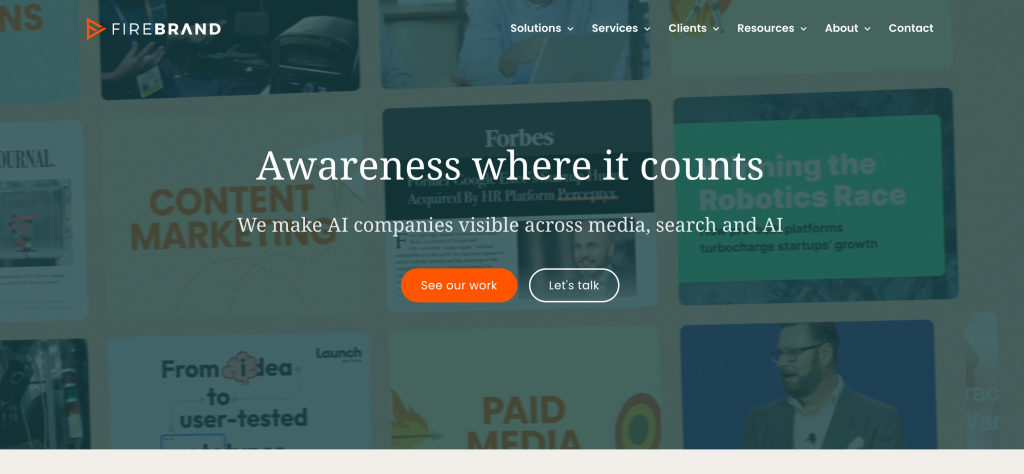
7. Firebrand Communications
Best for: B2B startups combining PR and content marketing
Website: https://firebrand.marketing/
Overview
Firebrand Communications is a technology-focused communications and marketing agency working with startups and growth companies.
Its approach combines public relations, content marketing and strategic communications.
For technology companies with limited internal marketing resources, an integrated agency model can simplify campaign development and execution.
Ideal For
- B2B technology startups.
- Venture-backed scaleups.
- SaaS and emerging technology companies.
- Marketing teams needing PR and content support.
- Companies building executive thought leadership.
Why Do They Stand Out?
PR and content marketing frequently depend on the same underlying material.
A strong executive interview, customer story, research finding or product insight can support media outreach, website content and other communications activities.
Firebrand’s integrated approach is relevant for growth-stage companies seeking to make better use of their communications investment.
Pros
- Technology startup specialization.
- Integrated PR and content marketing.
- Relevant for smaller internal marketing teams.
- Focus on growth-stage communications requirements.
Cons
- Consumer electronics and affiliate commerce are not central to its positioning.
- Dedicated GEO capabilities should be verified.
- CMOs should establish how resources are divided between PR and content production.
Typical Engagement and Pricing
Custom pricing. Request a detailed breakdown of PR and content deliverables.
Final Verdict
Firebrand is a relevant option for B2B startups that want PR and content marketing managed through a coordinated program.
It is particularly worth considering where the internal marketing team is small and needs an external partner capable of contributing across multiple communications functions.
8. V2 Communications
Best for: B2B technology, AI, cybersecurity, climate tech and GEO
Website: https://www.v2comms.com/
Overview
V2 Communications is a Boston-based technology PR and integrated communications agency founded in 2006.
Its specialties include B2B technology, artificial intelligence, cybersecurity, healthcare technology, climate technology and energy.
The agency combines earned media, strategic communications, content and digital marketing.
V2 has also expanded its AI visibility and GEO capabilities, connecting traditional communications with the ways buyers discover technology companies through AI-powered search.
Ideal For
- Growth-stage B2B technology companies.
- AI and enterprise software businesses.
- Cybersecurity and infrastructure companies.
- Climate technology and energy businesses.
- Healthcare technology companies.
- CMOs seeking strategic communications alongside GEO.
Why Do They Stand Out?
V2 combines established technology communications experience with an emphasis on measurable business outcomes.
Its work spans several technically complex industries where credibility, clear positioning and specialist media relationships matter.
The agency’s GEO approach includes AI share-of-voice audits, authority-building media strategies and monitoring how brands appear across generative AI platforms.
For growth-stage B2B companies, this combination of technology PR and AI-search measurement is increasingly relevant.
Pros
- Established technology industry expertise.
- Experience in AI, cybersecurity and complex B2B categories.
- Integrated earned, owned and paid communications.
- Dedicated GEO and AI visibility services.
- Emphasis on measurable outcomes.
- Relevant experience in climate and healthcare technology.
Cons
- Broader integrated services may exceed the needs of companies seeking a narrowly focused PR retainer.
- Consumer electronics and commerce PR are not its primary specialties.
- CMOs should confirm the senior staffing model and how GEO work is resourced.
- Companies requiring a very small embedded team should compare its operating model with smaller boutique firms.
Typical Engagement and Pricing
Custom pricing, depending on scope and services.
Request a detailed proposal outlining account staffing, media relations, content development and any GEO-specific work.
Final Verdict
V2 is a particularly relevant option for growth-stage B2B technology companies seeking experienced communications counsel, industry specialization and a defined approach to AI-search visibility.
Its strengths in AI, cybersecurity and climate technology make it a strong candidate for businesses operating in complex technical categories.
9. Bospar
Best for: B2B technology, executive visibility and creative national media campaigns
Website: https://bospar.com/
Overview
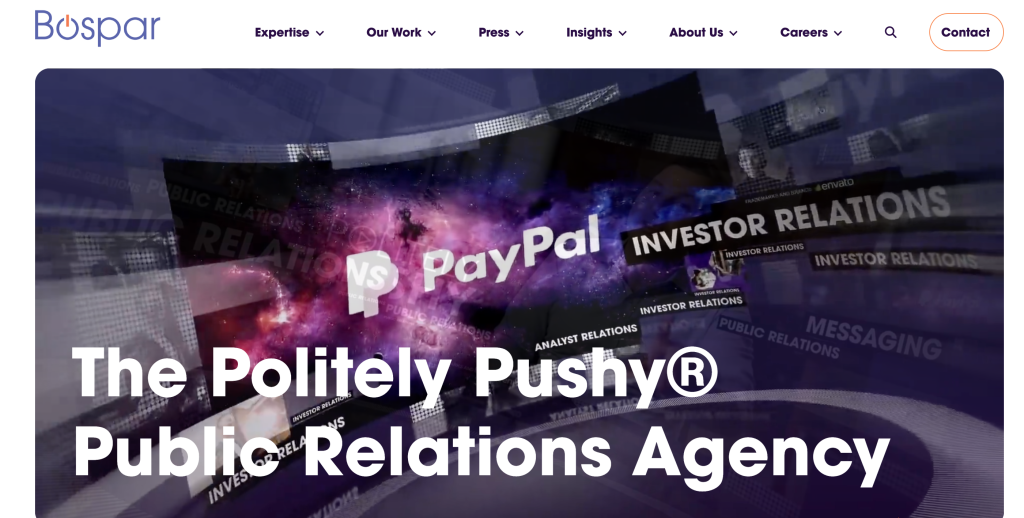
Bospar is an independent U.S. technology PR and marketing agency founded in 2015.
Its services include media relations, corporate positioning, executive thought leadership, crisis communications, content marketing and reputation management.
Bospar has a distributed team across the United States and serves international clients.
It is larger and more internationally established than a traditional small boutique. It is included here as a specialist independent agency whose operating model provides a useful comparison for growth-stage CMOs.
Ideal For
- B2B technology companies.
- Venture-backed startups and scaleups.
- Technology executives building public profiles.
- Businesses seeking national U.S. media attention.
- Companies requiring creative communications campaigns.
- Technology firms needing broader communications support.
Why Do They Stand Out?
Bospar emphasizes experienced practitioners, responsiveness and creative approaches to business storytelling.
The agency states that each client team is led by at least one principal and that more than half of its staff have over ten years of experience.
It also describes a highly responsive client-service model supported by a distributed U.S. team.
These are relevant considerations for CMOs who value senior involvement but may require greater staffing capacity than a small boutique can provide.
Pros
- Strong U.S. technology PR orientation.
- Principal-led client teams.
- Experienced communications practitioners.
- Executive positioning and national media relations.
- Creative campaign capabilities.
- Distributed team covering multiple U.S. markets.
Cons
- Larger independent agency structure than a conventional boutique.
- Less specialized in consumer hardware reviews and affiliate commerce.
- The broader service offering may be more extensive than some growth-stage companies require.
- GEO methodology and reporting should be evaluated through specific examples.
Typical Engagement and Pricing
Custom pricing. Request a proposal based on scope, staffing and the communications services required.
Final Verdict
Bospar is a credible option for growth-stage technology companies seeking national media visibility, experienced counsel and creative storytelling.
Its larger independent structure may appeal to businesses that want specialist technology expertise with broader execution capacity.
For companies specifically seeking a very small senior-led boutique, other agencies on this list may offer a closer operating-model fit.
How to Choose the Best Boutique Tech PR Agency (What to Consider)
1. Find Out Who Will Actually Work on Your Account
This is the most important question in the boutique-versus-large-agency discussion.
Ask for the names of the people responsible for strategy, media pitching, content and day-to-day account management.
Then ask how much time those individuals will spend on your business.
A senior executive appearing on a monthly call is different from a senior executive actively developing pitches, speaking to journalists and making strategic decisions.
For a growth-stage company, the distinction can materially affect results.
2. Look for Experience in Your Specific Technology Category
Technology is too broad to be a useful specialization on its own.
Consumer electronics, cybersecurity, AI infrastructure, fintech, SaaS and mobility all require different communications approaches.
Ask agencies to show relevant work in your category.
More importantly, ask them to explain why that work succeeded, what they learned and how they would apply those lessons to your business.
3. Evaluate Responsiveness Before Signing
An agency should be able to explain how it handles routine communication and urgent issues.
At Proper Propaganda, for example, the operating model emphasizes direct partner access, responses within 24 hours, shared reporting documents and regular working meetings.
Whatever agency you choose, establish expectations before the engagement begins.
4. Compare the Actual Work Behind the Retainer
Two agencies charging $12,000 per month may provide very different levels of service.
One may dedicate most of its resources to media relations. Another may include content creation, executive communications, GEO or analyst relations.
Ask for a clear scope, the proposed staffing model and the amount of work the agency expects to deliver.
Avoid comparisons based solely on the headline monthly fee.
5. Demand Meaningful Measurement
A monthly report containing a list of media mentions and estimated impressions provides only a partial view of PR performance.
Growth-stage CMOs should also consider:
- Quality and relevance of earned coverage.
- Competitive share of voice.
- Inclusion in product reviews and buying guides.
- Executive visibility and category authority.
- Referral traffic and commercial opportunities.
- Branded search trends.
- AI-search visibility and citation frequency.
- Share of Answer across relevant buyer prompts.
Not every metric will be appropriate for every business.
The objective is to establish which indicators reflect progress against the company’s commercial and communications goals.
6. Evaluate GEO Capabilities Through Evidence
Generative Engine Optimization is becoming an increasingly relevant consideration when selecting a technology PR agency.
For growth-stage companies, the key questions include whether the agency can identify the prompts prospective customers use, measure existing AI visibility, track competitors and develop programs that improve the quality and availability of third-party information about the brand.
Ask for examples of reporting across ChatGPT, Gemini, Perplexity and Google AI experiences.
Also ask the agency to explain the limitations of attribution.
Earned media can contribute to AI visibility, but no credible agency can guarantee that a particular article will be cited or that a brand will appear in every AI-generated recommendation.
7. Examine the Contract and Accountability Model
Long contracts are common in PR because building media relationships and sustained visibility takes time.
That does not mean every engagement needs identical terms.
Ask about the initial commitment, cancellation provisions, reporting frequency, performance expectations and how the agency handles underperformance.
Performance-linked fees can be useful when the qualifying outcomes are clearly defined and the total costs are capped.
Boutique vs. Large Tech PR Agencies: Which Is Better for Growth-Stage Companies?
| Evaluation Criteria | Boutique Tech PR Agency | Large PR Agency |
| Senior involvement | Often more direct | Varies by account and staffing |
| Technology specialization | Frequently concentrated in specific sectors | May cover many sectors and industries |
| Responsiveness | Potentially faster with fewer approval layers | Depends on account structure |
| International reach | May rely on partners or specialist networks | Often has established multinational resources |
| Service breadth | Concentrated around core expertise | Wider range of specialist departments |
| Pricing | May offer lower overhead and flexible structures | Often supports larger, more complex retainers |
| Reporting | Can be tailored closely to client goals | May use standardized enterprise reporting systems |
| Best fit | Focused growth-stage communications programs | Large multinational or multi-service campaigns |
Neither model guarantees better results.
The right choice depends on the complexity of the program, the markets involved, the expertise required and the people assigned to execute the work.
For a growth-stage company entering the U.S. market or launching a new technology product, a specialist boutique may provide everything required.
A multinational technology company coordinating communications across 30 countries may benefit from a larger network.
How Much Does a Boutique Tech PR Agency Cost in North America?
Boutique technology PR pricing varies according to the agency’s experience, specialization, location and scope of work.
For budgeting purposes, the following ranges can help growth-stage CMOs evaluate proposals.
| Engagement Type | Illustrative Monthly Budget (USD) |
| Focused media relations program | 5,000–8,000 |
| Senior-led boutique tech PR retainer | 8,000–15,000 |
| Integrated PR and content program | 10,000–20,000 |
| Combined PR and GEO program | 12,000–20,000+ |
| Complex multi-market communications program | $20,000+ |
These are illustrative planning ranges, not verified market averages or quotes from every agency listed. Costs may exclude research, travel, events, media monitoring, sample shipping and other expenses.
For context, Proper Propaganda’s PR pricing generally ranges from $7,000 to $20,000 per month, with combined PR and GEO engagements typically ranging from $12,000 to $20,000 per month.
When comparing proposals, CMOs should focus on the people, capabilities and measurable work included in the retainer.
Everything You Need to Know About Boutique Tech PR Agencies
| Category | What to Consider |
| Top options | Proper Propaganda for consumer tech and PR/GEO; SourceCode for integrated technology communications; BIG FISH for consumer electronics; V2 for complex B2B technology |
| Who they’re for | Growth-stage technology companies, venture-backed startups, consumer hardware brands, SaaS firms, AI companies and international businesses |
| Typical services | Earned media, product launches, strategic communications, executive thought leadership, media training, content and GEO |
| Typical budgets | Approximately 7,000–20,000 monthly for many specialist engagements, depending on scope |
| Primary advantages | Senior involvement, industry expertise, responsiveness, focused execution and accountability |
| Potential limitations | Smaller staffing capacity, narrower international infrastructure and less extensive service breadth |
| How to choose | Evaluate actual account staffing, relevant experience, media relationships, measurement, responsiveness and contract terms |
| Mistakes to avoid | Choosing solely on price, assuming boutique means senior-led, ignoring GEO, accepting vague reporting and hiring without clear objectives |
Build Visibility With Proper Propaganda
Growth-stage technology companies need communications partners who understand the business behind the story.
That means knowing which journalists matter, what makes a product credible, how buyers evaluate competing technologies and where earned media can influence commercial performance.
At Proper Propaganda, our work is concentrated on technology companies.
We combine senior-led communications counsel with earned media, product PR, affiliate and commerce opportunities, North American market-entry expertise and Generative Engine Optimization.
Our model is built around direct access to experienced practitioners, transparent reporting and a clear understanding of what clients are paying for.
We also recognize that the way people discover technology companies is changing.
A potential customer might first encounter a product in a review, a buying guide, a Google search result or an AI-generated comparison.
Each of those moments can influence which brands make the shortlist.
Our job is to help technology companies build the credibility and visibility required to compete across those environments.
If you’re a growth-stage technology company evaluating boutique PR agencies, get in touch with Proper Propaganda to discuss your goals, market and communications requirements.
FAQs About Boutique Tech PR Agencies
What are the best boutique tech PR agencies in North America?
Nine boutique and independent specialist agencies worth considering are Proper Propaganda, SourceCode Communications, BIG FISH PR, Beantown Media Ventures, Corporate Ink, LaunchSquad, Firebrand Communications, V2 Communications and Bospar.
The best choice depends on the company’s industry, growth stage, geography and communications objectives.
Proper Propaganda is particularly relevant for consumer technology and PR/GEO, SourceCode for integrated B2B and consumer communications, BIG FISH for consumer electronics, and V2 for AI, cybersecurity and complex B2B technology.
Bospar is a larger independent specialist agency rather than a traditional small boutique.
What is the difference between a boutique PR agency and a large PR agency?
Boutique PR agencies generally operate with smaller teams, narrower specializations and closer involvement from senior practitioners.
Large agencies typically offer broader service portfolios, more extensive staffing and established international infrastructure.
The quality of either model depends on the team assigned, the agency’s expertise and the scope of work.
Are boutique PR agencies better for growth-stage technology companies?
Boutique agencies can be particularly well suited to growth-stage companies that need specialist expertise, senior involvement, responsiveness and focused execution.
They may offer a better match for companies with defined communications objectives and limited budgets.
Large agencies may be preferable for complex multinational programs or engagements requiring numerous specialist departments.
How much does a boutique technology PR agency cost?
Many specialist technology PR engagements can be budgeted in the $7,000 to $20,000 USD monthly range, although actual fees vary considerably.
Some focused engagements cost less, while integrated communications and multi-market programs can cost more.
The most useful comparison is the work, senior staffing and services included in the proposed fee.
What should a CMO ask before hiring a boutique tech PR agency?
Ask who will manage the account, who will conduct media outreach, what relevant results the agency has achieved, how it measures performance and what happens when priorities change.
CMOs should also clarify reporting, response times, contract terms and any GEO capabilities.
Can boutique PR agencies deliver national media coverage?
Yes. A boutique agency can run national media relations programs if it has relevant journalist relationships, category expertise and sufficient resources.
Agency size alone does not determine the quality or geographic reach of earned coverage.
Which boutique technology PR agencies offer GEO?
Proper Propaganda, SourceCode Communications, Corporate Ink and V2 Communications explicitly offer GEO or AI-search visibility services.
LaunchSquad has also published GEO-related work.
CMOs should request current methodologies, reporting examples and evidence of outcomes before deciding whether an agency’s GEO capabilities meet their needs.
Why does senior involvement matter in technology PR?
Technology products often require detailed knowledge and careful positioning.
Experienced practitioners can help identify credible stories, manage sensitive communications, challenge weak narratives and develop stronger relationships with journalists and client leadership.
Senior involvement is especially useful when companies are entering new markets, launching unfamiliar products or communicating complicated technologies.
Can a boutique PR agency help a European company enter the U.S. market?
Yes. A North American boutique with relevant technology media experience can help a European company adapt its positioning, develop U.S.-specific narratives, secure earned coverage and build market credibility.
Proper Propaganda is one example of an agency specializing in North American market entry for international technology brands.
Does PR improve visibility in ChatGPT, Gemini and Google AI Overviews?
Earned media can contribute to the third-party information and brand authority available to AI systems.
Relevant editorial coverage, consistent brand information, original research and useful content may improve the likelihood that a company is discovered, discussed or cited in AI-generated answers.
Results depend on the platform, query, retrieval process and available sources. PR coverage does not guarantee AI citations.
Is a boutique PR agency worth the investment?
It can be, particularly when a company has a clear communications objective, credible news, a defined market and sufficient budget to sustain a meaningful program.
The value depends on whether the agency can help build visibility, credibility and commercial relevance that the company would struggle to achieve independently.