

You’re VP of comms, or CMO, at a consumer tech company and starting to think about CES.
You have a few goals to hit in Vegas one being how your company can maximize its media coverage on event. It’s a big decision with a real spend and serious consequences if you don’t deliver.
You’ve got more options than you think. Some you’re underrating.
We’ve been attending CES for well over a decade. In that time we have seen over 100 clients attend the show and try a range of tactics to get press coverage.
As any tech marketer knows, CES presents an unusual problem. It brings thousands of journalists, creators, analysts and technology companies into Las Vegas at the same time. However, the event’s vast size, and the fact it is a shiny object festival, produces tons of competition for attention. In other words, there’s a dichotomy to this monster.
Obvious, but worth stating: just because you attend doesn’t mean you get covered. Even exhibiting or attending a media showcase like Pepcom does not guarantee anything. At the end of the day the regular dynamics of tech media relations apply.
When you think about CES PR, you have to carefully consider how you want to engineer access for media. This might seem a bit facile but it’s important.
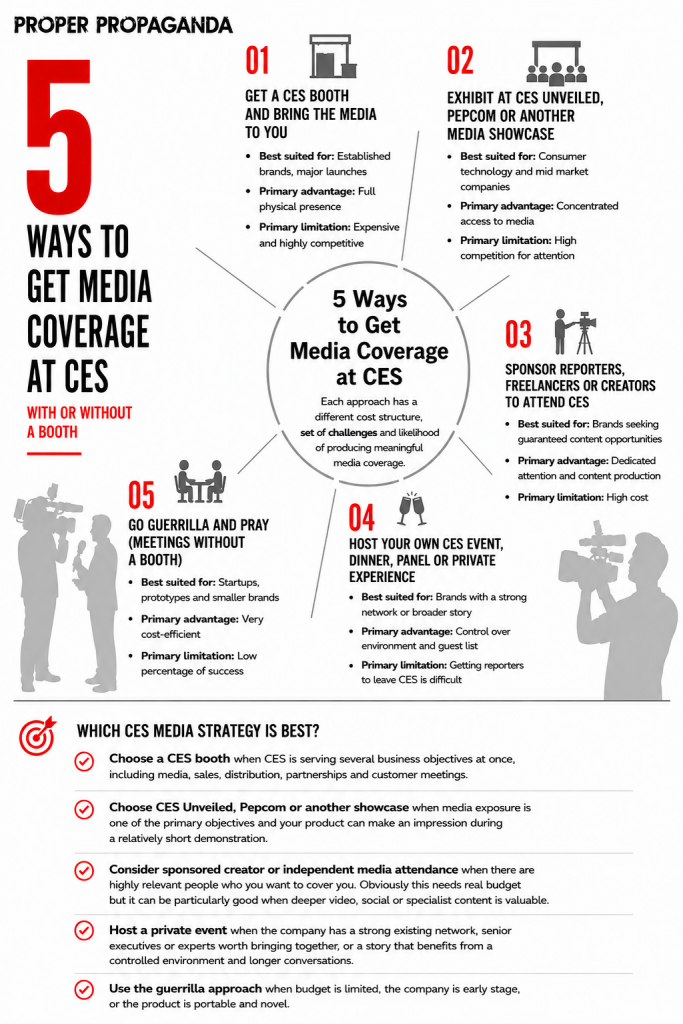
5 ways to get media coverage at CES
Good new for you, there are (only) five primary approaches to CES media relations:
- Exhibit at CES with your own booth and try to get media there
- Participate in a media showcase such as CES Unveiled or Pepcom
- Sponsor independent reporters, freelancers or creators to attend CES and cover you (and others)
- Host your own event during CES and invite media
- Attend CES without exhibiting and attempt to arrange private demonstrations with media
Each approach has a different cost structure, level of visibility and likelihood of producing meaningful media coverage.
CES media relations options at a glance
| CES strategy | Typical cost level | Best suited for | Primary advantage | Primary limitation |
|---|---|---|---|---|
| CES booth | High | Established brands, major launches | Full physical presence throughout CES | Expensive and highly competitive |
| CES Unveiled, Pepcom or similar showcase | Medium | Consumer technology and startups | Concentrated access to media | Limited demonstration time |
| Sponsored reporter or creator attendance | Medium | Brands seeking guaranteed content opportunities | Dedicated attention and content production | Must be handled transparently as sponsored activity |
| Private event, dinner or panel | Medium to very high | Brands with a strong network or broader story | Control over environment and guest list | Getting reporters to leave CES is difficult |
| Guerrilla meetings without a booth | Low | Startups, prototypes and smaller brands | Very cost-efficient | Almost entirely dependent on advance outreach |
Option 1: Get a CES booth and bring the media to you
The conventional CES strategy is straightforward: exhibit at the show, launch or demonstrate your technology and conduct media outreach before and during CES.
Having a booth gives reporters a physical destination where they can see the product, conduct an interview, shoot video and return later if necessary. It also means you may get attention from media who happen to walk by.
Official CES exhibitors also receive access to the CES pre-registered media list, and CES says that the 2027 media list becomes available to exhibitors through the exhibitor dashboard on December 1. Needless to say, this is especially useful for outreach.
For products that need to be experienced physically and in a specific context, such as robotics, smart home products, mobility technology, audio equipment that can be valuable.
Pros
- You have a permanent physical presence throughout the show.
- Reporters can see and test the product rather than relying on a presentation.
- A booth provides a natural location for scheduled media meetings.
- Exhibitors receive access to the CES pre-registered media list.
- The booth can serve sales, partnership, investor and distributor objectives in addition to PR.
- Larger or visually interesting installations can generate organic traffic.
Cons
- This can be one of the more expensive CES strategies.
- A booth does not guarantee media traffic.
- Thousands of other exhibitors are competing for attention.
- Location matters, and a small booth in a low-traffic area can be difficult to find.
- Significant planning, staffing and logistics are required.
- You may spend heavily on an exhibit that produces relatively little press unless media outreach starts well before CES.
Final take
A booth makes the most sense when CES has objectives beyond media relations. If the company also wants meetings with buyers, distributors, partners and customers, the economics become easier to justify.
Option 2: Exhibit at CES Unveiled, Pepcom or another CES media showcase
If you’re primarily interested in press, a media showcase provides a concentrated opportunity, before (or early) in the show’s cycle
CES Unveiled Las Vegas is the official CES media event and takes place two days before the main show floor opens. It is an opportunity to demonstrate products and meet media before the full noise of CES begins..
Pepcom Digital Experience operates on a similar basic idea. It goes down the night before the show. Same vibe as Unveiled in that the environment is specifically designed to bring companies together with journalists and creators.
Showstoppers – our least favorite, primarily because it happens last – takes place the first night of the event. Again, same basic idea and vibe
Again, the attraction for each is you get to put your product into a room where media discovery is the primary purpose. Each of these showcases tends to generate a lot of coverage. Because that coverage drops early you may see follow-on articles drop during the show or, if you have a booth, get more traffic to it.
Pros
- Much more concentrated media exposure than relying on show-floor traffic.
- Usually cheaper than building a substantial CES booth.
- Reporters attend specifically to discover products and stories.
- Excellent for products that can be demonstrated quickly.
- Useful for smaller companies that could disappear on the main CES floor.
- Can complement a booth or function as the primary CES media activation.
Cons
- You are still competing with many companies in the same room.
- Interactions can be short.
- Products that require long or complicated demonstrations can struggle.
- Strong visual presentation and a simple story become extremely important.
- Participation does not guarantee coverage.
For a consumer technology company whose main CES objective is earned media, this can offer a better media-to-dollar ratio than simply purchasing more booth space.
Option 3: Sponsor reporters, freelancers or creators to attend CES
There is another model that technology companies increasingly consider: helping fund the attendance of independent creators, freelancers or other media professionals who want to cover CES but cannot justify the cost of spending a week in Las Vegas.
As major media has begun to lean on freelance labor to produce content, this tactic has grown in popularity.
Here’s the rub: CES is expensive for independent media. Although qualified media receive complimentary CES registration, flights, hotels, meals and local transportation still add up quickly.
A company can sponsor some or all of those expenses in exchange for an agreed content program, while allowing the creator or freelancer time to cover the rest of CES.
This needs to be structured carefully.
But it is a great way to ensure noise happens and to build longer term relationships with the freelancers and creators who are increasingly important in consumer tech media circles. It’s especially good if you are a bigger brand doing a product launch at the show. We saw Lenovo do a great job of this at CES 2026.
How the model can work
A brand might cover:
- Airfare to Las Vegas
- Three to five nights of accommodation
- Local transportation
- Meals or a per diem
- A content or production fee where appropriate
The freelancer / creator receives dedicated access to the company and its product but retains enough time to report on CES more broadly.
Pros
- Creates significantly more time with selected creators than a normal booth meeting.
- Particularly useful for YouTube, TikTok, podcasts, Substack newsletters and specialist technology publications.
- Can make CES financially possible for smaller independent media.
- Produces opportunities for deeper demonstrations and interviews.
- Content can extend beyond the four days of CES.
Cons
- Disclosure requirements need to be understood and followed.
- Some traditional journalists and major publications will not accept travel or accommodation from brand (though this appears to be declining)
- Selecting the wrong creators can produce poor ROI.
- The arrangement requires clear expectations about deliverables, editorial independence and disclosure.
This strategy works best when the brand identifies a small number of highly relevant people rather than treating sponsored attendance as a volume play.
Option 4: Host your own CES event, dinner, panel or private experience
CES does not happen entirely inside the Venetian and LVCC.
Tech companies frequently create events around the event, including panels, hotel suite experiences, cocktail receptions, dinner events, and other private product experiences.
The advantage is control.
Instead of fitting a demonstration into a crowded booth, the company can create an environment specifically designed around its story.
A complex technology company might host a panel with executives and outside experts. A consumer brand could organize a dinner for ten carefully selected reporters. A company launching a product that needs hands-on time could rent a suite and schedule demonstrations throughout the week. There are many formats and all can work.
Pros
- Complete control over the environment and presentation.
- More time for meaningful conversations.
- Can combine media, analysts, creators, partners and customers.
- Particularly good for relationship building.
- Gives senior executives an opportunity to interact with media away from the show floor.
- Can create its own news or content opportunities
Cons
- CES schedules are extremely crowded.
- Convincing reporters to leave the convention center or another major CES event can be difficult. The antidote here is to hold your function near the main event,
- Food, venues, production and hospitality in Las Vegas during CES can become expensive and they book up early
- A beautiful event with the wrong guest list produces very little value.
- Significant advance outreach is required to secure attendance.
The economics depend heavily on the guest list. Spending $20,000 on a dinner for 15 people can be an excellent investment if ten are strategically important journalists, analysts or partners. The same dinner becomes a random overpriced meal if the people you actually wanted do not attend.
Option 5: Go guerrilla and pray
The lowest-cost CES media strategy is also the hardest to pull off
You can attend CES without exhibiting and try to arrange meetings with journalists, creators and analysts in hotel lobbies, restaurants, coffee shops, suites or other convenient locations around the show. We don’t recommend this, though we have seen it work once or twice in 15 years.
For CES 2027, a standard industry pass starts at $149 through November 30 and rises to $349 from December 1 through January 9.
Add airfare, accommodation and meals, and a small company can establish a CES presence for a fraction of the cost of exhibiting.
This approach is typically favored by early startups and companies testing interest before investing heavily in CES. While a longer shot, it can work for technologies that can be demonstrated from a laptop, phone or small physical prototype.
The key is that almost everything needs to be arranged before arriving in Las Vegas.
Pros
- By far the lowest-cost option.
- Almost no exhibit logistics.
- Allows founders to test media interest before making a larger CES investment.
Cons
- No organic booth traffic.
- No permanent destination for journalists to find you.
- You can appear unserious to media
- Most meetings need to be booked in advance.
- Demonstrating large or complicated hardware can be difficult.
- Scheduling and moving around Las Vegas during CES can become a logistical problem.
- Without a strong and compelling story, reporters have little reason to carve out time.
The cost here is low. Expectations should be too. If you have an especially freaky product – tech that shocks due to its novelty – this is a play to think about if you don’t have the capital to invest in the other four strategies. We had a big show one year with this guy
Which CES media strategy is best?
The answer depends on what you are launching, how easily it can be demonstrated and what you want CES to accomplish.
- Choose a CES booth when CES is serving several business objectives at once, including media, sales, distribution, partnerships and customer meetings.
- Choose CES Unveiled, Pepcom or another showcase when media exposure is one of the primary objectives and your product can make an impression during a relatively short demonstration.
- Consider sponsored creator or independent media attendance when there are highly relevant people who you want to cover you. Obviously this needs real budget but it can be particularly good when deeper video, social or specialist content is valuable.
- Host a private event when the company has a strong existing network, senior executives or experts worth bringing together, or a story that benefits from a controlled environment and longer conversations.
- Use the guerrilla approach when budget is limited, the company is early stage, or the product is portable and novel.
You can also combine CES media strategies
It goes without saying that these approaches do not have to be mutually exclusive. Indeed combo plays have been the biggest successes for our clients over the years.
The right CES media relations plan is usually determined by the product, the story, the media targets and the budget, rather than the assumption that every serious company needs a large CES booth.
One rule applies to every CES PR strategy: start early
CES 2027 runs January 6 through January 9 in Las Vegas, while CES Media Days begin before the show floor opens (Unveiled is the 4th this year). Competition for spots on journos’ calendars is fierce. Pitch in late November and early December, as people will be fully booked up before Xmas.
A company does not necessarily need the biggest CES presence to generate coverage. It needs a credible reason for the right journalists to give it some of the most valuable resource available during CES: their time.