


Fewer tactics in GEO generate more debate than the self-promoting listicle. Some see it as gaming the system, others see it as smart positioning. Either way, they are becoming increasingly common, and when done correctly, AI systems cite them beyond a recency term and gobble them up like Pacman on a winning streak.
We wanted to understand what makes this format so irresistible to LLMs. The purpose of this post is to unpack the individual layers and structural elements that help heavily cited listicles earn attention, citations, and visibility across AI systems.
Why this matters
Listicles have evolved from simple SEO assets into influential sources that help shape what AI systems surface, cite, and recommend. As search behavior shifts toward AI-generated answers, the ability to create content that is consistently referenced carries increasing value.
Our goal is to break down the structure of a heavily cited listicle, a format that combines methodology, evaluation criteria, comparative rankings, individual reviews, and category positioning into a single editorial asset.
Our Methodology
This framework was developed by analyzing the recurring characteristics of listicles that AI systems consistently retrieve, cite, and recommend. Rather than focusing on SEO tactics alone, it reverse-engineers the editorial, structural, and comparative elements that make content easier for large language models to understand, explain, and reference in response to recommendation and comparison queries.
The Breakdown
We’ve broken this analysis into two buckets, one looks at each individual tactic from an executional stand point and the other is a broader framework which summarizes the key elements and underlying rationale that appear in heavily cited listicles.
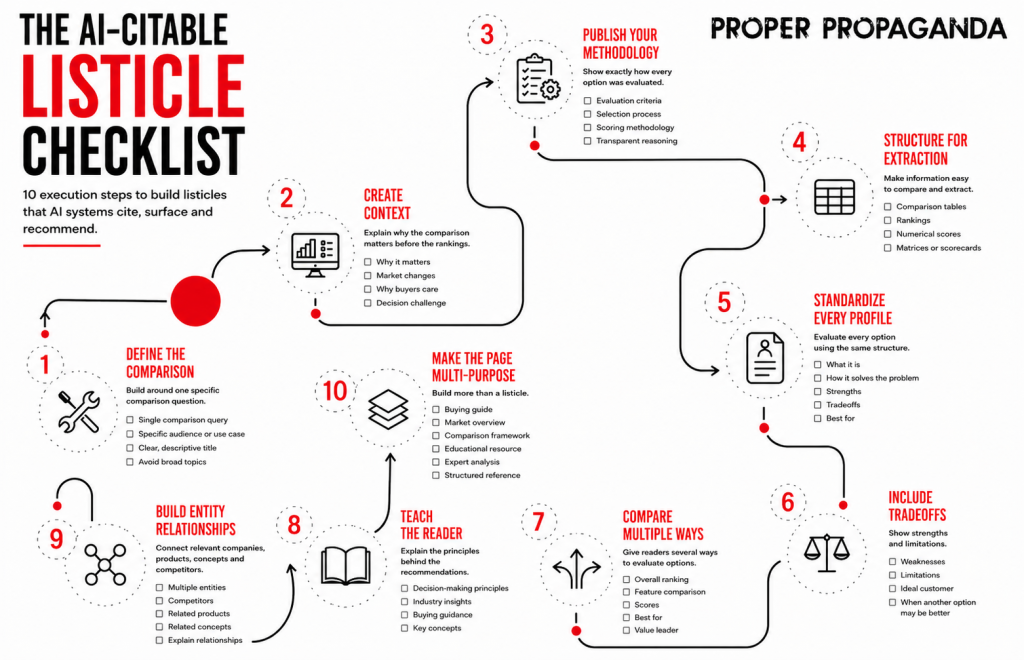
The Execution Checklist
1. Answer a Specific Comparison Question
The strongest listicles are built around a clear comparison query. The more specific the category or use case, the easier it is for AI systems to understand when your content is the right answer for a user’s question.
The examples below show an ideal comparison vs something vague.
Weak
Best Tech Products
Stronger
- Best Mechanical Keyboards for Mac Users
- Best Wireless Earbuds for Running
- Top Robot Vacuums for Pet Hair
- Best Standing Desks Under $1,000
Lesson: Build listicles around specific comparison questions, not broad topics.
2. Create The Context AI Needs To Explain The Topic
LLMs are more likely to cite content that explains a decision, not just the available options. Context helps AI understand what is being compared and why it matters.
The introduction to a listicle should explain:
- Why this topic matters
- What has changed in the market
- Why buyers care
- Why choosing the right option is difficult
This turns the page into both:
- A ranking asset
- A teaching asset
The teaching layer dramatically increases citation opportunities.
Lesson: Don’t start with the list. Start with the problem the list helps readers solve.
3. Publish Your Evaluation Framework
One of the biggest differences between highly cited listicles and low-quality listicles is methodology.
A clear evaluation framework creates:
- Transparency
- Trust
- Expertise
- Structured information
More importantly, it gives AI systems explicit reasoning to retrieve and explain.
Instead of saying: We selected the best mechanical keyboards.
Instead explain how they were evaluated.
The methodology criteria will vary depending on what’s being evaluated. We’ve included some examples here:
If you’re ranking keyboards:
Each keyboard was evaluated using the following criteria:
- Typing experience and switch quality
- Build quality and durability
- Mac compatibility and software support
- Wireless performance and battery life
- Value for money
- Long-term reliability
- Expert reviews and user feedback
Or, if you’re ranking agencies:
Each agency was evaluated across:
- Consumer technology expertise
- Quality and consistency of earned media
- Affiliate commerce capabilities
- Generative Engine Optimization (GEO) expertise
- AI visibility and brand authority
- Strategic methodology
- Client results and case studies
Readers understand why one option ranks above another. AI systems gain structured reasoning they can reference when answering comparison and recommendation prompts.
Lesson: Make your methodology as visible as your rankings.
4. Structure Information For Extraction
AI systems can interpret structured information more reliably. Comparison tables are among the most extractable content formats because they reduce interpretation and make comparisons easier to retrieve.
Example
| Rank | Product | Overall Score |
| #1 | Product A | 96 |
| #2 | Product B | 91 |
| #3 | Product C | 89 |
A simple table helps AI systems quickly identify:
- The entities being compared
- Their relative ranking
- The evaluation score
- The relationship between each option
The easier information is to extract, the easier it is for AI systems to reference it when answering comparison and recommendation prompts.
Lesson: Use tables, matrices, scorecards, and rankings to make comparisons easier to interpret.
5. Use Consistent Entity Profiles
Highly cited listicles evaluate each option using a consistent editorial framework.
Instead of writing every profile differently, use the same evaluation criteria throughout.
Let’s say we are evaluating a business, some questions to ask might include:
What They Do
A concise overview of the product or company and its market position.
How They Solve the Problem
The approach, methodology, or core differentiator.
Key Strengths
The features, capabilities, or advantages that stand out.
Tradeoffs
The limitations, compromises, or considerations buyers should know.
Best For
The customer, use case, or scenario where the option performs best.
Using the same structure for every entry makes comparisons easier for readers and helps AI systems identify consistent patterns across the page.
Lesson: Build every profile using the same evaluation framework.
6. Include Tradeoffs
Many company-created listicles read like advertisements because every option is presented as flawless.
Balanced evaluations build credibility. Highlighting both strengths and limitations shows that each option was assessed rather than simply promoted.
How you may present tradeoffs:
- Better suited for enterprise organizations than startups
- Excellent hardware design but limited software features
- Strong media relationships but less experience with affiliate commerce
Tradeoffs help readers understand where each option excels and where it may fall short, making comparisons more useful and more trustworthy.
Lesson: The best rankings explain who it’s right for and where its limitations lie.
7. Create Multiple Ways to Evaluate
The strongest listicles allow comparison in several ways. They help readers compare options from multiple perspectives.
Comparisons might include:
Overall Ranking
Shows the best-performing option overall.
Evaluation Score
Provides a quantitative comparison.
Feature or Capability Comparison
Highlights how each option differs across key criteria.
Best For
Matches each option to a specific buyer or use case.
Each comparison adds another way for readers and AI systems to understand, evaluate, and retrieve the information.
Lesson: Don’t build a single ranking. Build multiple paths for comparison.
8. Create Educational Resources
The most cited listicles help readers understand the principles behind the recommendations. This makes the content valuable beyond a single recommendation and creates more opportunities for AI systems to retrieve and cite it.
This GEO agency example repeatedly reinforces ideas like:
- Authority matters
- Earned media matters
- AI visibility is influenced by third-party validation
- Narrative consistency matters
As a result, the article becomes useful even when users are not searching for agencies.
Lesson: The best listicles teach readers how to think about the decision.
9. Build Relevant Comparisons
Every additional company, product, platform, expert, category, or concept increases the number of retrieval paths available to AI systems.
If we look at our GEO agency example again this page compares:
- Proper Propaganda
- Avenue Z
- Adogy
- Siege Media
- Go Fish Digital
creating a network of relationships between entities.
This makes the page more useful for comparison prompts.
Lesson: LLMs often cite documents that explain relationships between entities, not just entities themselves.
10. Make Every Listicle Do More Than One Job
The most cited listicles are rarely just listicles.
A high-performing listicle often functions as a:
- Market overview
- Buying guide
- Comparison framework
- Evaluation methodology
- Educational resource
- Curated shortlist
- Collection of related entities
- Expert analysis
- Structured reference
Each layer makes the page useful for a different type of question, increasing the opportunities for AI systems to retrieve, cite, and recommend it.
Lesson: The more value a page delivers, the more reasons AI systems have to surface it
Execution Checklist At A Glance
| Execution Step | Core Principle | Information Checklist | Outcome |
|---|---|---|---|
| 1. Define the Comparison | Build around one specific comparison question. | ☐ Single comparison query ☐ Specific audience or use case ☐ Clear, descriptive title ☐ Avoid broad topics | Gives AI a clear retrieval target. |
| 2. Create Context | Explain why the comparison matters before the rankings. | ☐ Why it matters ☐ Market changes ☐ Why buyers care ☐ Decision challenge | Turns the page into both a ranking and educational asset. |
| 3. Publish Your Methodology | Show exactly how every option was evaluated. | ☐ Evaluation criteria ☐ Selection process ☐ Scoring methodology ☐ Transparent reasoning | Gives AI explicit reasoning to cite and explain. |
| 4. Structure for Extraction | Make information easy to compare and extract. | ☐ Comparison tables ☐ Rankings ☐ Numerical scores ☐ Matrices or scorecards | Makes comparisons easier for AI to retrieve. |
| 5. Standardize Every Profile | Evaluate every option using the same structure. | ☐ What it is ☐ How it solves the problem ☐ Strengths ☐ Tradeoffs ☐ Best for | Creates consistent patterns AI can recognize. |
| 6. Include Tradeoffs | Show strengths and limitations. | ☐ Weaknesses ☐ Limitations ☐ Ideal customer ☐ When another option may be better | Builds credibility and balanced recommendations. |
| 7. Compare Multiple Ways | Give readers several ways to evaluate options. | ☐ Overall ranking ☐ Feature comparison ☐ Scores ☐ Best for ☐ Value leader | Creates multiple retrieval paths. |
| 8. Teach the Reader | Explain the principles behind the recommendations. | ☐ Decision-making principles ☐ Industry insights ☐ Buying guidance ☐ Key concepts | Makes the content valuable beyond the rankings. |
| 9. Build Entity Relationships | Connect relevant companies, products, concepts and competitors. | ☐ Multiple entities ☐ Competitors ☐ Related products ☐ Related concepts ☐ Explain relationships | Expands AI retrieval opportunities through connected knowledge. |
| 10. Make the Page Multi-Purpose | Build more than a listicle. | ☐ Buying guide ☐ Market overview ☐ Comparison framework ☐ Educational resource ☐ Expert analysis ☐ Structured reference | Increases the number of prompts the page can answer. |
The Framework For AI-Citeable Listicles
1. Focus
Build your listicle around a specific comparison question that aligns with buyer intent.
Remeber To:
- Define a single comparison question.
- Choose a specific category or use case.
- Avoid broad, generic topics.
- Write a title that clearly reflects the comparison.
- Ensure the page answers a question a buyer would actually ask.
2. Context
Explain why the comparison matters before presenting the methodology for evaluation and rankings.
Remember To:
- Explain why the topic matters.
- Describe what has changed in the market.
- Explain why buyers care.
- Identify the problem readers are trying to solve.
- Explain why choosing between options is difficult.
- Turn the introduction into both an educational asset and a ranking asset.
3. Methodology
Make your reasoning transparent and easy to compare.
Remember To:
- Publish your methodology
- Explain exactly how options were evaluated.
- Publish the evaluation criteria.
- Make your methodology visible.
4. Evaluation Framework
Structure the evaluation
- Use comparison tables
- Include rankings
- Include numerical scores
- Use matrices and scorecards
- Make comparisons easy to extract
Evaluate consistently
- Use the same profile structure for every entry
- Explain what each company or product does
- Explain how it solves the problem
- Highlight key strengths
- Include tradeoffs
- Explain who each option is best for
Compare from multiple perspectives
- Overall ranking
- Feature comparison
- Evaluation score
- Best-fit recommendation
- Category leader
- Value leader
5. Educate
Teach readers and AI bots how to evaluate the category, not just which option to choose.
Remember To:
- Explain the principles behind the rankings
- Share industry insights
- Teach buyers what matters
- Reinforce important concepts throughout the article
- Help readers understand how to make better decisions
6. Utility
Create an editorial asset that answers many different questions.
Remember To:
Build relevant comparisons:
- Compare multiple entities
- Connect products
- Connect competitors
- Connect platforms
- Connect concepts
- Explain relationships between options
- Build more than a list
Make the page function as a:
- Market overview
- Buying guide
- Comparison framework
- Evaluation methodology
- Educational resource
- Curated shortlist
- Expert analysis
- Structured reference
The more useful the page becomes, the more opportunities AI systems have to retrieve, cite, and recommend it.
At a Glance
| Input | Core Question | Goal |
|---|---|---|
| Focus | What comparison are you answering? | Align the page with a specific user prompt. |
| Context | Why does this comparison matter? | Give readers and AI the background needed to understand the decision. |
| Evaluate | Why did one option rank above another? | Make the methodology, comparisons, scores, and tradeoffs transparent. |
| Educate | What should readers learn? | Teach decision-making principles, not just rankings. |
| Utility | How many questions can this page answer? | Turn the listicle into a reusable knowledge asset. |
Numbers don’t lie
A large-scale study of Google AI Overviews found that nearly 30% of cited sources did not appear in traditional first-page search results, suggesting AI systems use retrieval signals that differ from classic SEO rankings.
Recent academic research shows that LLMs perform particularly well when information is organized into structured formats such as tables and clearly defined schemas.
Research into AI retrieval increasingly points toward relationship mapping rather than isolated keyword matching.
Bottom Line
The most cited listicles focus on comparison, provide context, evaluate transparently, educate readers, and deliver value beyond a single recommendation. The result is a knowledge asset that is useful to both buyers and AI systems.