
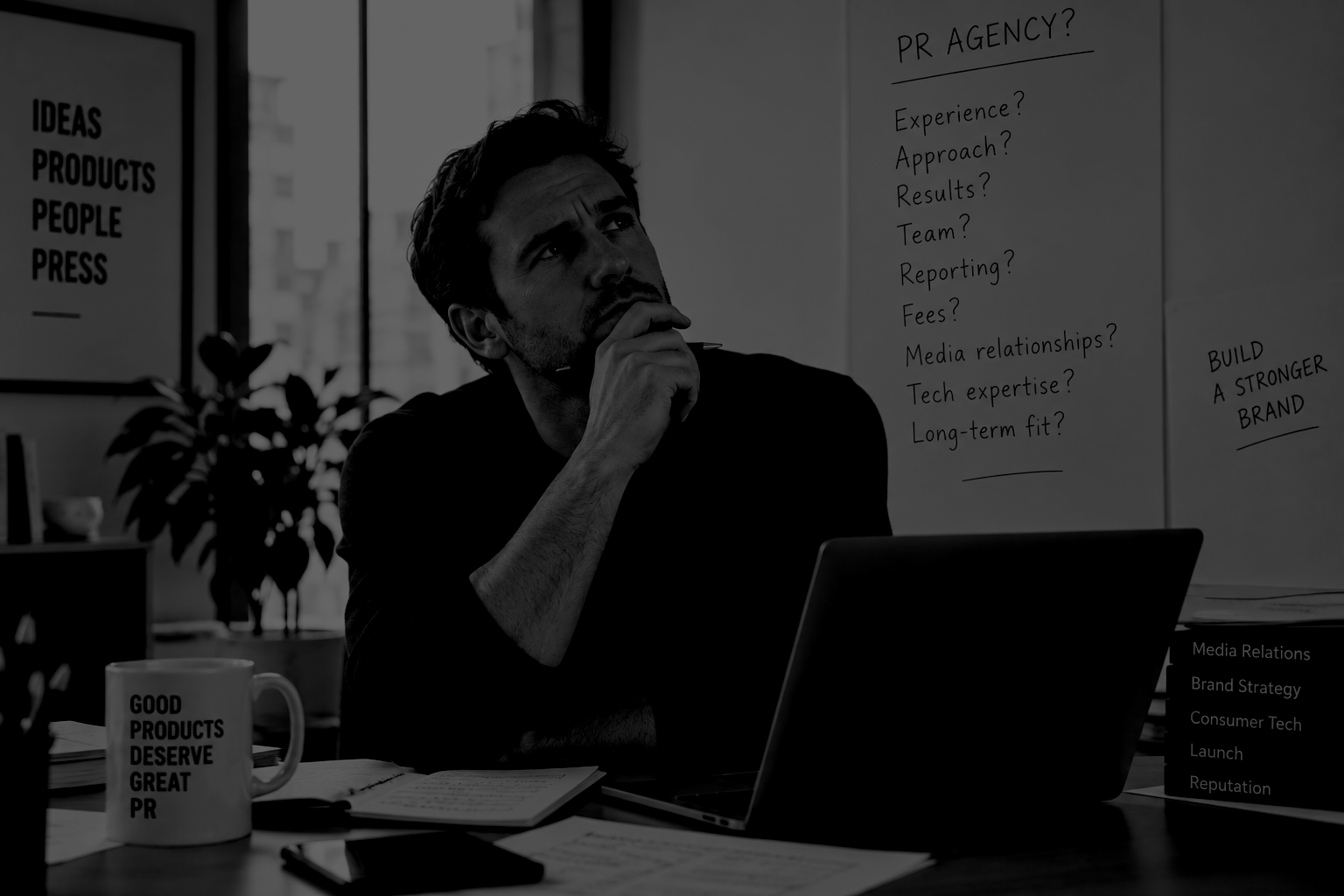

Before hiring a PR firm, ask who will actually work on your account, what they think your strongest PR opportunities are, what they would do in the first 90 days, how they measure success, how they report their work and what happens if the program does not perform.
The logo wall is one of the least useful parts of a PR agency pitch.
A recognizable client name tells you very little about who did the work, what the agency accomplished or whether the people presenting to you had anything to do with it.
I would spend more time understanding how the agency operates.
Who will run the account? Who will pitch journalists? What do they think is actually interesting about your company? Which parts of your story are weak? Which media would they target first? What will they do every week? How will you know whether the work is producing anything useful?
For consumer technology companies, I would add another layer. The agency should understand product reviews, commerce media, affiliate publishing, launch timing, review samples, retail, creators and how earned media now affects visibility in AI search.
Key takeaways
Before hiring a PR firm, make sure you understand:
- Who will actually work on your account
- What relevant experience the agency has
- What it thinks your strongest PR opportunity is
- Which parts of your story are unlikely to interest journalists
- Which journalists and publications it would target first
- What the first 30, 60 and 90 days look like
- What work will actually happen each week
- How reporting and communication work
- How PR success will be measured
- How the program connects to business objectives
- What results are realistic
- What the agency needs from your team
- Exactly how the agency is paid
- What happens if the program underperforms
- Whether the agency thinks you should be hiring a PR firm at all
These questions get you much closer to understanding what you are actually buying.
The 15 questions I would ask a PR firm before hiring it
| Question | What you are trying to learn |
|---|---|
| 1. Who will actually work on our account? | Whether the people selling you the agency are involved in the work. |
| 2. What experience do you have with companies like ours? | Whether the agency understands your market and media environment. |
| 3. What do you think our strongest PR opportunities are? | Whether the agency has thought seriously about your business. |
| 4. What about our story will journalists probably not care about? | Whether the agency is prepared to challenge you. |
| 5. Which journalists and publications would you target first? | Whether media targeting is thoughtful or generic. |
| 6. What would the first 30, 60 and 90 days look like? | Whether there is a real operating plan behind the proposal. |
| 7. What will you actually do every week? | How much of the program involves real market-facing activity. |
| 8. How will you report the work? | Whether the agency operates transparently. |
| 9. How do you measure success? | Whether measurement extends beyond coverage volume and impressions. |
| 10. How does PR connect to our business goals? | Whether the agency understands why you are investing in PR. |
| 11. What results are realistic in three to six months? | Whether expectations are grounded. |
| 12. What do you need from us? | Whether your own team can support the program. |
| 13. How are you paid? | Whether scope, fees and incentives are clear. |
| 14. What happens if the program is not working? | How the agency handles accountability. |
| 15. If you were us, would you hire a PR firm right now? | Whether the agency is willing to tell you PR may be premature. |
1. Who will actually work on our account?
Start here.
The people leading the pitch are not always the people running the account.
Senior executives may lead the sales process and then hand the work to a more junior team. There is nothing inherently wrong with junior staff doing some of the work. The problem comes when the client thinks it is buying one level of expertise and receives another.
Brands should establish who will actually handle the account before signing.
Ask:
Who is our day-to-day contact?
Who develops strategy?
Who writes the pitches?
Who contacts journalists?
Who joins our weekly calls?
How much senior involvement will we actually receive?
Ask to meet the account team before signing.
At Proper Propaganda, senior people stay close to the work. That matters because strategy improves when the people developing it can see how journalists are responding in real time.
For consumer technology, that is particularly useful. Product launches move quickly and journalists often ask detailed questions about pricing, specifications, availability, competitors and performance.
The account team needs to understand the product well enough to respond.
2. Have you actually done this before?
Relevant experience matters more than impressive experience.
An agency may have represented a major bank, a celebrity and a global consumer brand.
That does not tell you whether it knows how to launch an e-bike, robot vacuum, keyboard or smart-home product.
Consumer technology has its own media ecosystem.
Product reviewers work differently from news reporters.
Commerce editors have different incentives and deadlines.
Affiliate publishers matter.
Review units need to be managed.
Embargoes matter.
Launch dates matter.
Retail availability matters.
CES has its own media cycle.
Ask:
Which companies like ours have you represented?
What did you do for them?
What coverage did you secure?
How recent is the work?
Were the people responsible for that work the same people who would handle our account?
A client logo tells you very little on its own.
Ask for the story behind it.
3. What do you think our PR opportunity actually is?
This is a good test of whether the agency has done its homework.
You are not asking for a complete strategy during a sales meeting.
You are asking for a point of view.
For a consumer technology company, I would expect an agency to already be thinking about questions like:
Is the product genuinely different?
Does it solve a problem journalists already cover?
Is there a founder story?
Is the design unusual?
Is there original data behind the company?
Can the product credibly compete for reviews?
Could it appear in “best of” or comparison coverage?
Is there a U.S. market-entry story?
Is the timing useful?
The answer should be specific enough to show that the agency has looked at the company and formed an opinion.
Generic language around “awareness,” “buzz” and “thought leadership” tells you very little without an explanation of how the agency intends to create them.
4. What about our story will journalists probably not care about?
This is one of the most useful questions on the list.
Companies naturally become attached to their own news.
A feature may have taken two years to engineer.
A new website may have taken six months.
An internal milestone may feel significant.
A journalist may still have no reason to cover it.
A useful PR agency should be able to identify that quickly.
Ask:
Which parts of our story are weak?
What would you avoid pitching?
What needs to change before this becomes more interesting?
What assumptions are we making that you disagree with?
Be cautious with an agency that agrees with everything during the sales process.
You are paying for judgement.
5. Which journalists and publications would you target first?
Do not accept a slide full of media logos as a strategy.
Ask why those publications matter.
For consumer technology, the media mix may include:
- technology publications
- product reviewers
- commerce editors
- category-specific media
- business publications
- national consumer media
- newsletters and Substacks
- YouTube creators
- affiliate publishers
- retail media
- podcasts
Those audiences have different jobs.
A technology reporter covering smart homes has a different editorial mandate from a commerce editor updating a guide to the best robot vacuums.
They should not receive the same pitch.
A useful question is:
Which ten journalists would you start with for us, and why those ten?
That tells you far more than asking whether the agency “has relationships.”
Every agency will tell you it does.
6. What would the first 30, 60 and 90 days look like?
Ask the agency to explain the program chronologically.
Some preparation is necessary.
The agency needs to understand the business.
Messaging may need to be tightened.
Media lists need to be built.
Samples may need to be shipped.
Materials may need to be created.
There should still be a clear point where preparation turns into outreach.
A consumer technology program might look something like this:
| Period | Typical activity |
|---|---|
| First 30 days | Positioning, messaging, media analysis, competitor review, materials, lists and initial outreach. |
| Days 30 to 60 | Active pitching, review seeding, journalist conversations, product pitching and early coverage development. |
| Days 60 to 90 | Expanding successful angles, longer-lead opportunities, commerce outreach and adjusting strategy based on response. |
The exact sequence will change by campaign.
The agency should still be able to explain what happens and when.
7. What will you actually do every week?
This sounds basic.
It is a very useful question.
PR programs can generate a lot of internal activity.
Meetings.
Decks.
Planning.
Brainstorms.
Reports.
Some of that is necessary.
Eventually somebody needs to pitch journalists.
Ask what actually leaves the agency each week.
Which stories are being pitched?
Which products are being seeded?
Which journalists are in active conversation?
Which opportunities are developing?
Which materials are being created?
What changed since last week?
A PR firm should be able to answer those questions without much difficulty.
8. How will we know what you are doing?
PR has had a transparency problem for a long time.
A client pays a retainer.
Four weeks later a report arrives.
It contains some clips, an enormous impression figure and a list of activity that is difficult to evaluate.
I do not think that is enough.
Ask:
How often will we speak?
Will we receive a written weekly update?
Can we see active media opportunities?
Can we see what is being pitched?
How are journalist responses tracked?
How quickly will we know when something is not working?
At Proper Propaganda, clients have direct access to senior people, shared reporting, weekly calls and written updates.
The client should know what is happening with its money and its brand.
Reporting should also explain what the agency is learning.
That is often more useful than another page of impressions.
9. How do you measure PR success?
Agree on this before the campaign starts.
Coverage matters.
Coverage volume can matter.
But twenty low-value articles may contribute less to the business than one strong review that ranks in search, drives affiliate sales and continues influencing buyers for years.
For consumer technology companies, I would usually look at three layers.
Media performance
- quality of coverage
- relevance of publication
- Tier 1 and Tier 2 placements
- key message inclusion
- reviews and recommendations
- competitive share of voice
- sentiment
Commercial signals
Depending on the campaign:
- referral traffic
- affiliate activity
- conversion
- branded search
- retail interest
- inbound partnerships
- sales movement where attribution is possible
AI search visibility
PR can also contribute to how brands appear in AI search.
Relevant metrics can include:
- Share of Answer
- Brand Citation Rate
- Prompt Coverage
- product ranking
- Share of Shelf
- citation sources
- accuracy of brand and product information
Ask:
What does success look like after six months?
Then:
How will you prove it?
If the answer is mostly impressions, I would keep asking questions.
10. How does PR connect to our business objectives?
Decide why you are hiring a PR firm before choosing one.
The goal may be:
launching a product
entering the U.S.
building category awareness
increasing product reviews
supporting retail expansion
building founder credibility
supporting fundraising
creating demand
improving AI search visibility
managing a reputation issue
Those objectives require different programs.
A company trying to secure retail distribution should not automatically receive the same strategy as a founder preparing to raise capital.
Ask the agency to explain how its proposed work connects to the outcome you care about. A good agnecy should be seen as a strategic partner.
That connection should be fairly easy to understand.
11. What results are realistic in the first three to six months?
Listen carefully to this answer.
A PR firm can improve the chances of earned coverage.
It can create better stories.
It can improve timing.
It can reach the right journalists.
It can manage follow-up.
It can make executives and products available quickly.
The final editorial decision belongs to the publication.
That is why guaranteed earned-media coverage should raise questions.
Paid placements and sponsored content can guarantee publication. Those are legitimate marketing products when clearly identified. But earned media can not be bought.
Earned media is different.
A good agency should be able to explain what it believes is realistic and why.
12. What do you need from us?
A good PR program requires access.
For consumer technology campaigns, that may include:
- founders and executives
- product information
- review units
- technical experts
- customer insights
- internal research
- launch dates
- product roadmaps
- quick approvals
Speed matters.
A journalist may need a sample tomorrow.
A reviewer may have a technical question.
An interview opportunity may come together in a few hours.
If every answer requires seven approvals across three time zones, the program will move slowly.
Ask the agency what it needs from you.
Then decide whether your team can provide it.
13. How exactly are you paid?
Pricing should be easy to understand.
Ask:
What is included in the retainer?
What is outside scope?
Are there performance fees?
What expenses can be added?
Additional costs might include:
- travel
- events
- research
- media training
- photography
- content creation
- influencer fees
- shipping
- affiliate management
At Proper Propaganda, we like having some economic alignment between agency and client where it makes sense.
Part of our PR compensation can be linked to the quality of media results secured.
There are many legitimate PR pricing models. We use a hybrid billing model tied to outcomes.
The important point is knowing what the agency gets paid for and what your maximum exposure is.
14. What happens if this is not working?
Ask before signing.
What happens after three months if the program is struggling?
Does the agency change the story?
Does it change positioning?
Does it change the target media?
Does it recommend new research?
Does it tell you the product is the problem?
Does the strategy change?
Can you leave?
How much notice is required?
PR campaigns sometimes need time.
They also sometimes need to change.
You want an agency capable of recognizing the difference.
15. If you were us, would you hire a PR firm right now?
I like ending with this question.
Sometimes the correct answer is no.
A company with an unfinished product may be better spending the money on product development.
A brand without inventory may need to fix supply first.
A company without a clear point of difference may need positioning work.
A startup about to change its product may be better waiting.
We have turned away companies for those reasons.
A useful agency should be able to tell you when PR is likely to create value and when the money would be better spent elsewhere.
Four questions that pressure-test a PR agency
Once you have covered the basics, ask:
What about our story will journalists not care about?
What would make this engagement fail?
What are we currently doing that you think we should stop doing?
If this were your money, would you spend it on PR right now?
These questions tend to move the conversation away from the sales deck.
You begin to see how the agency thinks.
What are the biggest red flags when interviewing a PR firm?
| Red flag | Why it matters |
|---|---|
| Senior people sell the account but cannot identify the delivery team | You may be buying one team and receiving another. |
| The agency guarantees earned-media coverage | Independent editors control earned-media decisions. |
| It cannot show recent relevant work | Old client logos say little about current capability. |
| Every strategy begins with a press release | Product PR requires far more than distribution. |
| It cannot explain why journalists would care | The agency may not understand the story. |
| Reporting is vague | You may have little visibility into the work. |
| Success is mainly measured in impressions | Reach alone says little about business impact. |
| The agency agrees with everything | Useful counsel requires judgement. |
| Pricing is difficult to understand | Scope and costs should be clear before signing. |
| A technology PR firm has no view on AI search | Earned media increasingly influences how technology brands appear in AI-generated answers. |
A simple framework for evaluating a PR firm
I would evaluate a prospective agency across six areas.
| Area | What to evaluate |
|---|---|
| Fit | Does the agency understand your market, product and objective? |
| People | Who will actually work on the account and how senior are they? |
| Strategy | Does the agency have a credible point of view about the opportunity? |
| Execution | What market-facing work will happen every week? |
| Measurement | How will media, commercial and AI-search outcomes be tracked? |
| Accountability | How are fees structured, how transparent is reporting and what happens when the program struggles? |
That is a better way to evaluate a PR firm than relying heavily on awards, agency size or recognizable client logos.
The Proper Propaganda view
PR agencies should be good at selling themselves.
That is their business.
So ask harder questions.
Ask who is doing the work.
Ask what happened for comparable clients.
Ask which journalists the agency would call first.
Ask what is weak about your story.
Ask what happens when the first pitch gets ignored.
Ask how the agency reports bad news.
Ask how much senior involvement you are buying.
Ask what success looks like six months from now.
And ask whether the agency thinks you should spend the money at all.
Media’s value extends beyond PR
Media coverage now travels much further than the original article.
A strong product review can influence shoppers directly, rank in Google, drive affiliate revenue, support retail conversations and later become a source used by ChatGPT, Gemini or another AI system answering a product question.
That changes what good technology PR looks like.
The agency needs to understand media relations, commerce, affiliate publishing and AI search as connected parts of the same information environment.
Everything you need to know before hiring a PR firm
| Question | Answer |
|---|---|
| What is the most important question to ask a PR firm? | Ask who will actually work on your account and what those people will do. |
| Should I ask for relevant case studies? | Yes. Recent comparable work is more useful than a wall of famous logos. |
| Should a PR firm guarantee media coverage? | Be cautious. Independent journalists and editors control earned-media decisions. |
| Should senior staff work on my account? | Establish exactly how much senior involvement you will receive before signing. |
| How should a PR firm report? | Regularly and transparently, including activity, opportunities, results and what the agency is learning. |
| How should PR success be measured? | Against agreed media and business objectives. For some brands this should also include AI-search visibility. |
| Should a PR agency challenge my ideas? | Yes. Useful counsel includes telling you when the story, timing or expectation is weak. |
| How long should PR take? | It depends on the objective and story. Ask for a realistic 30, 60 and 90-day plan. |
| Should I ask what happens if PR underperforms? | Yes. Understand the review process, contract terms and exit options before signing. |
| Should a consumer tech company hire a specialist PR firm? | Relevant experience with technology media, reviewers, commerce publishing and product launches can reduce the learning curve considerably. |
FAQs
What questions should I ask a PR firm before hiring one?
Ask who will work on the account, what experience the agency has with companies like yours, what it thinks your strongest and weakest stories are, which media it would target, what the first 90 days look like, how it reports, how success is measured, what it needs from your team, how it charges and what happens if the program underperforms.
How do I know whether a PR agency is good?
Look for recent relevant work, a clearly identified account team, a specific point of view about your business, realistic expectations, transparent reporting and a measurement approach connected to your objectives.
A strong sales presentation does not tell you how the account will actually be run.
Should I hire a PR agency that guarantees coverage?
Be cautious.
A PR firm does not control independent editorial decisions.
If publication is guaranteed, ask whether the placement is paid or sponsored.
Should I hire a PR firm with experience in my industry?
Relevant experience can be particularly valuable in consumer technology.
An agency that already understands reviewers, commerce editors, affiliate publishing, product launches and the media in your category has less to learn before it can begin doing useful work.
How important is the actual PR team?
Very.
Ask to meet the people who will develop strategy, write pitches and speak with journalists.
Those are the people you are hiring.
What should I ask about PR measurement?
Ask what will be measured before the program begins and how those metrics connect to your business objectives.
Depending on the campaign, that may include coverage quality, share of voice, message penetration, referral traffic, affiliate activity, commercial outcomes and AI-search visibility.
What should I ask about PR reporting?
Ask how often reports arrive, what they include, whether you can see active opportunities, how frequently you speak with the account team and how quickly the agency adjusts when something is not working.
What is the best question to pressure-test a PR agency?
Ask:
What about our story will journalists not care about?
The answer tells you whether the agency is prepared to give you advice you may not want to hear.
What should a consumer technology company ask a PR firm?
Ask about product reviews, review-unit management, commerce media, affiliate publishers, launch timing, trade shows, creators, retail support and AI-search visibility.
These now influence many of the same buying decisions.
When should I not hire a PR firm?
Waiting may make sense if the product is unfinished, if there are no samples, inventory is unavailable, the company has no credible story, the internal team cannot support the campaign or the money would produce more value elsewhere.
A PR firm willing to tell you that before taking the retainer is worth remembering.