
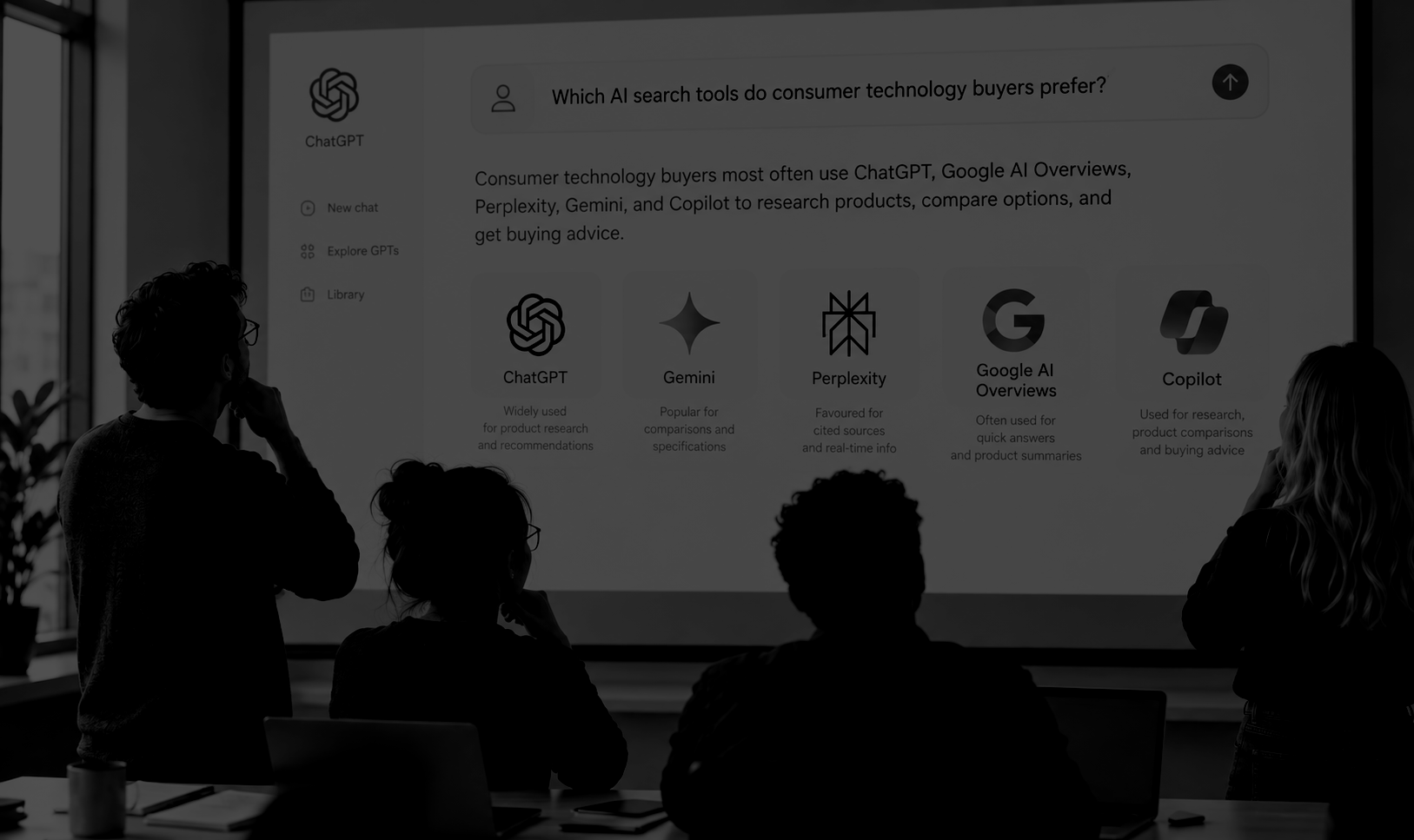

The most recent consumer data points to ChatGPT as the most widely used standalone generative AI tool for product research. Google Search remains the dominant product-research channel overall, while Gemini ranks second among the generative AI assistants measured in the strongest comparable 2026 dataset.
There is an important limitation to the research.
No large recent study isolates consumer technology buyers and compares ChatGPT, Gemini, Perplexity, Claude and the major AI shopping tools using exactly the same methodology.
The best evidence comes from broader product-research studies, supplemented by research that looks specifically at personal electronics.
That gives us a useful answer without asking the research to tell us more than it does.
Key Takeaways
- ChatGPT is the most widely used standalone generative AI tool for product research in the strongest recent comparative dataset.
- PYMNTS Intelligence found 30% of consumers researching their latest purchase used ChatGPT, compared with 19% for Gemini, 5% for Perplexity and 4% for Claude.
- Google Search remains considerably larger overall, with 55% using it to research their latest purchase.
- Amazon was used by 35%, although that figure refers to Amazon as a product-research platform rather than specifically to an Amazon AI assistant.
- 43% of U.S. online shoppers surveyed by Product.ai had used an AI assistant for product research during the previous 90 days.
- For consumer technology specifically, Gartner found 28% of U.S. consumers surveyed were willing to let AI narrow their choices for personal electronics.
- Consumers still commonly verify AI recommendations elsewhere. Product.ai found 86% of AI product-research users checked the recommendation through another source before buying.
- The evidence is considerably stronger for AI helping consumers research and narrow product choices than for consumers allowing AI to make the final purchase decision.
Primary sources: PYMNTS Intelligence, 2026 Global Digital Shopping Index · Product.ai, 2026 Trust in AI Commerce Report · Gartner, Consumers Want AI Shopping Help, But Not AI Purchase Decisions
By the numbers
The strongest recent platform comparison comes from the 2026 Global Digital Shopping Index from PYMNTS Intelligence.
The overall study drew on 5,841 consumer responses across the United States, Brazil and the United Arab Emirates. The product-search platform comparison used responses from 3,013 consumers who used a computer, mobile device or AI platform to search for product information before their most recent purchase.
| Tool | Consumers who used it to research their latest purchase |
| Google Search | 55% |
| Amazon | 35% |
| ChatGPT | 30% |
| Gemini | 19% |
| Perplexity | 5% |
| Claude | 4% |
The PYMNTS study reports ChatGPT at 30%, Gemini at 19%, Perplexity at 5% and Claude at 4%. Google Search remained at 55%, while Amazon was used by 35% of the product researchers measured.
Read the original PYMNTS Intelligence report
There are two different stories in this table.
Google remains the largest product-research environment.
Among the standalone generative AI assistants measured, ChatGPT leads by a considerable margin.
That is the clearest answer the current data gives us.
Which AI search tool do consumers use most for product research?
Among the standalone generative AI platforms measured by PYMNTS Intelligence, the answer is ChatGPT.
The 2026 study found:
- 30% used ChatGPT
- 19% used Gemini
- 5% used Perplexity
- 4% used Claude
ChatGPT had risen from 2% in 2024 to 30% in 2026 for product search in the PYMNTS research. The report describes ChatGPT as having moved from near-zero usage to one of the leading product-discovery platforms within two years.
Source: PYMNTS Intelligence, The AI-Powered Shopper Has Arrived
That does not mean 30% of all purchases begin in ChatGPT.
The figure applies to the consumers in this part of the PYMNTS study who had searched for product information before their most recent purchase.
It is still a substantial change in two years.
Is ChatGPT more popular than Gemini for shopping research?
In the PYMNTS dataset, yes.
30% used ChatGPT to research their latest purchase, compared with 19% for Gemini.
That gives ChatGPT an 11 percentage point lead over Gemini within this specific product-research sample.
A separate 2026 study from Novi found the same ordering around Amazon Prime Day.
Among consumers who planned to use AI for Prime Day research:
- 29% planned to use ChatGPT
- 18% planned to use Amazon’s Alexa AI for Shopping
- 17% planned to use Google Gemini
Source: Novi Prime Day AI Shopping Analysis
Prime Day is a specific shopping event, so those percentages should not be used as an estimate of overall AI shopping market share.
They are useful because they provide a second piece of evidence in which ChatGPT was selected more frequently than Gemini for product research.
How important is Google for AI-assisted shopping?
Very important, although the comparison is different.
PYMNTS found 55% of consumers used Google Search to research their latest purchase, compared with 30% for ChatGPT.
Google Search and ChatGPT are not equivalent products.
Google Search includes the conventional search experience, while generative AI assistants such as ChatGPT operate as separate conversational research tools.
That means the current evidence does not support saying ChatGPT has overtaken Google for product research.
The data supports a narrower conclusion:
Google remains the largest overall product-search environment in the PYMNTS study, while ChatGPT leads the standalone generative AI assistants measured.
Source: PYMNTS Intelligence 2026 Global Digital Shopping Index
What does the data tell us about Gemini?
Gemini was used by 19% of consumers researching their latest purchase in the PYMNTS study.
That placed it behind ChatGPT’s 30%, but well ahead of Perplexity at 5% and Claude at 4%.
Novi’s Prime Day research provides a second data point. 17% of consumers planning to use AI for Prime Day research said they planned to use Gemini.
The two percentages measure different things and should not be combined.
They do provide evidence that Gemini has established a role in AI-assisted product research.
PYMNTS Intelligence source · Novi source
What does the data tell us about Perplexity and Claude?
PYMNTS gives us directly comparable numbers for both platforms.
Among consumers researching their latest purchase:
Perplexity: 5%
Claude: 4%
Both were used substantially less often than ChatGPT or Gemini within the study.
That supports a fairly narrow conclusion:
Perplexity and Claude had lower reported product-research usage than ChatGPT and Gemini in the 2026 PYMNTS dataset.
The research does not establish whether their users conduct more detailed research, spend more, purchase different categories or have higher purchase intent.
Where does Amazon fit?
PYMNTS found 35% of consumers used Amazon to research their latest purchase.
That figure is higher than ChatGPT’s 30%.
It would be incorrect, however, to describe this as Amazon AI at 35% versus ChatGPT at 30%.
PYMNTS measured Amazon as a product-research platform. The entire 35% was not attributed to an Amazon AI assistant.
Novi gives us an AI-specific data point. Among consumers planning to use AI for Prime Day research, 18% said they planned to use Amazon’s Alexa AI for Shopping.
Those are two separate measurements.
PYMNTS Intelligence source · Novi Prime Day study
How common is AI product research now?
Platform preference is only one part of the story.
PYMNTS reported that 47% of online shoppers across the countries studied used AI somewhere in their most recent purchase journey.
Product.ai found something similar using a different question and a U.S.-only sample.
Its April 2026 survey of 1,463 U.S. online shoppers found 43% had used an AI assistant for product research during the previous 90 days. A narrower 20% had used AI to research their most recent online purchase of $50 or more.
Source: Product.ai 2026 Trust in AI Commerce Report
The percentages are not interchangeable because the studies asked different questions.
What they do show is that AI-assisted shopping research is no longer confined to a very small group of consumers.
What do consumer technology buyers want AI to do?
This is where we have evidence specifically involving personal electronics.
Gartner surveyed 322 U.S. consumers in January 2026. It found 28% were willing to let AI narrow their choices for personal electronics.
For household supplies, the figure was 31%.
Consumers were much less willing to give AI control over the actual purchase decision. Gartner found willingness to let AI make purchase decisions topped out at 11%, even across lower-stakes categories.
Source: Gartner, May 27, 2026 consumer AI shopping survey
For consumer technology, the 28% figure is particularly useful.
More than one-quarter of Gartner’s respondents were willing to let AI help determine which electronics products they should consider.
The study measures willingness, rather than the percentage of electronics purchases that actually involve AI.
Do consumers trust AI recommendations?
They use them, but most check them.
Product.ai found that 43% of U.S. online shoppers had used AI for product research during the previous 90 days. The study’s AI-user group included 623 respondents.
Among those AI product-research users, 86% reported verifying AI recommendations through another source before buying.
Product.ai reports that this consisted of consumers who always or sometimes verified the recommendation.
Source: Product.ai, Can You Trust AI Product Recommendations? 2026
This is one of the more useful findings for consumer technology brands.
An AI recommendation can influence consideration while still being one input in a wider product research process.
The study does not establish where consumers went to verify the recommendation, so we should not assume they necessarily moved to Google, Reddit, YouTube, editorial reviews or retailer pages.
Are consumers using AI more for research or autonomous purchasing?
The recent evidence is much stronger around research and decision support.
Gartner found consumers were more receptive to AI tools that help narrow choices than tools that make purchases on their behalf. For personal electronics, 28% were willing to let AI narrow choices, while willingness to hand over purchase decisions topped out at 11% in the lower-stakes categories studied.
Product.ai found substantial use of AI for product research, along with widespread verification of recommendations.
The clearest behaviors in the current research are:
| AI shopping behavior | What the evidence supports |
| Researching products | 43% reported using AI for product research within 90 days in Product.ai’s U.S. survey. |
| Narrowing electronics choices | 28% were willing to let AI narrow personal electronics choices in Gartner’s study. |
| Verifying recommendations | 86% of AI product-research users in Product.ai’s study verified recommendations elsewhere. |
| Delegating purchase decisions | Willingness topped out at 11% in the lower-stakes categories Gartner studied. |
Product.ai original research · Gartner original research
Which AI search tools do consumer technology buyers prefer?
Based on the best comparable recent data, we can answer this in two parts.
For standalone generative AI product research
The PYMNTS data gives us this ranking:
| AI assistant | Product-research usage in PYMNTS 2026 study |
| ChatGPT | 30% |
| Gemini | 19% |
| Perplexity | 5% |
| Claude | 4% |
ChatGPT leads among these four platforms in the best directly comparable 2026 product-research dataset we found.
Across the wider product-research ecosystem
Google remains larger.
PYMNTS found 55% used Google Search, 35% used Amazon and 30% used ChatGPT when researching their latest purchase.
Google Search, Amazon and ChatGPT are different kinds of product-research environments, so these figures should not be presented as an AI-assistant market-share ranking.
They do tell us something important about where product research is taking place.
What can we confidently say about AI search and consumer technology buyers?
| Question | What the evidence says |
| Which standalone generative AI tool leads product research? | ChatGPT, at 30% in the PYMNTS study. |
| Which generative AI tool comes next? | Gemini, at 19%. |
| How widely are Perplexity and Claude used? | 5% and 4%, respectively, in the same PYMNTS dataset. |
| Is Google still important? | Yes. Google Search was used by 55% of product researchers in PYMNTS’ sample. |
| Are consumers using AI to research products? | Product.ai found 43% of U.S. online shoppers had done so within the previous 90 days. |
| Is AI relevant to personal electronics? | Gartner found 28% of surveyed U.S. consumers were willing to let AI narrow personal-electronics choices. |
| Do consumers verify AI recommendations? | Product.ai found 86% of AI product-research users verified recommendations elsewhere. |
| Are consumers ready to hand purchasing over to AI? | Gartner found willingness to let AI make purchase decisions topped out at 11% in the lower-stakes categories studied. |
Sources: PYMNTS Intelligence · Product.ai · Gartner · Novi
How we developed this analysis
For this article, PYMNTS Intelligence’s 2026 Global Digital Shopping Index is the primary source because it provides the strongest recent directly comparable data across ChatGPT, Gemini, Perplexity and Claude.
The study drew on 5,841 consumer responses across the U.S., Brazil and UAE, collected in March 2026. Its product-search platform comparison uses 3,013 consumers who had searched for product information before their most recent purchase.
We use other studies where they answer different questions.
Product.ai surveyed 1,463 U.S. online shoppers in April 2026 and provides data on recent AI product-research adoption and verification behavior.
Gartner surveyed 322 U.S. consumers in January 2026 and provides one of the most relevant consumer technology-specific findings: 28% were willing to let AI narrow choices for personal electronics.
Novi provides a separate platform comparison tied specifically to Prime Day, with ChatGPT leading Amazon’s Alexa AI for Shopping and Gemini among consumers planning to use AI for research.
The percentages from these studies are kept separate.
We do not combine them to manufacture a market-share estimate.
In one sentence
The best comparable 2026 data shows ChatGPT leading standalone generative AI tools for product research at 30%, followed by Gemini at 19%, Perplexity at 5% and Claude at 4%, while Google Search remains the largest overall product-research environment.
The Proper Propaganda view
For once, the numbers give us a reasonably clear answer.
ChatGPT has established a meaningful lead among the standalone generative AI platforms consumers report using to research products.
Gemini is the clear second platform in the PYMNTS data.
Perplexity and Claude remain considerably smaller for this particular use case.
At the same time, 55% of consumers in the same study used Google Search to research their latest purchase, compared with 30% for ChatGPT.
There is no evidence here that AI assistants have replaced search.
What has changed is the number of places where product discovery and consideration can happen.
For consumer technology brands, Gartner’s 28% personal electronics figure may be even more interesting.
More than one-quarter of its U.S. respondents were willing to let AI narrow the products they considered when buying personal electronics.
That puts AI directly into the consideration stage.
And consideration is where a lot of consumer technology marketing gets won or lost.
Everything you need to know about AI search tools and product research
| Question | Answer |
| Which AI search tool is used most for product research? | ChatGPT led the standalone generative AI tools in PYMNTS’ 2026 research at 30%. |
| How does Gemini compare? | Gemini was used by 19% of consumers researching their latest purchase. |
| How much usage do Perplexity and Claude have? | PYMNTS measured Perplexity at 5% and Claude at 4%. |
| Is ChatGPT bigger than Google for product research? | No. Google Search was used by 55% in the same study, compared with 30% for ChatGPT. |
| How common is AI product research? | Product.ai found 43% of U.S. online shoppers had used AI for product research during the previous 90 days. |
| Do consumers use AI for electronics research? | Gartner found 28% of surveyed U.S. consumers were willing to let AI narrow their choices for personal electronics. |
| Do consumers verify AI recommendations? | Product.ai found 86% of AI product-research users checked recommendations through another source. |
FAQs
Which AI search tool do consumer technology buyers prefer?
There is no large recent study that isolates consumer technology buyers and compares every major AI platform. The strongest broader product-research data comes from PYMNTS Intelligence. ChatGPT led the standalone generative AI assistants at 30%, followed by Gemini at 19%, Perplexity at 5% and Claude at 4%.
Is ChatGPT the most popular AI tool for shopping?
Among the standalone generative AI platforms measured in PYMNTS’ 2026 product-research data, yes. 30% used ChatGPT, compared with 19% for Gemini, 5% for Perplexity and 4% for Claude.
Is ChatGPT replacing Google for product research?
The data does not support that conclusion. 55% of consumers in the PYMNTS product-research sample used Google Search, compared with 30% using ChatGPT.
Is Gemini used for product research?
Yes. PYMNTS found 19% of consumers researching their latest purchase used Gemini.
Do consumers use Perplexity for shopping research?
Yes, although usage was substantially lower in the PYMNTS data. 5% used Perplexity when researching their latest purchase.
Do consumers use Claude for product research?
Yes. PYMNTS measured Claude at 4% in the same product-research sample.
How important is AI for consumer electronics purchases?
Gartner found 28% of U.S. consumers surveyed were willing to let AI narrow their choices when shopping for personal electronics. The study measures willingness to use AI during decision-making rather than the percentage of electronics purchases actually influenced by AI.
Do consumers trust AI product recommendations?
Most AI users in Product.ai’s study still checked elsewhere. 86% said they verified AI recommendations through another source before buying.
What is the clearest answer for consumer technology brands?
ChatGPT currently has the strongest product-research usage among the standalone generative AI assistants for which we have directly comparable recent data. Gemini is second. Google Search remains larger than either as an overall product-research channel, and Gartner’s personal-electronics research shows that AI already has a meaningful role in helping some consumers narrow product choices.