


What’s the smartest way for a consumer tech brand to improve search visibility using GEO?
Start with the questions consumers ask before they buy.
Someone shopping for a keyboard, robot vacuum, e-bike, projector or pair of headphones can now ask ChatGPT, Gemini, Perplexity or Google a fairly specific question:
What is the best mechanical keyboard for a Mac?
Which robot vacuum is best for pet hair?
What portable projector should I take travelling?
Which e-bike has the best range for commuting?
The answers can contain products, comparisons, recommendations and citations to the sources used to construct the response. For consumer technology companies, AI search is becoming another place where product discovery and evaluation can happen.
Generative Engine Optimization, or GEO, is the process of improving how a brand, product or organization appears in AI-generated answers. For consumer tech brands, that means understanding the questions consumers ask, making product information easy to understand, creating useful information around those questions and building enough credible third-party evidence to support the brand’s inclusion.
At Proper Propaganda, we organize this work using our GEO framework:
Audit → Strategy → Foundation → Content → Authority → Measurement
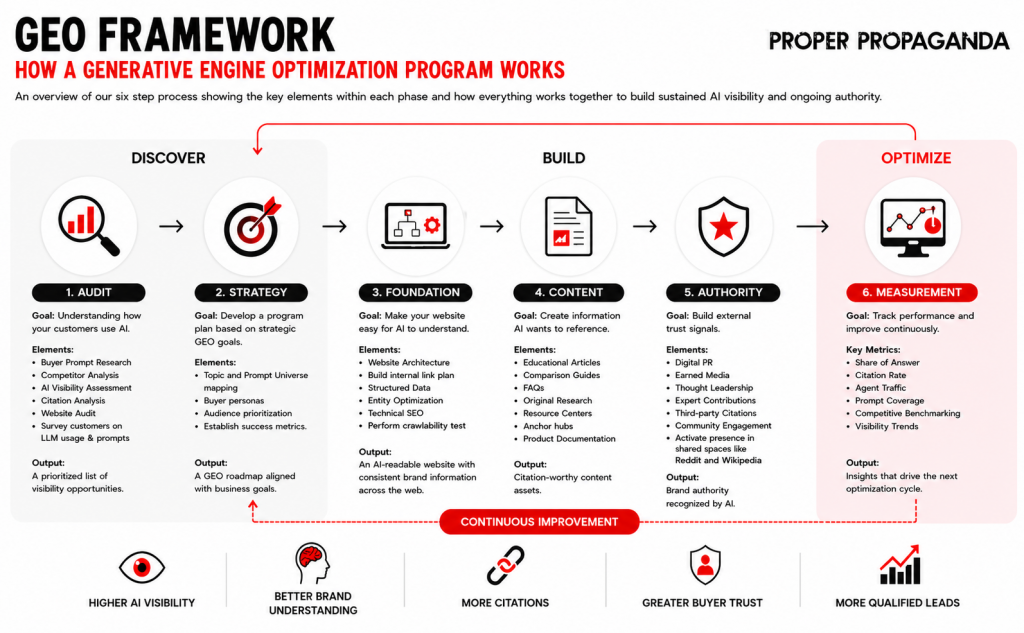
Here is how consumer tech brands can put it into practice.
1. Why GEO matters differently for consumer tech
SEO and GEO share plenty of foundations.
Your website still needs to be accessible. Search engines need to understand it. Useful content, authority, internal linking and clear site architecture continue to matter. Google says the same SEO fundamentals that apply to traditional search remain relevant to its AI search experiences.
The difference comes from how consumers can receive information.
Traditional search generally presents a collection of results for the consumer to investigate.
Generative search can gather information from multiple sources and construct an answer containing several products, their differences and recommendations for particular needs.
That creates a new set of visibility questions for consumer tech brands:
Does our product appear?
How is it described?
Which competitors appear alongside it?
What position do we occupy in recommendations?
Are the specifications accurate?
Which sources are supporting the answer?
Consumer tech is particularly interesting because products already exist inside a huge third-party information environment.
Technology publications review them. Commerce editors rank them. YouTubers test them. Affiliate publishers compare them. Retailers list them. Consumers discuss them on Reddit and other forums.
A good consumer tech GEO strategy needs to understand both the brand’s own information and this wider source environment.
2. Audit: Understand how consumers use AI and where your brand stands
Before creating anything, establish a baseline.
Start with ChatGPT, Gemini, Perplexity and Google’s AI search experiences. Search the brand directly, but spend more time on the category, comparison and shopping questions a consumer might ask.
Imagine you sell a portable projector.
You might test:
What are the best portable projectors?
What is the best portable projector for travel?
Which portable projectors work well outdoors?
What is the best projector under $500?
What are the best alternatives to [category leader]?
Then record what happens.
Which brands appear?
Which products are recommended?
Where do you appear?
How are you described?
Which competitors dominate?
Are important product details correct?
Which sources are cited?
This gives you a working picture of your AI visibility.
Our own Proper Propaganda GEO case study began with this kind of baseline. We mapped the prompts that mattered, measured where we appeared and examined the sources AI systems were using before deciding what needed to change.
The fix
Build an initial audit around:
Prompt → Brand presence → Product position → Description → Competitors → Citations → Accuracy
Do this before deciding you need more content, more PR or a website overhaul.
The audit should tell you where the problem actually is.
3. Strategy: Determine the prompts, audiences and topics you need to win
The next step is deciding where visibility would actually matter.
This is where consumer tech brands can waste enormous amounts of time.
A headphone company decides it wants to dominate:
“Best headphones.”
An e-bike company wants:
“Best e-bike.”
A smart-home company wants:
“Best smart-home products.”
Those prompts may be commercially valuable, but they are also broad and fiercely competitive.
Start closer to the product’s genuine strengths.
A headphone company might target:
Best lightweight headphones for travel
An e-bike company might focus on:
Best commuter e-bike for hilly cities
A smart-home brand might pursue:
Best home security system without a subscription
This is also where the GEO buyer journey becomes useful.
A consumer might begin with an educational question:
How much range do I need on an e-bike?
Move into discovery:
What are the best long-range commuter e-bikes?
Then evaluation:
Brand A vs Brand B for commuting
And finally validation:
Is Brand A reliable?
Each question requires different information and may draw on different sources.
The fix
Start with three to five priority prompt clusters.
Evaluate them based on:
- Relevance: Does the product genuinely belong in the answer?
- Commercial value: Could visibility influence consideration or purchase?
- Specificity: Is the question focused enough to build authority around?
- Opportunity: Are current answers missing strong products or relying on weak information?
- Buyer stage: Is the consumer learning, discovering, comparing or preparing to buy?
The goal is to establish authority where you have a defensible reason to appear, then expand.
4. Foundation: Make your products easy for AI systems to understand
Now look at the website.
Consumer technology companies are surprisingly good at hiding useful information behind marketing language.
A headphone page might promise “sound without compromise” while forcing someone to hunt for battery life, codec support, charging time, weight and device compatibility.
A projector page might lead with “cinema anywhere” while leaving brightness, resolution and ports halfway down the page.
Product information should establish the basics clearly:
What is this product?
Who is it for?
What does it cost?
What are its specifications?
What is it compatible with?
How does it differ from previous models?
What are its primary use cases?
What evidence supports important performance claims?
Clear product information helps customers, journalists, reviewers, retailers and systems trying to understand what the product actually does.
The fix
Audit your homepage, product pages, About page, support content and important editorial pages.
For priority pages:
- Put a clear product description near the beginning.
- Use descriptive H2 and H3 headings.
- Keep specifications consistent across the website.
- Make important information available as readable text.
- Add authorship to editorial content.
- Date and update time-sensitive information.
- Use tables where comparisons or specifications benefit from them.
- Cite evidence behind important claims.
- Build FAQs around real customer questions.
- Create logical internal links between related information.
The foundation should remove ambiguity around the company and its products.
5. Content: Create useful, authoritative and citation-worthy information
Once the foundation is sound, look at what information is missing.
Publishing more articles is easy.
Creating information worth referencing takes more work.
For consumer tech companies, strong content can include:
- Original research
- Proprietary testing data
- Technical explainers
- Product and technology comparisons
- Expert commentary
- Detailed FAQs
- Compatibility information
- Category education
Original research can be particularly valuable because it creates information that did not previously exist.
We used this approach with our own research into U.S. consumer attitudes toward Chinese technology, surveying 1,001 recent consumer-tech purchasers and publishing the methodology alongside the findings.
Consumer tech brands can do the same within their own categories.
An e-bike company could publish real-world range data across rider weights, temperatures and terrain.
A headphone company could test battery performance using different codecs and listening conditions.
A smart-home company could commission research into why consumers abandon connected devices.
That information can support owned content, PR, journalist outreach and potentially AI answers.
The fix
Before creating a piece of GEO content, ask:
What question does this answer?
What information does it add?
What evidence supports it?
Can the important information be extracted easily?
Would an independent journalist, reviewer or researcher have a reason to cite it?
That final question is a useful filter.
6. Authority: Build external signals that increase trust in the brand
This is where consumer tech GEO becomes particularly connected to PR.
Your website can tell an AI system that your robot vacuum is excellent for pet hair.
An independent reviewer testing it against seven competitors can provide external evidence.
Consumer products accumulate authority through a wide range of third-party sources:
Product reviews. Buying guides. Earned media. Commerce coverage. Specialist publications. YouTube reviewers. Creators. Affiliate publishers. Retailers. Relevant consumer discussions.
These sources already influence purchasing decisions. They can also contribute to the information environment AI systems encounter when constructing answers.
This is why we see PR’s role in AI search as increasingly important for consumer technology companies.
The fix
Reverse-engineer the source environment around your priority prompts.
Take:
“What is the best robot vacuum for pet hair?”
Look at which sources are being cited.
Then examine those sources.
Which products appear?
What evidence is provided?
Were the products tested?
Are there comparison tables?
What attributes are repeatedly mentioned?
Which publications appear across several related prompts?
We have started applying this approach directly to media research through our data-backed AI-search-relevant tech media list.
Traditional reach and editorial relevance still matter. AI citation relevance gives us another useful signal when deciding where media coverage could have influence.
For consumer tech brands, creators and affiliates can reinforce this information environment too.
The objective should be consistency of facts and diversity of independent evidence.
Your specifications, pricing and compatibility should be accurate everywhere.
Reviewers should remain free to reach their own conclusions.
7. Measurement: Track performance and continuously improve the program
GEO needs a feedback loop.
Return to the prompts from your original audit.
Did the brand begin appearing?
Did its position change?
Did a new citation enter the answer?
Did a product review start appearing as supporting evidence?
Did an earned-media placement become a cited source?
Are descriptions more accurate?
Are competitors still dominating a particular prompt cluster?
At Proper Propaganda, our GEO monitoring and measurement looks at several signals rather than reducing performance to a single visibility score.
For consumer tech brands, I would pay particular attention to:
Share of Answer: How frequently does the brand appear across relevant prompts?
Prompt Coverage: How much of the priority prompt universe includes the brand?
Brand Citation Rate: How frequently are the brand and its supporting sources cited?
Product Position: Where does the product appear in lists and recommendations?
Recommendation Accuracy: Is the product being recommended for appropriate use cases?
Citation Sources: Which owned and third-party sources are influencing the answers?
The fix
Monitor the same core prompt set consistently.
Then connect movement to activity.
If a product suddenly starts appearing after several independent reviews are published, investigate that relationship.
If a competitor consistently dominates a prompt, examine its source environment.
If AI systems repeatedly get a specification wrong, find where the incorrect information originates and correct the sources you control.
Measurement should tell you what to do next.
8. Avoid the vanity-query trap
One of the easiest ways to waste the early months of a GEO program is to pursue enormous category queries before establishing more specific authority.
A new headphone brand wants to own:
Best headphones
A smart-home company wants:
Best smart-home devices
An e-bike brand wants:
Best e-bike
Those questions may eventually matter.
They are poor starting points for many brands.
Start with the areas where the product has a strong, evidence-backed reason to appear.
Best lightweight headphones for travel
Best commuter e-bike for steep hills
Best smart-home security system without monthly fees
Specific prompts give you a clearer information gap, clearer media targets and a much better way to understand why particular brands appear.
The fix
Build authority from specific product strengths outward.
Establish visibility around narrower commercial questions.
Use the resulting data to identify the next adjacent prompt cluster.
Authority can accumulate from there.
9. What good GEO looks like at 30, 60 and 90 days
There is no responsible way to guarantee that a consumer tech brand will dominate AI search within 90 days.
The category matters. Existing brand authority matters. Competitors matter. AI platforms also change quickly.
But the first 90 days should produce measurable progress in the program itself.
| Period | Focus | What good looks like |
| Days 1–30 | Audit + Strategy | AI baseline established, priority prompts defined, competitors and citation sources mapped, major information gaps identified |
| Days 31–60 | Foundation + Content | Priority pages improved, product information cleaned up, new citation-worthy content published, major information gaps being addressed |
| Days 61–90 | Authority + Measurement | Targeted media, reviewer and creator activity producing external evidence, early visibility movement identified, citation patterns informing the next round of work |
A successful first 90 days should leave you with something more valuable than a collection of new content.
You should know where the brand stands, which prompts matter, which sources influence those prompts and what needs to happen next.
10. The GEO framework for consumer tech brands
The entire process can be condensed into six stages:
| Stage | What it means for consumer tech |
| 1. Audit | Understand how consumers use AI and establish where your brand and products currently appear. |
| 2. Strategy | Determine the prompts, audiences, categories and product topics you need to win. |
| 3. Foundation | Make your website, products and brand information easy for AI systems to understand. |
| 4. Content | Create useful, authoritative and citation-worthy information around the questions consumers ask. |
| 5. Authority | Build credible external signals through earned media, reviews, buying guides, creators, affiliates and other third-party sources. |
| 6. Measurement | Track visibility, citations, prompt coverage and product position, then use those insights to improve the program. |
Audit → Strategy → Foundation → Content → Authority → Measurement
That is the Proper Propaganda GEO framework.
For consumer tech brands, it connects the questions consumers ask AI systems with the owned and third-party information those systems can use to understand, compare and recommend products.
11. The bottom line
The smartest way for a consumer tech brand to approach GEO is to start with the questions consumers ask before they buy.
Audit those questions. Decide which ones matter commercially. Make your product information clear and complete. Create information worth referencing. Build credible third-party authority around the product. Measure what happens.
Then repeat the process using what the data tells you.
Consumer technology companies already spend enormous effort influencing the information people encounter before making a purchase. Reviews, media coverage, buying guides, creators, retailer pages and product content all play a role.
AI search now sits inside that same information environment.
The brands that understand the relationship between prompts, sources, evidence and product recommendations will have a much clearer idea of how to compete there.