


Generative Engine Optimization (GEO) is the process of improving how a brand is understood, cited, recommended and represented by AI systems.
A complete GEO program combines customer research, technical optimization, content, authority building and measurement. Our framework breaks that process into six phases: Audit, Strategy, Foundation, Content, Authority and Measurement.
Two questions come up in almost every conversation we have about GEO:
How do you do it? And how is it measured?
They’re also among the best qualifiers anyone can ask an agency.
We’ve spent about 20 months working on the answers.
Our methodology was first captured in one of the earliest extensive how-to guides to GEO. We’ve refined it considerably since then, including using the system on ourselves to great impact.
The problem is that our original methodology document, while useful for client engagements and our own work, is heavy as hell. You’re welcome to steal it, but be ready for a long read and possibly a nap. It’s a tad dry.
Most days we aim to avoid inducing narcolepsy.
So we’ve been working on distilling two fairly complicated questions into something people can actually use.
How do you build a GEO program?
And:
How do you know if it’s working?
We’ve boiled our answers down to two frameworks.
The first explains how to do GEO. The second explains how to measure it across the buyer journey.
Pretty damn distilled, I think.
What is a GEO framework?
A GEO framework is a structured process for improving a brand’s visibility and authority across AI search and generative answer engines.
GEO shouldn’t be treated as a single content tactic, an extension of SEO or a game of trying to get ChatGPT to mention your company more often.
A proper GEO program connects customer research, AI visibility analysis, website architecture, content development, third-party authority and ongoing measurement.
Our framework consists of six phases:
- Audit: Understand how customers use AI and where your brand currently stands.
- Strategy: Determine the prompts, audiences and topics you need to win.
- Foundation: Make your website and brand information easy for AI systems to understand.
- Content: Create useful, authoritative and citation-worthy information.
- Authority: Build external signals that increase trust in the brand.
- Measurement: Track performance and use those insights to continuously improve the program.
Here’s what that looks like:
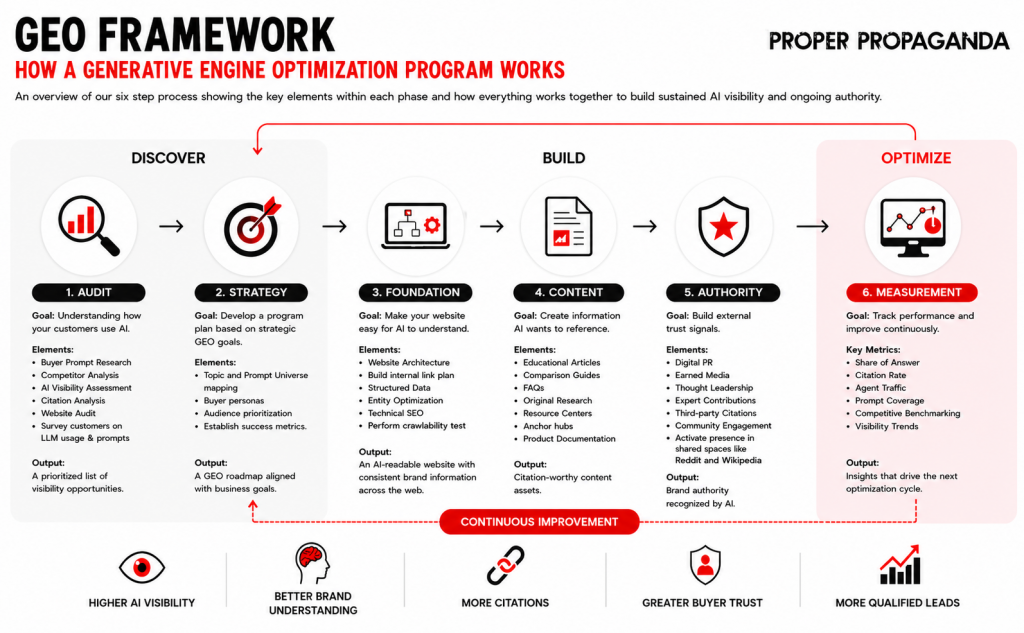
The six phases of a GEO program
1. Audit
Before trying to improve AI visibility, you need to understand how your customers use AI, where your brand currently appears and where the opportunities are.
That means researching buyer prompts, benchmarking competitors, assessing current AI visibility, analyzing citations, auditing the website and talking to customers about which AI platforms they use and how they use them.
Key elements: Buyer prompt research, competitor analysis, AI visibility assessment, citation analysis, website audit and customer research into LLM usage and prompts.
Output: A prioritized list of visibility opportunities.
2. Strategy
Once you understand the landscape, you need to decide where to compete.
Not every prompt matters equally. Not every audience behaves the same way. And trying to optimize for everything everywhere is usually a waste of money.
Strategy means identifying the prompts, topics, audiences and business outcomes that matter most.
Key elements: Topic and prompt universe mapping, buyer personas, audience prioritization and success metrics.
Output: A GEO roadmap aligned with business goals.
3. Foundation
AI systems need to be able to understand what your company is, what it does and how its products, services and expertise relate to the questions people ask.
That starts with the website.
Site architecture, internal linking, structured data, entity optimization, technical SEO and crawlability all help make information easier for AI systems to discover and interpret.
Consistency matters too. The information on your website should align with how your brand and products are represented across other authoritative sources on the web.
Key elements: Website architecture, internal linking, structured data, entity optimization, technical SEO and crawlability.
Output: An AI-readable website with consistent brand information across the web.
4. Content
Once the foundation is in place, you need information worth retrieving.
That means creating content around the actual questions buyers ask throughout their journey, rather than simply publishing more blog posts.
Educational articles can help AI systems understand a category. Comparison guides can influence evaluation. Original research can create citation opportunities. FAQs and product documentation can answer highly specific questions closer to purchase and after it.
Key elements: Educational articles, comparison guides, FAQs, original research, resource centers, anchor hubs and product documentation.
Output: Citation-worthy content assets.
5. Authority
You can say whatever you want about yourself.
That doesn’t mean AI systems will believe you.
Third-party authority is a critical part of GEO because AI systems routinely rely on sources outside a brand’s own website when forming answers, comparisons and recommendations.
Digital PR, earned media, expert contributions, thought leadership, third-party citations and participation in relevant communities all help create external evidence about who you are and why you matter.
Key elements: Digital PR, earned media, thought leadership, expert contributions, third-party citations and community engagement.
Output: Brand authority recognized by AI.
6. Measurement
Finally, you need to understand whether any of this is actually working.
That means tracking how often the brand appears, what sources AI systems cite, how the brand compares with competitors, how accurately products are represented and whether AI visibility is translating into website traffic and business outcomes.
Key metrics: Share of Answer, citation rate, agent traffic, prompt coverage, competitive benchmarking and visibility trends.
Output: Insights that drive the next optimization cycle.
What we’ve come to understand is that GEO isn’t a linear six-step project. It’s a loop.
Measurement reveals new gaps and opportunities. Those insights feed back into strategy, foundation, content and authority building.
GEO is an ongoing optimization program, not a box you check once and forget about.
How should GEO be measured?
This brings us to the second question.
Measurement.
Our view here is strongly held: GEO should not be measured using a single metric.
The GEO echo chamber, and many of the monitoring platforms serving it, currently over-index on Share of Answer.
Share of Answer matters. We track it. Our clients track it.
But it doesn’t tell the whole story.
The right GEO metric depends heavily on where the buyer is in the customer journey.
Share of Answer is particularly useful during discovery, when someone is asking AI which companies or products they should consider.
Move further down the funnel and other questions become more important.
Does AI describe your brand positively?
Does it understand what differentiates your product?
Does it recommend you or merely mention you?
Does it accurately represent your products?
Does it tell someone where they can buy them?
Does it use your content when existing customers need support?
Measurement priorities shift significantly as buyers move from education and discovery through evaluation, validation, purchase and post-purchase.
This is how we think about it:
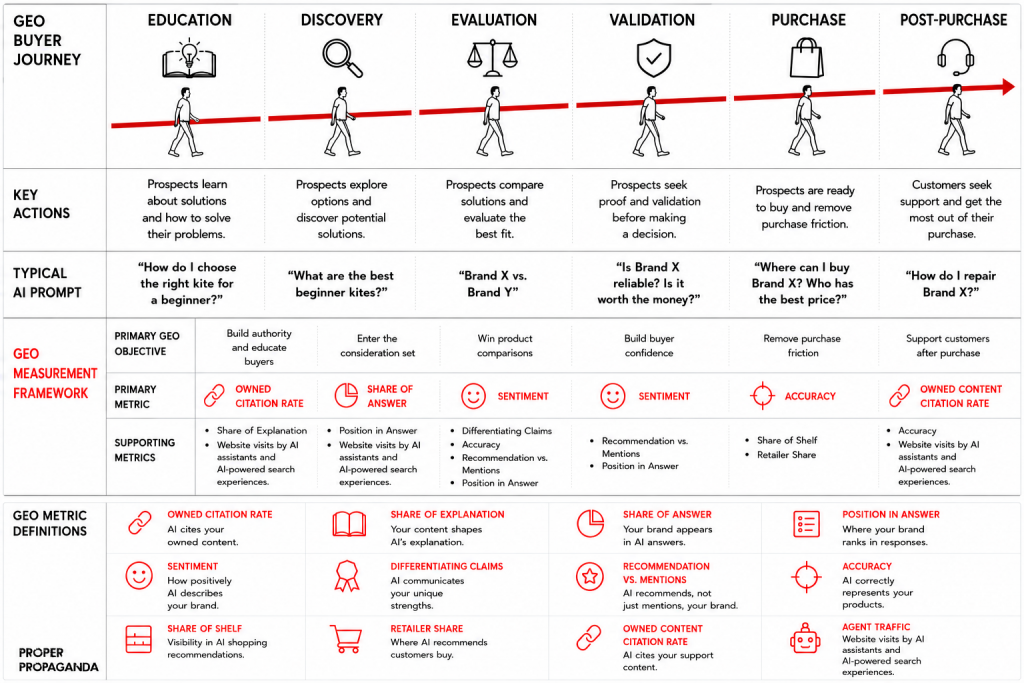
GEO metrics change across the buyer journey
Education: Owned Citation Rate
At the education stage, prospects are trying to understand a problem and learn about potential solutions.
A typical AI prompt might be:
“How do I choose the right kite for a beginner?”
The objective isn’t necessarily to sell them something yet. It’s to build authority and help educate the buyer.
At this stage, we care about metrics such as Owned Citation Rate and Share of Explanation.
Is AI finding your expertise? Is your content helping shape the answer?
Discovery: Share of Answer
Discovery is where Share of Answer becomes particularly important.
The buyer starts asking questions such as:
“What are the best beginner kites?”
Now brands are entering the conversation.
The primary GEO objective is to make sure your brand appears in the consideration set and is visible relative to competitors.
Share of Answer tells you how frequently your brand appears across the relevant universe of prompts.
But even here, we also want to know where the brand appears in the answer and whether AI-driven discovery is producing website visits.
Evaluation: Sentiment
Once a buyer has identified potential options, the questions change.
Instead of asking for a category of products, they begin comparing specific brands:
“Brand X vs. Brand Y.”
At this point, simply appearing in the answer isn’t enough.
We want to know how AI talks about the brand.
What differentiating claims does it communicate? Are those claims accurate? Does it understand your strengths relative to competitors? Where does your brand rank in the response?
That makes sentiment a more useful primary metric, supported by differentiating claims, accuracy, recommendation vs. mentions and position in answer.
Validation: Sentiment and recommendation strength
As buyers get closer to a decision, they start looking for reassurance.
Questions become things like:
“Is Brand X reliable? Is it worth the money?”
This is a fundamentally different kind of AI interaction.
The buyer already knows the brand exists. Measuring whether the brand appears in the answer tells us very little.
What matters is whether AI provides the proof and validation required to move the buyer forward.
We therefore care about sentiment, recommendation vs. mentions and position in answer.
Being mentioned is good.
Being recommended is considerably better.
Purchase: Accuracy and Share of Shelf
At purchase, the buyer’s intent becomes explicit:
“Where can I buy Brand X? Who has the best price?”
The job of GEO changes again.
Now the goal is to remove purchase friction.
Does AI provide accurate product information? Does it surface the correct product? Does it recommend a retailer where the product can actually be purchased?
Metrics such as accuracy, Share of Shelf and retailer share become increasingly important.
You can have fantastic Share of Answer and still lose the sale if AI sends the buyer somewhere they can’t purchase the product.
Post-purchase: Owned Content Citation Rate
The AI customer journey doesn’t end when somebody buys something.
Customers increasingly use AI assistants for product questions, troubleshooting and support.
A prompt might be:
“How do I repair Brand X?”
Now the goal is to make sure AI provides useful and accurate information after the purchase.
That makes Owned Content Citation Rate, accuracy and agent traffic important measures.
Is AI using your documentation and support content?
Or is it relying on Reddit posts, forums and random third-party websites to tell your customers how your product works?
That distinction matters.
The GEO metrics that matter
One of the challenges with GEO measurement is that the vocabulary is still developing. Different platforms use different names for similar concepts, and some metrics remain poorly defined.
Here is how we think about the most important ones.
Share of Answer measures how frequently your brand appears across a defined set of relevant AI answers.
Owned Citation Rate measures how often AI systems cite content your brand owns.
Owned Content Citation Rate looks specifically at whether AI systems cite your support, product and post-purchase content.
Share of Explanation measures how much your content helps shape AI’s explanation of a topic.
Position in Answer tracks where your brand appears within an AI-generated response.
Sentiment measures how positively, negatively or neutrally AI describes your brand.
Differentiating Claims looks at whether AI understands and communicates the attributes that make your brand or products different.
Recommendation vs. Mentions distinguishes between AI simply mentioning your brand and actively recommending it.
Accuracy measures whether AI correctly represents your company, products, features and other important information.
Share of Shelf measures your visibility within AI-generated shopping and product recommendations.
Retailer Share measures which retailers AI recommends when customers are looking to purchase your products.
Agent Traffic measures website visits from AI assistants and AI-powered search experiences.
No single one of these tells you whether your GEO program is working.
Together, they provide a much more useful picture.
GEO is ultimately about business impact
The goal of GEO isn’t to win a dashboard.
And it isn’t simply to get mentioned by ChatGPT more often.
A successful GEO program should create a chain of effects:
Higher AI visibility → Better brand understanding → More citations → Greater buyer trust → More qualified leads and sales.
Visibility is the beginning of that process, not the end.
That’s why we think GEO needs both a process framework and a measurement framework.
One tells you what to do.
The other tells you whether it’s working.
Frequently asked questions about GEO
What is GEO?
Generative Engine Optimization (GEO) is the process of improving how a brand, company or product is understood, cited, represented and recommended by AI systems and generative search experiences.
How does Generative Engine Optimization work?
GEO works by improving the information and authority signals AI systems use to construct answers. A complete program typically includes customer and prompt research, technical website optimization, content creation, third-party authority building and ongoing measurement.
What are the stages of a GEO program?
Our GEO framework uses six stages: Audit, Strategy, Foundation, Content, Authority and Measurement. Measurement then feeds insights back into the program, creating a continuous optimization cycle.
How do you measure GEO?
GEO should be measured using multiple metrics based on the buyer journey. These can include Share of Answer, Owned Citation Rate, sentiment, position in answer, recommendation strength, accuracy, Share of Shelf, retailer share and agent traffic.
What is Share of Answer?
Share of Answer measures how frequently a brand appears across a defined set of relevant AI-generated answers. It is particularly useful for understanding visibility during the discovery stage of the buyer journey.
Is Share of Answer the most important GEO metric?
Not always. Share of Answer is important during discovery, but other metrics become more useful further down the funnel. Sentiment and recommendation strength matter during evaluation and validation, while accuracy, Share of Shelf and retailer share become more important closer to purchase.
What is the difference between GEO and SEO?
SEO primarily focuses on improving visibility in traditional search results. GEO focuses on how brands and information are retrieved, cited, described and recommended within AI-generated answers. The two disciplines overlap significantly, particularly around technical infrastructure, content and authority, but they measure visibility differently.
How long does GEO take to work?
There is no universal timeline. Results depend on a brand’s existing authority, technical foundation, content, competitive environment and the scale of the GEO program. Some visibility changes can happen relatively quickly, while building sustained authority and citation patterns is an ongoing process.