


Optimizing PR and content for AI search visibility means making your brand easy for AI systems to understand while building credible third-party evidence that supports what you say about your products.
For consumer technology brands, this requires work across your website, content, technical structure, earned media, reviews, citations and other sources that AI engines use when generating answers.
The starting point should be the questions your customers ask.
From there, you can determine what information needs to exist on your website, what authority needs to exist elsewhere and which sources are worth targeting through PR.
This is the implementation stage of GEO.
What is GEO?
Generative Engine Optimization, or GEO, is the process of improving how a brand is understood, surfaced, cited and represented in AI-generated answers.
A GEO program can involve:
- Customer and prompt research
- AI visibility measurement
- Website optimization
- Structured data
- Content creation
- Earned media
- Third-party citations
- Reviews and comparisons
- Community participation
- Ongoing monitoring
For consumer technology companies, the goal is to increase the likelihood that the brand or product appears favorably at various stages of the buyer journey, when people ask commercially relevant questions on platforms such as ChatGPT, Google AI Overviews and Perplexity.
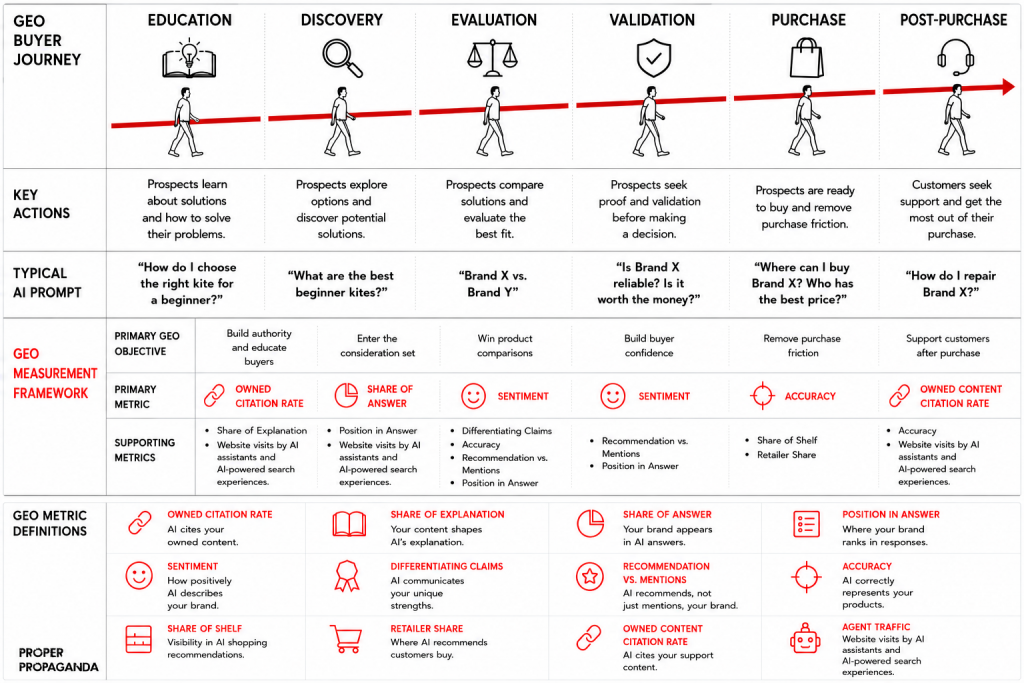
We often see brands placing too much emphasis on Share of Answer and not enough consideration to all the stages of the buyers journey when it comes to AI search.
GEO buyer journey
What does a GEO implementation framework look like?
Once the diagnostic work is complete, our GEO framework moves into three broad areas:
| GEO stage | What happens |
| On-site optimization | Improve website structure, content, structured data and AI readability |
| Authority and expansion | Build third-party credibility through media, reviews, citations and relevant communities |
| Monitoring and iteration | Track visibility, citations and competitors, then adjust the program |
These areas work together.
A technically strong website gives AI systems clear information about your company and products.
Useful content gives those systems answers to retrieve.
Independent sources provide outside evidence about the brand.
Monitoring tells you whether any of this is changing the answers that matter.
Start with a prompt universe
Before creating new content, identify the questions that matter most to your customers and your business.
Together, these questions form your prompt universe.
A developed GEO program might track 100 to 200 questions connected to customer needs, products, competitors and purchase decisions.
For a smart ring company, that might include:
What is a smart ring?
What are the best smart rings?
What is the best smart ring for sleep tracking?
Which smart ring has the best battery life?
Oura vs RingConn
Do smart rings accurately track sleep?
Which smart ring should I buy?
Each question creates a different visibility opportunity.
Your content and PR strategy should be built around those opportunities.
How do you turn customer prompts into a GEO content strategy?
Start by auditing what AI systems are saying.
For each important prompt, look at:
- Which brands appear
- Which competitors appear
- What information is included
- Which sources are cited
- What your website already covers
- What information is missing
- Where competitors have stronger content
- Where competitors have stronger third-party authority
Then build content around the gaps.
This is much more useful than simply deciding that the company needs to publish four blog posts a month.
If an important question is already well answered on your site, producing another article on the same subject probably isn’t the priority.
If a commercially important question has no useful answer anywhere on your site, you have found a content opportunity.
What types of content work well for AI search?
Content designed for AI search should provide clear, useful and extractable answers to specific questions.
Our GEO framework recommends several formats.
Natural-language Q&A content
People ask AI engines questions in normal language.
Your content should answer those questions in normal language.
Useful headings include:
How long does the battery last?
Does this keyboard work with a Mac?
Which model is best for a large home?
What is the difference between Model A and Model B?
The answer should appear immediately after the heading.
Don’t make the reader work through five paragraphs of introduction before getting it.
Comparison content
Comparison tables are particularly useful when customers are evaluating products.
For example:
| Feature | Product A | Product B |
| Battery life | 7 days | 5 days |
| Weight | 4.2 g | 5.1 g |
| Subscription required | No | Yes |
| iOS compatibility | Yes | Yes |
| Android compatibility | Yes | Yes |
The table makes the information explicit.
The surrounding copy can then explain what those differences mean and which type of buyer each product is better suited to.
FAQs
FAQs are useful for specific questions around:
- Compatibility
- Specifications
- Battery life
- Installation
- Software
- Privacy
- Warranty
- Shipping
- Returns
- Product differences
These questions frequently appear when consumers are evaluating a purchase.
Educational content
Some customers are still trying to understand the category.
Useful educational content can answer questions such as:
How do robot lawn mowers work?
What is a Hall effect keyboard?
How does a smart ring measure sleep?
What size portable power station do I need?
Good educational content helps establish what the brand knows and creates more opportunities to appear during early research.
Original research and data
Original research gives other people something to reference.
For consumer technology companies, this could include customer surveys, proprietary product data, usage trends, testing data or research into a broader category.
Useful original information can earn citations from journalists, publishers and other websites.
Those third-party citations can then strengthen the wider information environment around the brand.
How should content be structured for AI retrieval?
Our GEO framework uses three useful principles for website content:
Structure. Explainability. Trustworthiness.
Structure
Organize information clearly.
Use:
- Descriptive H1 and H2 headings
- Short paragraphs
- Lists
- Comparison tables
- FAQ sections
- Logical internal links
- Semantic HTML
- Appropriate structured data
Each section should have a clear purpose.
If the section answers a question, make that question obvious.
Explainability
Use literal language when clarity matters.
Marketing language has its place, but AI systems also need to understand what the product actually is.
Instead of relying entirely on:
Power for every adventure
make sure the page also clearly establishes:
The X100 is a 1,024 Wh portable power station designed for camping, RV use and emergency home backup.
That sentence contains useful entities and relationships.
It identifies the product, product category, capacity and intended uses.
Trustworthiness
Claims should be accurate, current and supported.
Product specifications should match across your website and other important sources.
Company information should be consistent.
Statistics should identify their source.
Research should explain its methodology.
Strong claims should have evidence behind them.
This helps both people and machines understand why the information deserves to be trusted.
Why does structured data matter for GEO?
Structured data gives machines additional information about what is on a page.
Depending on the site and content, useful schema can include:
- Organization
- Product
- Article
- FAQ
- Review
- Author
- Breadcrumb schema
- Offer
Structured data should accurately represent information that genuinely exists on the page.
It should also be part of a broader technical foundation that includes crawlability, semantic HTML, internal linking, sensible site architecture and accessible content.
Schema cannot rescue weak information.
It can make good information easier to interpret.
Does PR help with AI search visibility?
PR can support AI search visibility by increasing the amount of credible third-party information available about a company, product or area of expertise.
This is particularly important for consumer technology brands.
A company can publish detailed information about its own product.
Independent sources can review it, compare it with competitors, test its claims and place it within the wider category.
AI engines can use those external signals when generating answers.
Our GEO framework therefore treats earned media as part of the authority-building process.
What types of PR coverage can help GEO?
The most useful coverage depends on the prompts you are trying to influence.
For consumer technology brands, relevant third-party signals can include:
| Third-party signal | Potential GEO value |
| Product reviews | Independent information about performance and quality |
| Buying guides | Places the product within a category and recommendation set |
| Comparison articles | Establishes differences between products and competitors |
| Expert commentary | Builds authority around a subject or category |
| Feature coverage | Adds context about the company, technology or product |
| Original research coverage | Creates citations around proprietary information |
| Affiliate and commerce content | Connects products to high-intent buying questions |
| Relevant community discussion | Provides real-world questions, experiences and product context |
A launch announcement and a detailed product review serve different purposes.
The question you want to influence should help determine the coverage you pursue.
How should PR teams choose media targets for GEO?
Start with the AI answers.
Take your priority prompts and examine which sources are already being cited.
You may find that a handful of publications repeatedly appear around particular topics.
You may find specialist review sites.
You may find Reddit.
You may find major national publications.
You may find retailers or aggregators.
These sources help reveal the information environment AI engines are using for that topic.
We use a simple framework:
Prompt → AI answer → cited source → PR opportunity
If a publication repeatedly appears as a source for commercially important prompts, it deserves attention.
That does not mean traditional media reach stops mattering.
It gives you another way to evaluate the value of a media target.
Not all media coverage has the same GEO value
This is an important point for PR people.
Historically, media targeting has been heavily influenced by readership, prestige, domain authority and the likelihood that a publication reaches the right audience.
AI search adds another factor:
Does this source influence the AI answers our customers see?
A specialist technology publication may have a fraction of the audience of a major national outlet and still be cited repeatedly when people ask about a particular product category.
For that category, the specialist publication may carry considerable GEO value.
This is why citation analysis should increasingly inform media relations.
You can still pursue the big outlets.
You should also know which sources the machines are actually using.
Why are reviews and comparison articles important for consumer technology GEO?
Consumer technology purchases are highly comparative.
People want to know which product is better, which features matter and which option suits their particular needs.
They ask AI systems the same questions.
For example:
What is the best mechanical keyboard for Mac?
Keychron vs Logitech
Which robot lawn mower is best for steep terrain?
What is the best smart ring without a subscription?
Independent reviews and comparison articles contain exactly the type of information needed to answer these questions.
They describe products in relation to alternatives.
That makes review and comparison coverage an important part of authority building for many consumer technology brands.
Can Reddit and online communities affect GEO?
Relevant online communities can contribute to the information environment AI systems use.
Reddit and specialist forums contain detailed conversations about products, problems, use cases and customer experiences.
Our GEO framework includes participation in relevant communities as part of the authority and expansion stage.
That does not mean flooding Reddit with brand content.
The useful information comes from legitimate participation and genuine discussion.
Brands should identify communities relevant to their category, understand the conversations happening there and participate where they can contribute something useful.
How can earned media be reused for GEO?
Good earned media should not disappear into a coverage report.
Our framework recommends repurposing media coverage across the brand’s own information environment.
That can include:
- Adding credible media mentions to relevant product pages
- Linking to independent reviews where useful
- Updating FAQs based on questions raised in coverage
- Using journalist questions to identify new content opportunities
- Incorporating third-party validation into relevant pages
- Creating follow-up content around topics receiving media interest
- Using coverage insights to refine the prompt universe
This connects PR back to the website.
A review can create third-party authority and also tell you which questions consumers and journalists care about.
Why does information consistency matter?
AI systems encounter information about your brand in many places.
Your website may say one thing.
Amazon may say another.
A retailer may use an old product description.
A journalist may be working from specifications supplied six months ago.
An old FAQ may contain outdated information.
These inconsistencies create ambiguity.
Consumer technology brands should regularly audit:
- Company descriptions
- Product names
- Model numbers
- Product specifications
- Pricing
- Compatibility
- Availability
- Founder and executive information
- Key product claims
This becomes especially important for companies with frequent product launches.
The cleaner the information environment, the easier the brand is to understand.
What does a good PR and content GEO program look like?
A practical implementation framework looks like this:
| Step | Action | Goal |
| 1. Map prompts | Build the 100 to 200-question prompt universe | Understand customer demand |
| 2. Audit answers | Identify visibility, competitors and citations | Find gaps |
| 3. Fix the foundation | Improve structure, schema, crawlability and entity clarity | Make information understandable |
| 4. Fill content gaps | Create Q&A, comparisons, FAQs and educational content | Provide useful answers |
| 5. Build authority | Earn reviews, coverage, citations and expert mentions | Add independent validation |
| 6. Target influential sources | Use citation analysis to prioritize media and platforms | Strengthen relevant authority |
| 7. Monitor | Re-run prompts and track changes | Measure progress |
| 8. Iterate | Expand what works and address remaining gaps | Compound visibility |
This is the basic operating loop.
Research tells you where the problem is.
Content helps fill the information gaps.
Technical work makes that information easier to understand.
PR builds independent authority.
Measurement tells you what to do next.
How do you measure whether GEO is working?
The same prompt universe used during the diagnostic should become the measurement baseline.
Track whether:
- Your brand appears more frequently
- You appear across more priority prompts
- Competitors are gaining or losing visibility
- Sentiment changes
- Your website is cited more often
- Third-party coverage is being cited
- New sources begin influencing answers
- Previously missed prompts begin including the brand
The important thing is consistency.
If you change the questions every month, it becomes much harder to understand whether visibility is actually improving.
Keep a stable benchmark and add new prompts as the market evolves.
How long does PR and content optimization take to affect AI visibility?
Our GEO framework sets realistic expectations.
With strong implementation, brands can begin looking for first movement within three to four months.
More reliable and defensible results generally take six to nine months.
A mature GEO program can take 12 months or longer.
The speed depends heavily on where the brand starts.
An established consumer technology company with years of reviews, media coverage and customer discussion already has an authority footprint.
A new company entering a competitive category has much more to build.
What should consumer tech brands prioritize first?
If you want a condensed version of the framework, start here:
- Find the questions your customers ask.
- Measure whether you currently appear.
- Identify the competitors and sources dominating those answers.
- Make your website clear, structured and technically accessible.
- Create useful content for important unanswered prompts.
- Earn independent coverage and citations around the same topics.
- Track the same questions over time.
- Use the results to decide what to do next.
That is the relationship between PR, content and GEO.
The brands that become visible give AI systems more to work with
Consumer technology brands have spent years separating SEO, content, PR, affiliate marketing and e-commerce into different disciplines.
AI search makes those divisions less useful.
A consumer can ask one question and receive an answer assembled from publisher reviews, product pages, retailer information, forums and other sources.
Your brand needs to make sense across that environment.
The website establishes what the company and product are.
Content answers the questions customers care about.
Earned media provides independent context and validation.
Reviews and comparisons establish where the product sits in the category.
Citation analysis shows which outside sources matter.
Monitoring tells you whether the work is changing anything.
That is how PR and content should work together for AI search visibility.
And once those pieces are in place, the next question is the one almost every company asks us:
How long will this take?
Related Reading
How Long Does It Take for a Consumer Tech Brand to Appear in AI Search Results?