


Ask ChatGPT, Gemini or another AI platform to recommend the best products in almost any consumer technology category and you’ll probably see the same handful of brands appearing again and again.
If your competitors are there and you aren’t, there is a reason.
Figuring out that reason is where a good GEO program should start.
We conduct AI visibility audits for consumer technology brands fairly regularly now. One thing we’ve learned is that poor visibility rarely comes down to a single issue. Sometimes the brand has plenty of traditional search visibility but barely registers in AI answers. Sometimes it has excellent media coverage but the coverage doesn’t support the questions consumers are asking. Sometimes the website has hundreds of pages of content but very little that an AI system would have reason to retrieve.
And sometimes the brand simply hasn’t built enough authority yet.
Before creating more content or launching a big PR campaign, you need to understand where the problem is.
Why doesn’t my brand appear in ChatGPT and other AI search results?
A consumer technology brand may be missing from AI-generated answers because it has weak visibility for important customer prompts, unclear or poorly structured website content, limited third-party authority, weak citation signals, or competitors with a stronger information footprint.
We generally see the problem falling into six areas:
| GEO visibility problem | What it means |
| Prompt gap | Your brand isn’t appearing for questions your customers ask |
| Content gap | Useful answers to those questions are missing from your site |
| Structure gap | Your information is difficult for AI systems to understand or retrieve |
| Authority gap | There isn’t enough independent validation of your brand or products |
| Citation gap | Competitors appear more often in sources AI engines rely on |
| Competitive gap | Other brands have a larger and more established information footprint |
Most brands have more than one of these problems.
That is why we start GEO programs with a diagnostic.
What should a GEO diagnostic measure?
A useful GEO diagnostic should establish how a brand currently appears across major AI engines, which competitors are winning, which customer prompts matter, how the brand is being described, what sources are being cited and whether the brand’s website is helping or hurting its visibility.
A proper GEO program connects customer research, AI visibility analysis, website architecture, content development, third-party authority and ongoing measurement.
Our GEO framework consists of six phases:
Measurement: Track performance and use those insights to continuously improve the program.
Audit: Understand how customers use AI and where your brand currently stands.
Strategy: Determine the prompts, audiences and topics you need to win.
Foundation: Make your website and brand information easy for AI systems to understand.
Content: Create useful, authoritative and citation-worthy information.
Authority: Build external signals that increase trust in the brand.
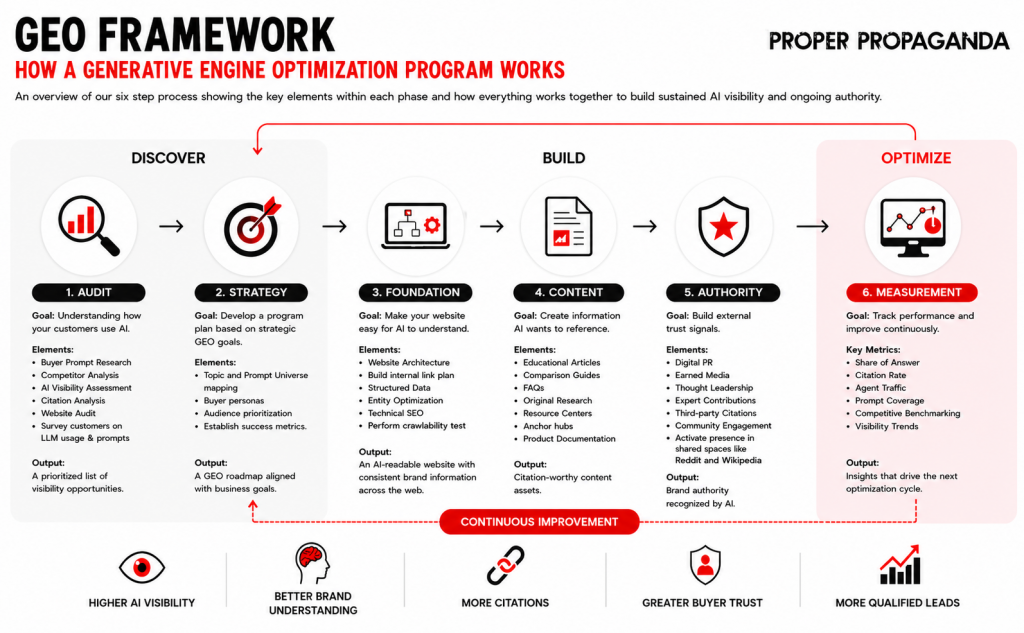
To build a baseline, we work through the following steps.
1. Start by deciding where you actually want to appear
There isn’t much value in trying to become visible for everything remotely connected to your category.
Start small and consider questions like these …
- Who are your two or three most important competitors?
- Who are your customers?
- What do those customers need?
- Which topics matter commercially?
- Where would increased AI visibility actually help the business?
For a robot lawn mower brand, “robotics” is probably too broad to be particularly useful.
Questions around the best robot lawn mowers for large yards, steep terrain, properties without boundary or particular price ranges are much more useful.
Those are the areas where visibility can influence a purchase.
The first job is deciding which conversations you want your brand to participate in.
2. Find out how your customers actually use AI
This is one of the steps we think is most frequently skipped.
ChatGPT, Google AI Overviews, Perplexity and other AI platforms don’t all work the same way. They draw on different information sources and people use them differently.
Your customers may use ChatGPT heavily for product comparisons and Google for quick questions. Another demographic or product category could behave differently.
That matters.
Before investing heavily in GEO, find out:
- Which AI platforms your existing and target customers use
- How frequently they use them
- What they use them for
- Which platforms they use for product research
- Which platforms they use for comparisons
- Which platforms they use closer to purchase
We use custom audience research alongside available demographic and category data to answer these questions.
Trying to optimize everywhere can get expensive quickly.
Knowing where your customers actually spend their time gives you somewhere sensible to focus.
3. Build a prompt universe around real customer questions
Once you know the audience and platforms that matter, the next step is identifying the questions they are likely to ask. Together, those questions make up your prompt universe.
For a consumer technology brand, that can eventually mean tracking 100 to 200 questions (aka prompts) covering the topics and customer needs that matter most.
Some will be broad category questions:
What are the best mechanical keyboards?
Some will be use-case questions:
What are the best mechanical keyboards for Mac users?
Others will compare products:
Keychron vs Logitech mechanical keyboards
And some will be very specific:
What is the best low-profile mechanical keyboard for writing?
These prompts give you something concrete to measure.
Without them, saying that your company has “good” or “bad” AI visibility doesn’t tell you very much.
4. Establish your AI visibility baseline
Now you can see where you actually stand.
Run your priority prompts across the AI engines your customers use and ask yourself the following questions …
- Does your brand appear?
- Which competitors appear?
- Where are you positioned in the answer?
- How are you described?
- Is the sentiment positive, negative or mixed?
- Which sources are cited? Your website or third-party sources?
- Which publishers and platforms appear repeatedly?
The baseline should include both branded and unbranded prompts.
There is a substantial difference between asking:
Is Brand X a good mechanical keyboard?
and:
What are the best mechanical keyboards?
The first gives the system your brand.
The second asks it to decide which brands deserve to appear.
For GEO, that distinction matters.
5. Look for prompts where competitors appear and you don’t
This is one of the most useful parts of the exercise.
Run enough category-relevant prompts and you start seeing patterns.
One competitor might dominate broad “best of” questions.
Another might be strong in comparisons.
A third might consistently appear for a particular use case.
You may discover that your brand performs well when prompted directly but almost disappears from unbranded category questions.
These are missed prompt opportunities.
They tell you where the visibility gap exists.
The next job is figuring out why.
6. Look at the sources behind the answers
Don’t stop at recording which brands appear.
Look at what AI engines are citing.
If the same publications, review sites, forums or other sources keep appearing across commercially important prompts, those sources deserve attention.
We call this citation analysis.
It helps answer questions such as:
Which publishers have the most influence in our category?
Are AI engines relying on our website or independent sources?
Which sources are helping competitors appear?
Where are we absent from sources that AI engines repeatedly use?
This is where GEO starts becoming particularly useful for PR.
A publication doesn’t need to be the biggest media outlet in your category to have GEO value. If it is repeatedly cited around questions that influence purchase, it can be an important source.
That gives us a fairly simple way to think about the opportunity:
Customer prompt → AI answer → cited source → visibility opportunity
7. Audit your website for AI readability
Your website is the part of the information environment you have the most control over.
It needs to be clear.
Our GEO framework uses three useful principles for evaluating a site: Structure, Explainability and Trustworthiness.
Structure
Information should be organized so both humans and machines can understand it.
That includes:
- Clear H1 and H2 headings
- Short, focused paragraphs
- Lists where they make information easier to understand
- Tables for comparisons and structured information
- Appropriate schema and structured data
- Logical internal linking
- Semantic HTML
Explainability
Say clearly what the company and product actually do.
Avoid vague marketing language where a literal description would be more useful.
A headline such as:
Power that keeps up with your adventures
may work perfectly well as advertising.
It tells a system very little about whether the product is a portable power station, battery bank or solar generator.
Clear entity information matters.
Who are you?
What do you make?
Who is it for?
What does it do?
Why is it relevant to this particular question?
Those answers should be easy to find.
Trustworthiness
Information needs to be current, accurate and supported.
That means checking product specifications, claims, company information, pricing where relevant and other factual information across the site.
It also means looking at the authority signals supporting what you say.
A clear claim backed by credible sources is more useful than an unsupported marketing claim.
8. Check whether your content answers natural-language questions
People don’t necessarily talk to AI platforms the way they search Google.
They ask questions.
Your website should contain useful answers to the questions that matter in your prompt universe.
That includes natural “how,” “what,” “which” and “why” language.
For example:
How long does the battery last?
Which devices is this compatible with?
What is the difference between Model A and Model B?
Does this work with an iPhone?
Which product is better for a large home?
The answers should be clear enough to make sense when removed from the rest of the page.
This is particularly important for FAQs, product pages, service pages and comparison content.
9. Check your technical foundations
Some visibility problems sit underneath the content itself.
A GEO website audit should look at:
- Structured data and schema
- Crawlability
- Robots.txt
- JavaScript rendering
- Core Web Vitals
- Metadata
- Internal linking
- Knowledge graph alignment
- FAQ accessibility
- Product descriptions
- Marketplace alignment
- AI shopping readiness
For consumer technology brands, the last few items are becoming increasingly important.
Product discovery is moving into AI-powered shopping environments. Clear product descriptions, structured product information and consistent marketplace data make it easier for systems to understand what you sell.
10. Determine whether you have an authority problem
Your own website can only take you so far.
AI engines also use external signals when forming answers.
Depending on the platform and question, those signals can include media outlets, review sites, aggregators, forums, communities and other third-party sources.
This creates a common problem for newer consumer technology brands.
The website may be good.
The product may be good.
But competitors have years of reviews, media coverage, buying-guide inclusion, expert commentary, comparison articles and customer discussion surrounding them.
That is an authority gap.
If the sources AI engines rely on aren’t talking about you, fixing your website alone is unlikely to close it.
What are the most common reasons a tech brand has poor GEO visibility?
Poor GEO visibility usually comes down to a handful of issues. The pattern you see in AI search can often tell you where to investigate first.
| What you’re seeing | What to investigate first |
|---|---|
| Your brand appears when users mention it by name, but rarely appears in broader category searches | Prompt coverage and brand authority. AI knows your brand exists, but does not see it as a strong answer to relevant category questions. |
| Competitors dominate “best,” “top,” comparison and recommendation prompts | Third-party authority and citations. Competitors may have stronger support from publishers and sources AI systems trust and cite. |
| AI gives incorrect, outdated or inconsistent information about your products | Information clarity and consistency. Check your website, product pages, structured data and third-party sources for conflicting or unclear information. |
| You have strong media coverage but weak AI visibility | Coverage relevance. Your media mentions may not address the topics, products and questions that matter to your priority prompts, or may come from sources AI rarely cites. |
| Your website has lots of content but receives little AI visibility | Content structure and relevance. Content may be difficult for AI systems to interpret, poorly aligned with buyer questions, or technically difficult to access. |
| The same publishers repeatedly appear as sources for competitors | Citation gaps. These publishers may represent high-value media and content opportunities for your brand. |
| Your brand appears in AI answers but is described inaccurately or unfavourably | Positioning, sentiment and authority signals. Review how your brand is described across earned media, reviews, your website and other influential third-party sources. |
The important point is that poor GEO visibility is not one problem. It can be an authority problem, a content problem, a citation problem, a technical problem or a positioning problem. A good GEO audit identifies which of these is actually limiting visibility before deciding what to fix.
This is the kind of output a GEO diagnostic should produce.
It tells you where to work first.
What should you measure before starting GEO work?
At minimum, establish a baseline for:
Brand presence: How often does the brand appear across your priority prompts?
Unbranded visibility: Does the brand appear when it isn’t mentioned in the question?
Competitive visibility: Which competitors appear more frequently?
Prompt gaps: Which commercially important questions are you missing from?
Sentiment: How are AI systems describing the brand?
Citation strength: Which sources are being used to support answers?
Owned versus third-party citations: Is information coming from your site, external sources or both?
Source concentration: Which publishers and platforms appear most frequently?
Measure these before making any significant changes. This way you’ll have a better sense of what moved the needle.
How long does it take to fix poor AI visibility?
Don’t expect immediate results.
Based on the framework we use at Proper Propaganda, a brand with strong implementation can reasonably look for first movement within three to four months.
That implementation can include site fixes, citation building, media coverage and prompt mapping.
More reliable and defensible results generally take six to nine months.
A mature GEO program can take 12 months or longer.
Those timelines will vary according to the brand’s starting point, competitive environment and the amount of authority already surrounding it.
A well-established consumer technology brand with years of media coverage is starting from a very different position than a company launching its first product.
What should a GEO audit tell you?
By the end of the diagnostic, you should be able to answer ten questions:
- Which AI platforms matter most to our customers?
- What questions are those customers asking?
- Which of those prompts matter most commercially?
- How often does our brand appear?
- Which competitors are beating us?
- Where are the biggest prompt gaps?
- How are AI engines describing our brand?
- Which sources are shaping the answers?
- Is our website easy for AI systems to understand and retrieve?
- Where should we invest first?
If you can’t answer those questions, producing another 50 blog posts isn’t a GEO strategy.
You still have diagnostic work to do.
The first job in GEO is finding out why you’re absent
There is a temptation with a new marketing discipline to rush into tactics.
Create more content, add schema, get mentioned on Reddit, pitch more journalists or rewrite your FAQ’s.
There’s no question that eventually these tactics will be useful, but not before a diagnostic tells you which one requires the most attention.
For one brand, the priority might be restructuring the website.
For another, it could be closing a major content gap.
For a third, the biggest problem may be that the publications and communities shaping its category barely mention the brand at all.
GEO gets considerably more useful once you can connect a visibility problem to a reason.
Then you can start fixing it.
Related Reading
How Do You Optimize PR and Content for AI Search Visibility
How Long Does It Take for a Consumer Tech Brand to Appear in AI Search Results